


Superman is often called upon to save the world from evildoers, but in his latest big-screen incarnation, he is also being asked to swoop in and save a franchise.
James Gunn’s Superman, which opened in theaters worldwide last week, is a reboot aimed at relaunching the so-called DC Universe of comic book-based superhero movies, which also features Wonder Woman and Batman.
The celluloid efforts of Warner Bros and DC Studios have been widely eclipsed by Disney’s Marvel Cinematic Universe — the world of Iron Man, Thor, Black Panther and the Fantastic Four, who are getting their own reboot later this month.
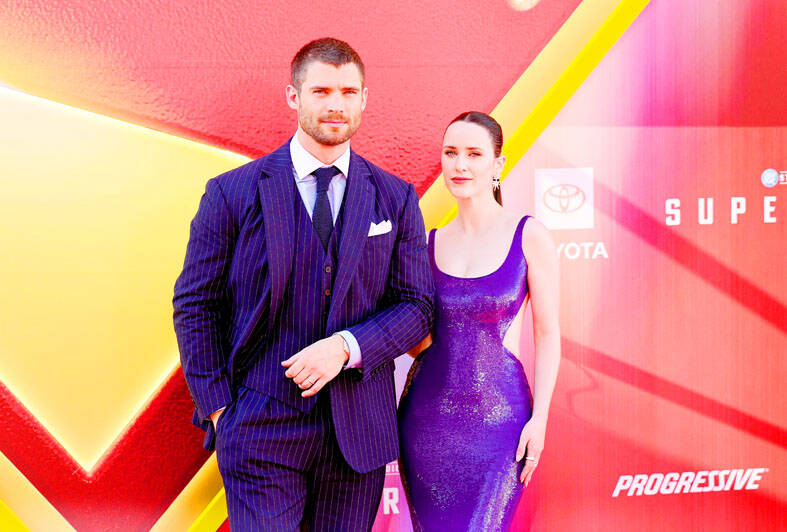
Photo: AFP
“Warner Bros has invested a lot of energy and money in trying to refocus and renew DC Studios, and this is going to be the big release from that,” Franchise Entertainment Research analyst David A. Gross said.
The heavy task falls on the shoulders of Gunn, the writer-director who won praise from fans of the genre with Marvel’s Guardians of the Galaxy trilogy.
Gunn has shrugged off the high stakes surrounding the movie’s box office success.
“Is there something riding on it? Yeah, but it’s not as big as people make it out to be,” he told GQ Magazine. “They hear these numbers that the movie’s only going to be successful if it makes US$700 million or something, and it’s just complete and utter nonsense.”
The hype around the movie is real — the White House even superimposed US President Donald Trump onto one of the movie’s official posters with the caption “THE SYMBOL OF HOPE. TRUTH. JUSTICE. THE AMERICAN WAY. SUPERMAN TRUMP.”
Warner Bros hopes the DC Universe can catch up with Marvel, which — after years of huge successes with the Avengers movies — has seen more muted box office returns with the recent Thunderbolts and Captain America: Brave New World.
Gross said that superhero films hit a peak right before the COVID-19 pandemic, with box office earnings and audience enthusiasm waning ever since that time.
“It’s really a diminished genre,” Gross said.
However, the analyst said early buzz for Superman was “really good.” The film stars up-and-comer David Corenswet as the new Superman/Clark Kent, with The Marvelous Mrs. Maisel star Rachel Brosnahan playing love interest Lois Lane and Nicholas Hoult as archvillain Lex Luthor.
The story follows the Man of Steel coming to terms with his alien identity as he finds his place in the human world.
The supporting cast is a selection of other DC Comics characters, from the peacekeeping Green Lantern (Nathan Fillion) — who is scheduled to reprise the role in upcoming TV series Lanterns — to the mace-wielding Hawkgirl.
However, DC Studios needs to shake off a reputation for producing mediocre films that did not score well with audiences.
The last round of DC Extended Universe films included the well-liked Wonder Woman (2017) starring Gal Gadot — but also box office flops like Shazam! Fury of the Gods (2023) and the under-performing Aquaman sequel with Jason Momoa.
“The success was mixed, and they were spending a lot of money on some of the new spinoff characters who were not working particularly well,” Gross said, citing 2021’s The Suicide Squad — directed by Gunn — as an example.
The last films featuring Superman, starring Henry Cavill and directed by Snyder, were relatively successful for Warner Bros until Justice League — DC’s effort at recreating the Avengers vibe — which lost millions of dollars.
Right-wing pundits have criticized Superman’s specific characterization as an immigrant, saying the superhero had become “woke.”
Gunn addressed the criticism, telling The Times newspaper that “Superman is the story of America,” with the character reflecting those who “came from other places and populated the country.”
“I’m telling a story about a guy who is uniquely good, and that feels needed now,” he added.
Ultimately, time would soon tell if Corenswet’s chiseled looks and Gunn’s directorial vision would be the superpowers that DC Studios need — or prove to be its Kryptonite.

Netherlands-based semiconductor equipment supplier ASML Holding NV yesterday said that it is planning to hire an additional 1,000 people in Taiwan this year in response to growing demand from clients. ASML had previously planned to recruit 600 people this year, but that the plan has been adjusted upward, ASML vice president and ASML Taiwan general manager Grace Wang (汪佳慧) told reporters. ASML has a workforce of more than 4,500 in Taiwan, accounting for about 10 percent of its global total, Wang said. This year’s recruitment campaign would focus on adding people in the customer support, manufacturing and supply chain domains to assist ASML
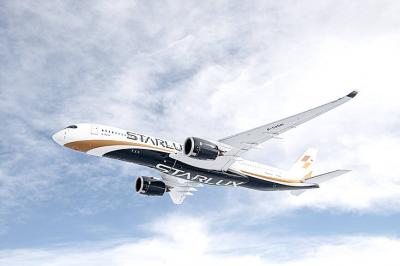
Starlux Airlines Co (星宇航空) today unveiled a long-haul network expansion plan at a shareholders’ meeting in Taipei, including direct flights to Barcelona, Spain, and Zurich, Switzerland, as well as a service connecting Taipei, Sydney and New Zealand. Starlux is to become the first Taiwanese carrier to offer non-stop services to the two European cities, while the inaugural oceanic route is expected to expand transit opportunities within the Australia-New Zealand market, Starlux said. Flight services to Chicago, Dallas, Washington and New York are under evaluation, the airline added. Prior to the shareholders’ meeting, the airline earlier this year announced that it would be

UNDER MICROSCOPE: Taiwan detained three people who allegedly conspired to buy servers in Taiwan and export them using fraudulent documentation, prosecutors said Nvidia Corp chief executive officer Jensen Huang (黃仁勳) on Saturday urged Super Micro Computer Inc to tighten up on compliance after Taiwan detained three people this week for allegedly making fraudulent declarations about artificial intelligence (AI) servers made by its US partner. The development marked the nation’s first crackdown on semiconductor smuggling, which grew after the US slapped restrictions on exports of high-end chips such as Nvidia AI accelerators to China. Nvidia is “rigorous” in explaining regulations to all of its partners, Huang told reporters after arriving in Taipei. “Ultimately Super Micro has to run their own company,” he said in response to
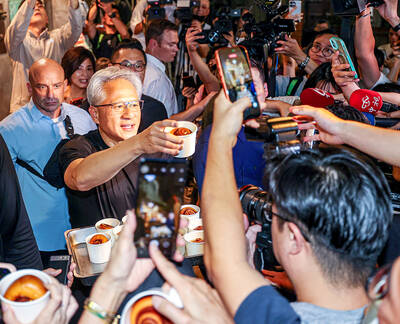
Nvidia Corp yesterday announced that CEO Jensen Huang (黃仁勳) would attend an employee meeting in Taipei tomorrow to celebrate the launch of the company’s Taiwan headquarters project. Huang would attend a gathering at the site of Nvidia’s planned headquarters in Beitou Shilin Technology Park (北投士林科技園區), the company said in a statement. After arriving in Taiwan on Saturday last week, Huang told reporters that he plans to meet with Quanta Computer Inc (廣達) chairman Barry Lam (林百里) and Taiwan Semiconductor Manufacturing Co (TSMC, 台積電) chairman C.C. Wei (魏哲家), and would attend the groundbreaking ceremony for Nvidia’s Taiwan headquarters tomorrow. Nvidia has not yet applied


 RSS
RSS