


Nvidia Corp CEO Jensen Huang (黃仁勳) on Thursday met with US President Donald Trump at the White House, days before a planned trip to China by the head of the world’s most valuable chipmaker, people familiar with the matter said.
Details of what the two men discussed were not immediately available, and the people familiar with the meeting declined to elaborate on the agenda.
Spokespeople for the White House had no immediate comment.
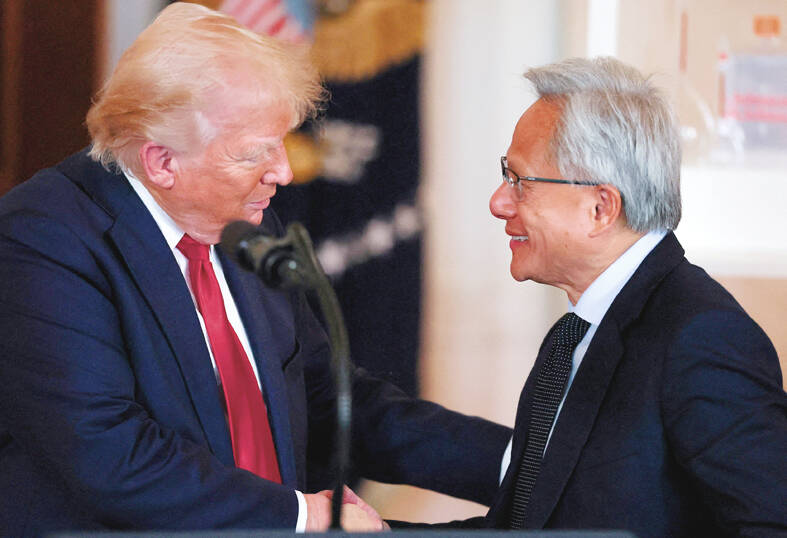
Photo: Reuters
Nvidia declined to comment.
Nvidia’s CEO has been vocal about the need for US companies to access the world’s largest semiconductor market and is a frequent visitor to China.
He is returning to the country at a sensitive time for the company, which has become ensnared in a broader US-China tech conflict as the foremost producer of chips for artificial intelligence (AI) development.
Huang has called for easing US technology export curbs, because they give Chinese rivals, such as Huawei Technologies Co (華為), an unfair advantage.
US restrictions have effectively locked Nvidia out of China, the largest market for chips, and as a result, the company expects to lose out on US$8 billion in sales this quarter alone.
Huang’s meeting with Trump also came a day after Nvidia became the first company to surpass US$4 trillion in market capitalization, with investors signaling continued enthusiasm for an AI boom that has buoyed shares across the technology sector.
Trump touted the company’s soaring share price in a social media post earlier on Thursday, citing the boom in tech stocks as a reason for the US Federal Reserve to cut interest rates.
Nvidia’s chips are prized for their ability to power AI applications, with tech giants Microsoft Corp, Meta Platforms Inc, Amazon.com Inc and Alphabet Inc projected to put about US$350 billion into capital expenditures in their upcoming fiscal years.
Huang is scheduled to travel to Beijing where he would meet with senior Chinese officials, including the commerce minister, a person familiar with the situation said.
He would also be taking part in the International Supply Chain Expo in Beijing next week, the person said, asking to remain anonymous to discuss a plan still in flux.
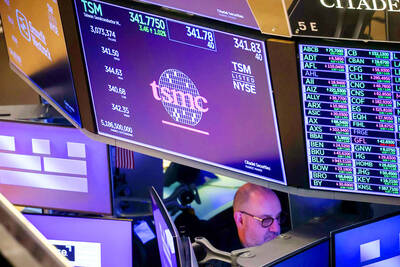
STRONG INTEREST: Analysts have pointed to optimism in TSMC’s growth prospects in the artificial intelligence era as the cause of the rising number of shareholders The number of people holding shares of chipmaker Taiwan Semiconductor Manufacturing Co (TSMC, 台積電) hit a new high last week despite a decline in its stock price, the Taiwan Depository and Clearing Corp (TDCC, 台灣集保) said. The number of TSMC shareholders rose to 2.46 million as of Friday, up 75,536 from a week earlier, TDCC data showed. The stock price fell 1.34 percent during the same week to close at NT$1,840 (US$57.55). The decline in TSMC’s share price resulted from volatility in global tech stocks, driven by rising international crude oil prices as the war against Iran continues. Dealers said
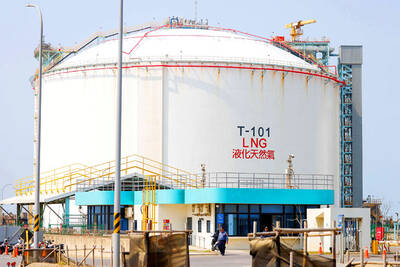
Taiwan’s natural gas supply remains stable through the end of May, despite rising concerns about potential disruptions to Qatari liquefied natural gas (LNG) supplies due to escalating conflicts in the Middle East, the Ministry of Economic Affairs said yesterday. The ministry in a statement said that Taiwan has completed preparations for natural gas supply and shipping schedules through the end of May. It has also made plans to increase natural gas imports from regions outside the Middle East in June to ensure a stable supply, it added. Taiwan sources natural gas from 14 countries and is not solely dependent on the Middle East,

China is clamping down on fertilizer exports to protect its domestic market, industry sources said, putting an additional strain on global markets that were already grappling with shortages caused by the US-Israeli war on Iran. China is among the largest fertilizer exporters — shipping more than US$13 billion of it last year — and it has a history of controlling exports to keep prices low for farmers. Shipments through the war-blocked Strait of Hormuz account for about one-third of the sea-borne supply. This month, Beijing banned exports of nitrogen-potassium fertilizer blends and certain phosphate varieties, sources said. The ban, which has not
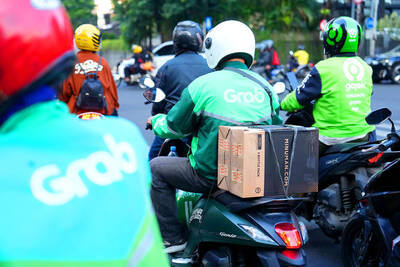
Grab Holdings Ltd agreed to buy Delivery Hero SE’s Foodpanda operations in Taiwan for US$600 million, a deal that marks its first foray outside of its Southeast Asian base. The cash acquisition will allow Grab to expand into 21 cities across Taiwan, the Singapore-based ride-hailing and delivery company said in a statement yesterday. Grab expects the transaction to be completed in the second half, subject to regulatory approvals. The purchase will give Grab a presence on the island of about 23 million people, helping it to expand beyond its intensely competitive home market. Grab has seen growth slow dramatically as it takes


 RSS
RSS