


US chip designer Advanced Micro Devices Inc (AMD) yesterday launched an office in Tainan’s Gueiren District (歸仁), marking a significant milestone in the development of southern Taiwan’s artificial intelligence (AI) industry, the Tainan City Government said in a statement.
AMD Taiwan general manager Vincent Chern (陳民皓) presided over the opening ceremony for the company’s new office at the Shalun Smart Green Energy Science City (沙崙智慧綠能科學城), a new AI industry base and cybersecurity hub in southern Taiwan.
Facilities in the new office include an information processing center, and a research and development (R&D) center, the Tainan Economic Development Bureau said.
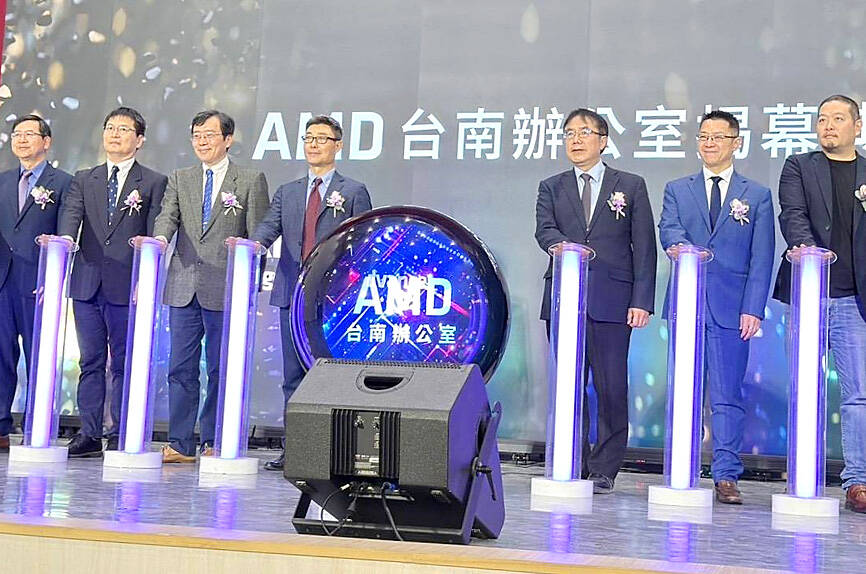
Photo courtesy of Tainan City Government
The Ministry of Economic Affairs in August last year confirmed that AMD would establish R&D centers in Tainan and Kaohsiung as part of the company’s efforts to accelerate the development of cutting-edge technologies such as AI and silicon photonics.
Also at the ceremony was Tainan Mayor Huang Wei-che (黃偉哲), Southern Taiwan Science Park Bureau Director-General Alice Cheng (鄭秀絨), Innolux Corp (群創) chairman Jim Hung (洪進揚) and S. Felix Wu (吳士駿), dean of the College of Electrical Engineering and Computer Science at National Cheng Kung University.
Huang said that Tainan is at the core of the “S-shaped semiconductor industry corridor” in southern Taiwan and AMD’s presence in the Shalun technology complex demonstrates significant progress in the city’s AI development.
Tainan in the past few years has been focusing on the dual-engine development of Southern Taiwan Science Park (南部科學園區) and Shalun Smart Green Energy Science City to attract semiconductor, cybersecurity and AI businesses to drive the city’s economic development, the statement said.
The world’s five largest semiconductor equipment giants — Applied Materials Inc, ASML Holding NV, Tokyo Electron Ltd, Lam Research Corp and KLA-Tencor Corp — have established a presence in the Southern Taiwan Science Park, the statement said.
Together with major Taiwanese IC design companies such as MediaTek Inc (聯發科), Realtek Semiconductor Corp (瑞昱) and Novatek Microelectronics Corp (聯詠), the science park has developed into a crucial cluster for the advanced semiconductor industry, the statement added.
Revenue generated by firms in the Southern Taiwan Science Park (南部科學園區) grew 39.55 percent to a record-high NT$2.21 trillion (US$66.9 billion) last year, data released by the National Science and Technology Council on March 12 showed.

Taiwan’s foreign exchange reserves fell below the US$600 billion mark at the end of last month, with the central bank reporting a total of US$596.89 billion — a decline of US$8.6 billion from February — ending a three-month streak of increases. The central bank attributed the drop to a combination of factors such as outflows by foreign institutional investors, currency fluctuations and its own market interventions. “The large-scale outflows disrupted the balance of supply and demand in the foreign exchange market, prompting the central bank to intervene repeatedly by selling US dollars to stabilize the local currency,” Department of Foreign
Intel Corp is joining Elon Musk’s long-shot effort to develop semiconductors for Tesla Inc, Space Exploration Technologies Corp and xAI, marking a surprising twist in the chipmaker’s comeback bid. Intel would help the Terafab project “refactor” the technology in a chip factory, the company said on Tuesday in a post on X, Musk’s social media platform. That is a stage in the development process that typically helps make chips more powerful or reliable. The chipmaker’s shares jumped 4.2 percent to US$52.91 in New York trading on Tuesday. The Terafab project is a grand plan by Musk to eventually manufacture his own chips for
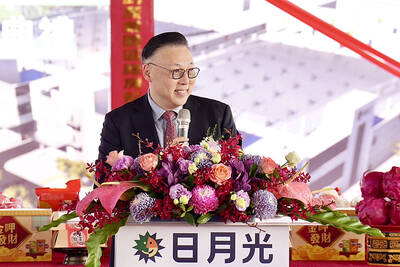
ENERGY ISSUES: The TSIA urged the government to increase natural gas and helium reserves to reduce the impact of the Middle East war on semiconductor supply stability Chip testing and packaging service provider ASE Technology Holding Co (日月光投控) yesterday said it planned to invest more than NT$100 billion (US$3.15 billion) in building a new advanced chip testing facility in Kaohsiung to keep up with customer demand driven by the artificial intelligence (AI) boom. That would be included in the company’s capital expenditure budget next year, ASE said. There is also room to raise this year’s capital spending budget from a record-high US$7 billion estimated three months ago, it added. ASE would have six factories under construction this year, another record-breaking number, ASE chief operating officer Tien Wu

For weeks now, the global tech industry has been waiting for a major artificial intelligence (AI) launch from DeepSeek (深度求索), seen as a benchmark for China’s progress in the fast-moving field. More than a year has passed since the start-up put Chinese AI on the map in early last year with a low-cost chatbot that performed at a similar level to US rivals. However, despite reports and rumors about its imminent release, DeepSeek’s next-generation “V4” model is nowhere in sight. Speculation is also swirling over the geopolitical implications of which computer chips were chosen to train and power the new


 RSS
RSS