


Fubon Financial Holding Co (富邦金控) yesterday reported a net income of NT$30 billion (US$911.3 million) for the first two months, up 34 percent year-on-year, with earnings per share of NT$2.2.
The company attributed the performance to interest income, capital gains and dividends from its investment holdings, saying it would adopt a quick and dynamic hedging approach amid currency volatility.
It also realized capital gains from its share holdings at home and abroad last month, as the TAIEX experienced sharp fluctuations and US bond prices climbed and yields declined, it said.
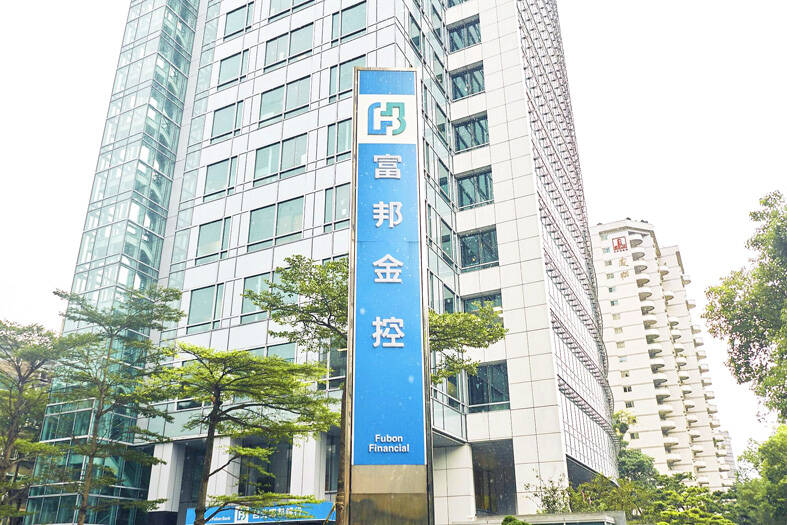
Photo: An Rong Xu, Bloomberg
Fubon Life Insurance Co (富邦人壽), a company subsidiary, raised its position in US government bonds to enhance recurring income and mitigate market fluctuations, it added.
Fubon Life accumulated net income of NT$18.18 billion in the first two months, expanding 36 percent from a year earlier, after first-year premiums to NT$25.1 billion, Fubon Financial said, adding that total premiums rose 13 percent to NT$69.7 billion.
At the same time, Taipei Fubon Commercial Bank (台北富邦銀行) posted a new high for net profit at NT$7.05 billion, or a pickup of 22 percent year-on-year, driven by strong core business operations.
Its net interest income and fee income saw a growth of 10 percent and 20 percent respectively, Fubon Financial said.
The company added that it would adopt a quick and dynamic hedging approach amid currency volatility.
The New Taiwan dollar weakened against its US counterpart last month, but the trajectory has been different so far this month, it said.

BYPASSING CHINA TARIFFS: In the first five months of this year, Foxconn sent US$4.4bn of iPhones to the US from India, compared with US$3.7bn in the whole of last year Nearly all the iPhones exported by Foxconn Technology Group (富士康科技集團) from India went to the US between March and last month, customs data showed, far above last year’s average of 50 percent and a clear sign of Apple Inc’s efforts to bypass high US tariffs imposed on China. The numbers, being reported by Reuters for the first time, show that Apple has realigned its India exports to almost exclusively serve the US market, when previously the devices were more widely distributed to nations including the Netherlands and the Czech Republic. During March to last month, Foxconn, known as Hon Hai Precision Industry

Taiwan Semiconductor Manufacturing Co (TSMC, 台積電) and the University of Tokyo (UTokyo) yesterday announced the launch of the TSMC-UTokyo Lab to promote advanced semiconductor research, education and talent development. The lab is TSMC’s first laboratory collaboration with a university outside Taiwan, the company said in a statement. The lab would leverage “the extensive knowledge, experience, and creativity” of both institutions, the company said. It is located in the Asano Section of UTokyo’s Hongo, Tokyo, campus and would be managed by UTokyo faculty, guided by directors from UTokyo and TSMC, the company said. TSMC began working with UTokyo in 2019, resulting in 21 research projects,

Taiwan’s property market is entering a freeze, with mortgage activity across the nation’s six largest cities plummeting in the first quarter, H&B Realty Co (住商不動產) said yesterday, citing mounting pressure on housing demand amid tighter lending rules and regulatory curbs. Mortgage applications in Taipei, New Taipei City, Taoyuan, Taichung, Tainan and Kaohsiung totaled 28,078 from January to March, a sharp 36.3 percent decline from 44,082 in the same period last year, the nation’s largest real-estate brokerage by franchise said, citing data from the Joint Credit Information Center (JCIC, 聯徵中心). “The simultaneous decline across all six cities reflects just how drastically the market

Ashton Hall’s morning routine involves dunking his head in iced Saratoga Spring Water. For the company that sells the bottled water — Hall’s brand of choice for drinking, brushing his teeth and submerging himself — that is fantastic news. “We’re so thankful to this incredible fitness influencer called Ashton Hall,” Saratoga owner Primo Brands Corp’s CEO Robbert Rietbroek said on an earnings call after Hall’s morning routine video went viral. “He really helped put our brand on the map.” Primo Brands, which was not affiliated with Hall when he made his video, is among the increasing number of companies benefiting from influencer


 RSS
RSS