


US President Donald Trump on Saturday ordered a probe into potential tariffs on lumber imports — a move threatening to stoke trade tensions — while also pushing for a domestic supply boost.
Trump signed an executive order instructing US Secretary of Commerce Howard Lutnick to begin an investigation “to determine the effects on the national security of imports of timber, lumber and their derivative products.” The study might result in new tariffs being imposed, which would pile on top of existing levies.
The investigation takes aim at exporters like Canada, Germany and Brazil, with White House officials earlier accusing these economies of “dumping lumber into our markets at the expense of both our economic prosperity and national security.”
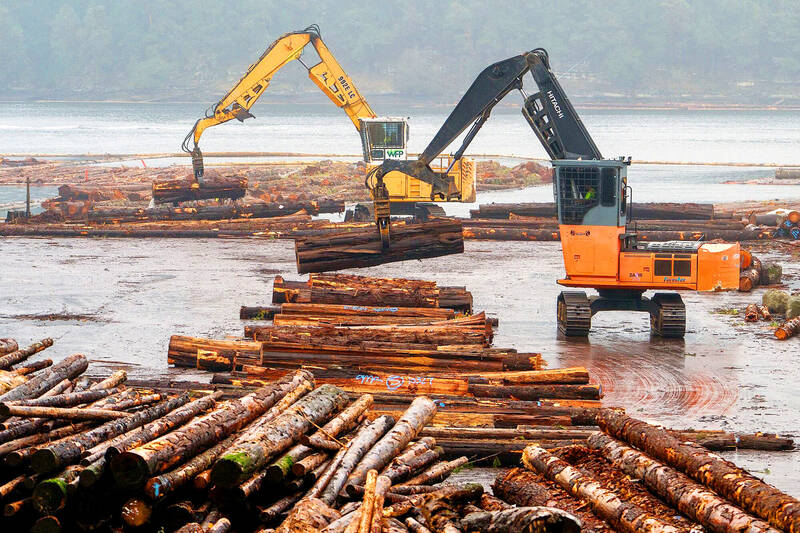
Photo: Bloomberg
Canada for example is among the world’s biggest exporters of softwood lumber, with its largest export market being the US.
The probe under Section 232 of the Trade Expansion Act comes days after Trump used the same tool to study copper imports, and after he unveiled tariff hikes on steel and aluminum products.
Speaking to reporters ahead of the announcement, a White House official criticized “bad actors” globally who develop “massive overcapacity” with the help of government subsidies.
The official, who spoke on condition of anonymity, said such dumping caused the world’s biggest economy to lose its manufacturing capacities despite having natural resources.
For example, while the US has anti-dumping and countervailing duties on Canadian lumber, officials said that this was not sufficient to address the problem.
The investigation would consider both imported articles and derivative products like furniture, the official said.
The report must be submitted to the president within 270 days, the executive order said.
Trump signed a second executive order on Saturday aimed at increasing US timber production, with the aim of lowering construction and housing costs.
Industry players have warned that imposing new tariffs on timber imports could have the opposite effect, potentially hitting housing affordability.
“Tariffs on lumber and other building materials increase the cost of construction and discourage new development,” National Association of Home Builders chairman Carl Harris said after Trump announced possible levies on Canada and Mexico.
“Consumers end up paying for the tariffs in the form of higher home prices,” he said.
Since returning to the White House, Trump has announced — and halted — steep duties on Canada and Mexico, and threatened reciprocal levies that could hit both friend and foe.
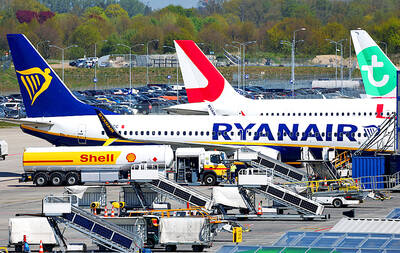
Ryanair, Transavia, Volotea and other low-cost airlines are feeling the financial pain from high jet fuel prices as a result of the Middle East war and are cutting flights. The closure of the Strait of Hormuz has taken a huge chunk of oil supplies off the market, sending the price of jet fuel soaring and triggering fears of shortages that could force airlines to cancel flights. Airlines are not waiting for a lack of supplies to react. “Travel alert: Airlines are cutting thousands of flights right now,” Travel Therapy host Karen Schaler said in an Instagram reel this past weekend.
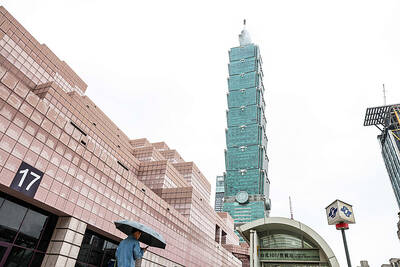
MANAGING RISKS: Taiwan has secured LNG sufficient to cover 95 percent of electricity demand for next month, UBS said, describing the government’s approach as proactive UBS Group AG has raised its forecast for Taiwan’s economic growth this year to 8 percent, up from 6.9 percent previously, and said expansion could reach as high as 8.6 percent if external energy shocks are avoided. The upgrade reflects a stronger-than-expected first-quarter performance and sustained momentum in artificial intelligence (AI)-driven exports, which UBS said are providing a firm foundation for growth despite geopolitical and energy risks. Taiwan’s GDP expanded 13.69 percent year-on-year in the first quarter, the fastest growth since the second quarter of 1987, the Directorate-General of Budget, Accounting and Statistics (DGBAS) reported on Thursday. On a seasonally

The Fair Trade Commission’s (FTC) ongoing review of Grab Holdings Ltd’s US$600 million acquisition of Foodpanda Taiwan’s operations, announced on March 23, has taken on fresh urgency as industry experts warn that the transaction could embed significant Chinese cybersecurity vulnerabilities into Taiwan’s digital infrastructure through Grab’s deep ties to autonomous-driving firm WeRide (文遠知行). Less than 16 months after the FTC blocked Uber Eats’ direct attempt to acquire Foodpanda Taiwan — citing potential combined market shares of 80 to 90 percent — the emergence of Grab as the buyer has prompted questions about whether the same competitive harm is simply being rerouted

The list of Asian stocks that benefit from business partnership with Nvidia Corp is getting longer, as the region further integrates into the artificial intelligence (AI) chip giant’s business ecosystem. Just in the past week, South Korea’s LG Electronics Inc, Taiwan’s Nanya Technology Corp (南亞科技), as well as China’s Huizhou Desay SV Automotive Co (德賽西威) and Pateo Connect Technology Shanghai Corp (博泰車聯) have become the latest to rally on news of tie-ups, supply-chain participation or product collaboration with the US chip designer. Asian suppliers account for about 90 percent of Nvidia’s production costs, up from about 65 percent last year, data compiled


 RSS
RSS