


Boeing Co on Tuesday reported a hefty fourth-quarter loss following a bruising last year, but shares rallied on hopes that early turnaround signs under a new CEO might bear fruit.
The US aviation giant reported a loss of US$3.9 billion as the company continued to experience a hit from a more than seven-week labor strike that shuttered two major assembly plants.
However, chief executive Kelly Ortberg, who joined Boeing in August last year, said the company is making progress.
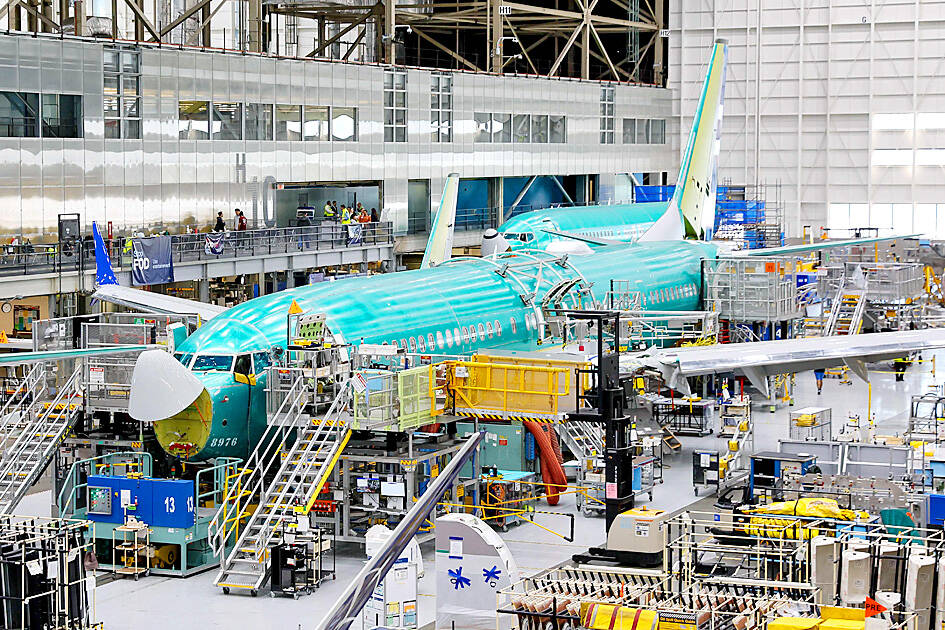
Photo: AFP
Company officials said they expect to lift 737 MAX production this year and to clear out planes in inventory, improving the outlook for free cash flow later in the year.
Boeing has worked with the US Federal Aviation Administration (FAA) on “an agreed upon path for rate increases” on the 737 MAX, Ortberg told analysts.
Ortberg described a number of operational performance indicators that look at parts shortages, work performed out of sequence and other factors.
“We need to stay disciplined on maintaining a stable production system,” he said. “But early signs are encouraging.”
Boeing’s fourth-quarter loss took the company’s full-year loss — its sixth in a row — to US$11.8 billion. The 31 percent drop in fourth-quarter revenue to US$15.2 billion reflected a hit from fewer plane deliveries, which came in at barely a third of the level in the previous year as the labor stoppage halted output on the 737 MAX and the 777. Boeing’s performance was also marred by a troubled flight in January last year in which a 737 MAX flown by Alaska Airlines made an emergency landing after the plane suffered a mid-flight blowout on a window panel.
Boeing has also continued to suffer from legacy fixed-cost defense contracts that have led to losses for the company.
Ortberg told CNBC that Boeing is “actually a little ahead of where I expected” in terms of ramping up production on the 737 MAX following the strike and intensified process control checks after the Alaska Airlines incident.
Boeing has been producing the MAX at under the 38 per month authorized by the FAA. Analysts view the restoration of output to 38 per month and subsequent production increases as critical to Boeing’s profit outlook.
Ortberg expressed confidence in achieving higher MAX output, telling CNBC “I expect by the second half of the year, we’ll have that approval, and we’ll be moving to a higher production rate.”
Shares of Boeing finished up 1.5 percent.
“It seems investors are focusing on the improvements on the production front and focusing less on the financial results,” Briefing.com said. “We also think investors are looking a few quarters ahead on the hopes of a turnaround.”

BYPASSING CHINA TARIFFS: In the first five months of this year, Foxconn sent US$4.4bn of iPhones to the US from India, compared with US$3.7bn in the whole of last year Nearly all the iPhones exported by Foxconn Technology Group (富士康科技集團) from India went to the US between March and last month, customs data showed, far above last year’s average of 50 percent and a clear sign of Apple Inc’s efforts to bypass high US tariffs imposed on China. The numbers, being reported by Reuters for the first time, show that Apple has realigned its India exports to almost exclusively serve the US market, when previously the devices were more widely distributed to nations including the Netherlands and the Czech Republic. During March to last month, Foxconn, known as Hon Hai Precision Industry

Taiwan Semiconductor Manufacturing Co (TSMC, 台積電) and the University of Tokyo (UTokyo) yesterday announced the launch of the TSMC-UTokyo Lab to promote advanced semiconductor research, education and talent development. The lab is TSMC’s first laboratory collaboration with a university outside Taiwan, the company said in a statement. The lab would leverage “the extensive knowledge, experience, and creativity” of both institutions, the company said. It is located in the Asano Section of UTokyo’s Hongo, Tokyo, campus and would be managed by UTokyo faculty, guided by directors from UTokyo and TSMC, the company said. TSMC began working with UTokyo in 2019, resulting in 21 research projects,

Taiwan’s property market is entering a freeze, with mortgage activity across the nation’s six largest cities plummeting in the first quarter, H&B Realty Co (住商不動產) said yesterday, citing mounting pressure on housing demand amid tighter lending rules and regulatory curbs. Mortgage applications in Taipei, New Taipei City, Taoyuan, Taichung, Tainan and Kaohsiung totaled 28,078 from January to March, a sharp 36.3 percent decline from 44,082 in the same period last year, the nation’s largest real-estate brokerage by franchise said, citing data from the Joint Credit Information Center (JCIC, 聯徵中心). “The simultaneous decline across all six cities reflects just how drastically the market

Ashton Hall’s morning routine involves dunking his head in iced Saratoga Spring Water. For the company that sells the bottled water — Hall’s brand of choice for drinking, brushing his teeth and submerging himself — that is fantastic news. “We’re so thankful to this incredible fitness influencer called Ashton Hall,” Saratoga owner Primo Brands Corp’s CEO Robbert Rietbroek said on an earnings call after Hall’s morning routine video went viral. “He really helped put our brand on the map.” Primo Brands, which was not affiliated with Hall when he made his video, is among the increasing number of companies benefiting from influencer


 RSS
RSS