


Retail sales and revenue generated by food and beverage sectors hit record highs last year on the back of strong domestic demand, the Ministry of Economic Affairs said on Thursday.
Retail sales last year rose 2.6 percent from a year earlier to NT$4.85 trillion (US$148.4 billion), while revenue posted by the food and beverage industry rose 3.6 percent from a year earlier to NT$1.04 trillion, data compiled by the ministry showed.
Department of Statistics deputy head Huang Wei-jie (黃偉傑) said that the consumer price index grew 1.89 percent last year, but retail sales still grew 2.6 percent, indicating strong domestic demand despite inflationary pressure.
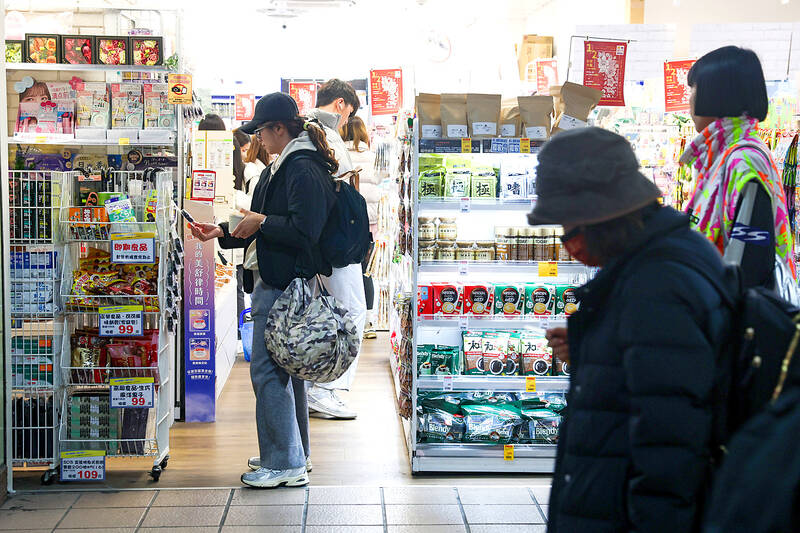
Photo: CNA
In addition, dining out expenses in Taiwan grew 3.13 percent, but sales generated by food and beverage operators still rose 3.6 percent, which provided additional evidence of strong domestic demand, Huang said.
Department stores, supermarkets, convenience stores and hypermarkets enjoyed record sales of NT$447.8 billion, NT$259.8 billion, NT$423.5 billion and NT$248.4 billion, up 9.2 percent, 5.4 percent, 8.7 percent and 5.1 percent respectively from a year earlier, the data showed.
Online retail sales also hit a new high of NT$653.3 billion last year, up 2.7 percent from a year earlier, with retailers keen to diversify their sales channels, the ministry said.
Sales posted by restaurants rose 2.9 percent from a year earlier to NT$838.7 billion, while revenue generated by beverage vendors grew 3.5 percent to NT$133.1 billion, with sales recorded by the catering business up 13.3 percent to NT$65.9 billion, the data showed.
Last month alone retail sales totaled NT$433.2 billion, up 2.9 percent from a year earlier, with buying boosted by an increase in demand ahead of the nine-day Lunar New Year holiday, which starts today, the data showed.
The food and beverage industry posted NT$96.0 billion in sales last month, up 4.4 percent from a year earlier, with large-scale New Year parties and pop concerts pushing up consumption, the ministry said.
Retail sales are expected to range between NT$435.8 billion and NT$448.5 billion this month, up 3.1 to 6.1 percent from a year earlier, while revenue posted by the food and beverage industry is forecast to range from NT$100.2 billion to NT$102.9 billion, up 11.6 to 14.6 percent, Huang said.
Positive factors such as an increase in the minimum wage, tax cuts and cash dividend payments by listed companies are expected to maintain domestic demand and boost consumption this year, Huang said.
However, as the local population failed to grow and local departures still outpaced foreign arrivals, domestic consumption could be hindered by these negative factors down the road, he added.
Sales last year by the wholesale sector stood at NT$12.95 trillion, up 8.8 percent from a year earlier after revenue last month rose 9.5 percent from a year earlier to NT$1.17 trillion, the ministry said.
BIG BUCKS: Chairman Wei is expected to receive NT$34.12 million on a proposed NT$5 cash dividend plan, while the National Development Fund would get NT$8.27 billion Taiwan Semiconductor Manufacturing Co (TSMC, 台積電), the world’s largest contract chipmaker, yesterday announced that its board of directors approved US$15.25 billion in capital appropriations for long-term expansion to meet growing demand. The funds are to be used for installing advanced technology and packaging capacity, expanding mature and specialty technology, and constructing fabs with facility systems, TSMC said in a statement. The board also approved a proposal to distribute a NT$5 cash dividend per share, based on first-quarter earnings per share of NT$13.94, it said. That surpasses the NT$4.50 dividend for the fourth quarter of last year. TSMC has said that while it is eager
‘IMMENSE SWAY’: The top 50 companies, based on market cap, shape everything from technology to consumer trends, advisory firm Visual Capitalist said Taiwan Semiconductor Manufacturing Co (TSMC, 台積電) was ranked the 10th-most valuable company globally this year, market information advisory firm Visual Capitalist said. TSMC sat on a market cap of about US$915 billion as of Monday last week, making it the 10th-most valuable company in the world and No. 1 in Asia, the publisher said in its “50 Most Valuable Companies in the World” list. Visual Capitalist described TSMC as the world’s largest dedicated semiconductor foundry operator that rolls out chips for major tech names such as US consumer electronics brand Apple Inc, and artificial intelligence (AI) chip designers Nvidia Corp and Advanced
Saudi Arabian Oil Co (Aramco), the Saudi state-owned oil giant, yesterday posted first-quarter profits of US$26 billion, down 4.6 percent from the prior year as falling global oil prices undermine the kingdom’s multitrillion-dollar development plans. Aramco had revenues of US$108.1 billion over the quarter, the company reported in a filing on Riyadh’s Tadawul stock exchange. The company saw US$107.2 billion in revenues and profits of US$27.2 billion for the same period last year. Saudi Arabia has promised to invest US$600 billion in the US over the course of US President Donald Trump’s second term. Trump, who is set to touch

SKEPTICAL: An economist said it is possible US and Chinese officials would walk away from the meeting saying talks were productive, without reducing tariffs at all US President Donald Trump hailed a “total reset” in US-China trade relations, ahead of a second day of talks yesterday between top officials from Washington and Beijing aimed at de-escalating trade tensions sparked by his aggressive tariff rollout. In a Truth Social post early yesterday, Trump praised the “very good” discussions and deemed them “a total reset negotiated in a friendly, but constructive, manner.” The second day of closed-door meetings between US Secretary of the Treasury Scott Bessent, US Trade Representative Jamieson Greer and Chinese Vice Premier He Lifeng (何立峰) were due to restart yesterday morning, said a person familiar


 RSS
RSS