


Gold prices topped US$2,500 an ounce for the first time, bolstered by hopes the US Federal Reserve is edging closer to cutting interest rates.
Spot bullion climbed as much as 2.2 percent on Friday, exceeding the previous record set last month, as a disappointing reading on the US housing market reinforced expectations of fast and deeper cuts by the Fed. Lower rates generally are positive for gold as it pays no interest.
Meanwhile, Goldman Sachs Group Inc economists lowered the probability of a US recession next year to 20 percent from 25 percent, citing the latest retail sales and jobless claims data.
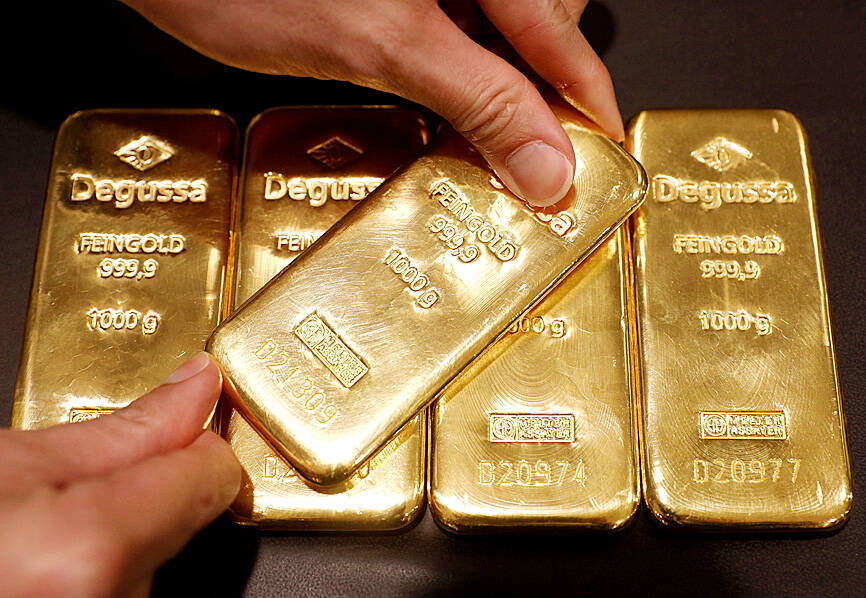
Photo: Reuters
The precious metal is up more than 20 percent this year amid mounting optimism on monetary easing and large purchases by central banks. It also has seen increased demand as a haven asset due to rising geopolitical risks, including tensions in the Middle East and Russia’s war with Ukraine.
Bullion began shooting higher earlier in the year — surprising seasoned analysts and veterans as there was not always a clear macro catalyst to justify its price rally. It sustained those gains even as traders dialed back bets on the timing of rate cuts.
More recently, gold has ticked higher as US officials widely are expected to start lowering rates soon.
A slew of US data on recent activities has convinced markets that the US central bank is on the cusp of lowering borrowing costs from a more than two-decade high, with the metal’s conventional drivers returning to the fore.
There is debate around how deep the Fed might cut rates given recent economic readings gave conflicting signals on the state of the US economy.
Goldman economists said they have become “more confident” the Fed would cut interest rates by 25 basis points at their policy meeting next month, but added that “another downside jobs surprise on Sept. 6 could still trigger a 50-basis-point move.”
Gold investors are “typically more prone to think the Fed will be more aggressive on the monetary accommodation front,” TD Securities Inc global head of commodity strategy Bart Melek said.
Prices could rise further to US$2,700 in the coming quarters, as “the macro/monetary and central bank ducks are aligning in a row,” he added.
Speculators boosted their net-bullish bets on Comex gold futures to a near four-year high last week, US Commodity Futures Trading Commission data showed.
Meanwhile, gold holdings in exchange-traded funds have risen over the past few months following a couple of years of outflows, data compiled by Bloomberg showed.

Cairo’s new monorail slices across the city skyline, running above the familiar chaos of blaring horns and aging buses’ exhaust fumes that mark rush hour below. The US$4.5 billion monorail, opened this month, is among Egypt’s most prominent new transport projects, part of a debt-funded infrastructure drive criticized for sapping state finances while bringing limited benefits to most of the country’s 109 million people. “It feels like you’re in a different country,” said Ramy Sayed, a restaurant manager, aboard a driverless Innovia 300 train. “No noise, no traffic, we’re not used to this.” The eastern line runs 56km from the bustling middle-class

Taiwanese firms have increased investment in the Philippines in recent years as Manila’s ties with Washington deepen and global supply chains continue to shift away from China, an expert at the Chung-Hua Institution for Economic Research (CIER, 中華經濟研究院) said yesterday. The Philippines had not been among Taiwanese investors’ top choices in Southeast Asia, CIER Taiwan ASEAN Studies Center director Kristy Hsu (徐遵慈) said at a seminar in Taipei. However, Taiwan’s investment in the country has grown significantly since the COVID-19 pandemic, reaching US $257 million last year, a high in recent years, she said. Although Taiwan’s total investment in the Philippines still lags
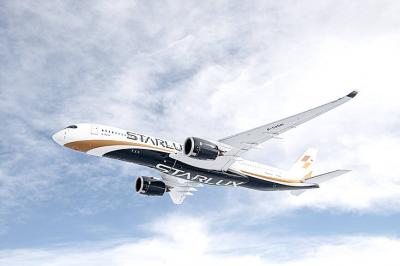
Starlux Airlines Co (星宇航空) today unveiled a long-haul network expansion plan at a shareholders’ meeting in Taipei, including direct flights to Barcelona, Spain, and Zurich, Switzerland, as well as a service connecting Taipei, Sydney and New Zealand. Starlux is to become the first Taiwanese carrier to offer non-stop services to the two European cities, while the inaugural oceanic route is expected to expand transit opportunities within the Australia-New Zealand market, Starlux said. Flight services to Chicago, Dallas, Washington and New York are under evaluation, the airline added. Prior to the shareholders’ meeting, the airline earlier this year announced that it would be

Intel Corp regards Taiwan Semiconductor Manufacturing Co (TSMC, 台積電) as a longstanding partner, as the US chipmaker would continue outsourcing production of advanced chips to TSMC, Intel chief executive officer Lip-Bu Tan (陳立武) said yesterday. “I don’t look at people as competitors. I look at the collaboration... Nvidia is also, you know, a good friend,” Tan told a news conference following his keynote speech at the Computex trade show in Taipei. “It’s a very trusted partnership for us... We are a big, top customer for them, and we’re going to continue doing that,” he said, referring to TSMC, the world’s largest foundry


 RSS
RSS