


Canadian Prime Minister Justin Trudeau’s government has published options it will consider for deterring Chinese-made electric vehicles (EVs) from accessing the Canadian market, including putting tariffs on imported and blocking Chinese investment in new Canadian factories.
Trudeau’s government appears to only be considering tariffs on finished vehicles, based on the document released on Tuesday. The list of items that could see tariffs doesn’t include batteries or battery components, for example.
The paper was released as part of the formal consultations Canada must conduct before imposing tariffs. Those consultations, announced by Canadian Minister of Finance Chrystia Freeland last week, will seek feedback from stakeholders including labor unions and automotive industry groups, and will run until Aug. 1.
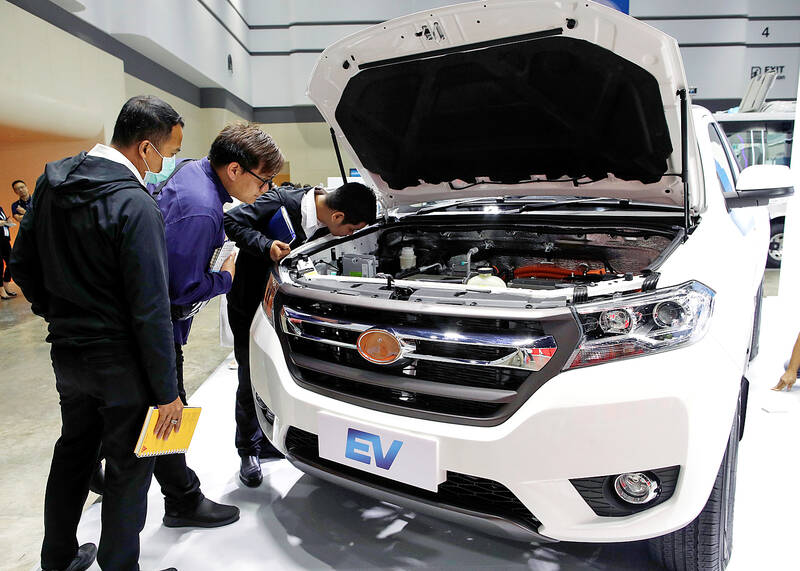
Photo: Rungroj Yongrit, EPA-EFE
Canada’s EV industry is “at risk of being undermined by the significant recent increase in exports of Chinese EVs to the Canadian and global markets, enabled by unfair support through China’s use of a broad range of non-market policies and practices,” the consultation paper says.
The Chinese policies include “pervasive subsidization, including of the supply chains of necessary components, problematic or non-existent labor and environmental standards, and other measures to artificially lower production costs, which is leading to significant overcapacity in Chinese EV production,” the document says.
The paper doesn’t provide potential tariff rates and instead asks for feedback on what those may be for various vehicle classes. It also seeks comment on how tariffs might affect EV affordability in general.
In another section, the paper considers the possibility that “Chinese companies could seek to establish facilities to manufacture EVs within Canada” in an attempt to “access the North American market in light of potential tariff measures.”
The document asks for feedback on whether “additional actions like further policy guidance, monitoring, or restrictions related to transactions and investment from Chinese sources in the Canadian EV supply chain are required.”
Two other areas are outlined for feedback. One is whether Canada should make Chinese-made EVs ineligible for federal consumer incentives. The other is on data privacy and security considerations for connected vehicles and related infrastructure.
In considering tariffs and other measures, Canada is following in step with its allies. The US unveiled plans this spring to nearly quadruple US tariffs on Chinese-manufactured electric vehicles, up to a final rate of 102.5 percent. The European Union also plans to increase tariffs, taking those levies as high as 48 percent on some vehicles.
Although the value of Chinese EVs imported by Canada has surged recently, there has so far been little activity involving Chinese domestic vehicle makers.
The vast majority of Canada’s EV imports from China are Tesla Inc vehicles produced from its Shanghai factory. Freeland wouldn’t comment on whether tariffs might apply to those vehicles.
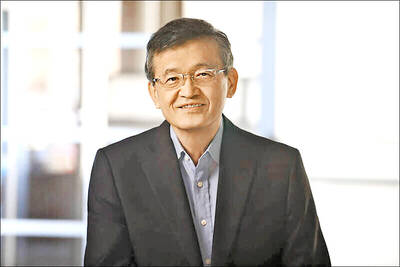
Intel Corp chief executive officer Lip-Bu Tan (陳立武) is expected to meet with Taiwanese suppliers next month in conjunction with the opening of the Computex Taipei trade show, supply chain sources said on Monday. The visit, the first for Tan to Taiwan since assuming his new post last month, would be aimed at enhancing Intel’s ties with suppliers in Taiwan as he attempts to help turn around the struggling US chipmaker, the sources said. Tan is to hold a banquet to celebrate Intel’s 40-year presence in Taiwan before Computex opens on May 20 and invite dozens of Taiwanese suppliers to exchange views

Application-specific integrated circuit designer Faraday Technology Corp (智原) yesterday said that although revenue this quarter would decline 30 percent from last quarter, it retained its full-year forecast of revenue growth of 100 percent. The company attributed the quarterly drop to a slowdown in customers’ production of chips using Faraday’s advanced packaging technology. The company is still confident about its revenue growth this year, given its strong “design-win” — or the projects it won to help customers design their chips, Faraday president Steve Wang (王國雍) told an online earnings conference. “The design-win this year is better than we expected. We believe we will win
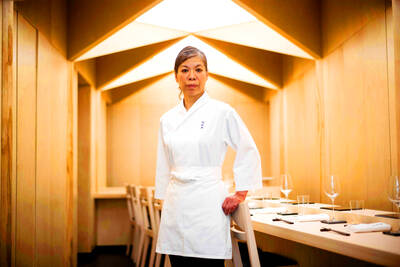
Chizuko Kimura has become the first female sushi chef in the world to win a Michelin star, fulfilling a promise she made to her dying husband to continue his legacy. The 54-year-old Japanese chef regained the Michelin star her late husband, Shunei Kimura, won three years ago for their Sushi Shunei restaurant in Paris. For Shunei Kimura, the star was a dream come true. However, the joy was short-lived. He died from cancer just three months later in June 2022. He was 65. The following year, the restaurant in the heart of Montmartre lost its star rating. Chizuko Kimura insisted that the new star is still down
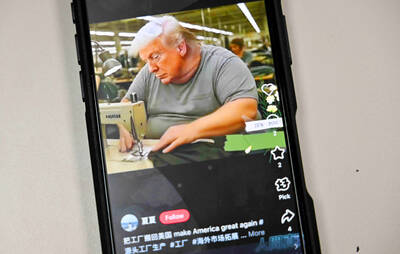
While China’s leaders use their economic and political might to fight US President Donald Trump’s trade war “to the end,” its army of social media soldiers are embarking on a more humorous campaign online. Trump’s tariff blitz has seen Washington and Beijing impose eye-watering duties on imports from the other, fanning a standoff between the economic superpowers that has sparked global recession fears and sent markets into a tailspin. Trump says his policy is a response to years of being “ripped off” by other countries and aims to bring manufacturing to the US, forcing companies to employ US workers. However, China’s online warriors


 RSS
RSS