


Tesla Inc halted production at its German factory yesterday after high-voltage lines supplying the carmaker’s only European plant were set on fire in an act of “sabotage” claimed by a far-left group.
Emergency services were called in the early hours yesterday to reports of a burning electricity pylon southeast of Berlin, close to the Tesla plant.
The blaze was extinguished but damage to the lines knocked out power to the factory, as well as surrounding villages.
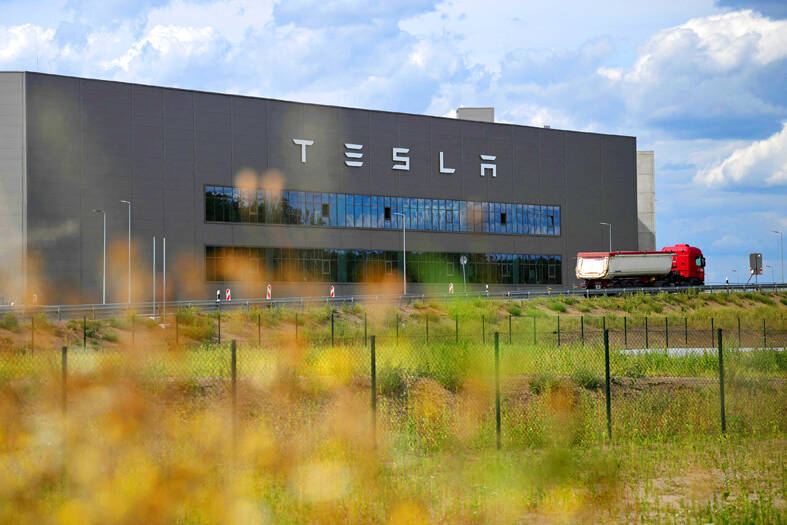
Photo: Reuters
After police said they had launched an investigation into suspected arson the act was claimed by far-left activists from the so-called Vulkangruppe (Volcano Group).
“With our sabotage, we have set ourselves the goal of achieving the biggest possible blackout of the Gigafactory,” the group said in a statement posted on a far-left Web site.
The group highlighted concerns about the environmental impact of the plant and the local water supply.
“We feel connected to all the people who won’t let Tesla turn the tap off,” the group said.
Michael Stuebgen, interior minister for Brandenburg state, said that if arson was confirmed, it would be “a perfidious attack on our electricity infrastructure.”
“Thousands of people have been cut off from their basic supply and put in danger. The rule of law will react to such an act of sabotage with the utmost severity.”
Tesla said the production facilities at the Gruenheide plant were in a “safe state” after the shutdown, and workers had been sent home.
“We are in close contact with the authorities and of course (electricity supplier) Edis. We are currently unable to say when production can be expected to resume,” the company said in a statement.
The power outage is the latest problem to hit the factory. In January, most production was halted at the site for two weeks due to a shortage of parts following shipping delays caused by Yemeni rebel attacks in the Red Sea, a vital trade route.
Tesla’s German plant started production in 2022 following an arduous two-year approval and construction process dogged by administrative and legal obstacles.
Tesla wants to expand the site by 170 hectares (420 acres) and boost production up to one million vehicles annually to feed Europe’s growing demand for electric cars and take on rivals who are shifting away from combustion engine vehicles.
But the plans have annoyed local residents, who voted against the project in a non-binding ballot last month.
After the vote, Tesla said it might have to rethink the plans.
“We recognize that the citizens of Gruenheide have concerns in connection with the planned expansion of the site,” the company said.
Environmental activists opposed to the expansion of the factory run by Elon Musk’s company recently set up a camp in a wooded area near the plant.
Protestors at the forest camp, situated in an area of forest that the carmaker will have to raze if the expansion goes ahead, share many of the locals’ objections to the factory.
As well as deforestation, the activists say there is a threat to local drinking water supplies.
Stop Tesla, the group behind the protest camp, said yesterday it had “no information” about the cause of the fire and shared its “solidarity with the workers at Tesla and the local residents.”


Taiwanese firms have increased investment in the Philippines in recent years as Manila’s ties with Washington deepen and global supply chains continue to shift away from China, an expert at the Chung-Hua Institution for Economic Research (CIER, 中華經濟研究院) said yesterday. The Philippines had not been among Taiwanese investors’ top choices in Southeast Asia, CIER Taiwan ASEAN Studies Center director Kristy Hsu (徐遵慈) said at a seminar in Taipei. However, Taiwan’s investment in the country has grown significantly since the COVID-19 pandemic, reaching US $257 million last year, a high in recent years, she said. Although Taiwan’s total investment in the Philippines still lags

Intel Corp regards Taiwan Semiconductor Manufacturing Co (TSMC, 台積電) as a longstanding partner, as the US chipmaker would continue outsourcing production of advanced chips to TSMC, Intel chief executive officer Lip-Bu Tan (陳立武) said yesterday. “I don’t look at people as competitors. I look at the collaboration... Nvidia is also, you know, a good friend,” Tan told a news conference following his keynote speech at the Computex trade show in Taipei. “It’s a very trusted partnership for us... We are a big, top customer for them, and we’re going to continue doing that,” he said, referring to TSMC, the world’s largest foundry

Hon Hai Precision Industry Co (鴻海精密) yesterday said it would work with US chipmaker Intel Corp to jointly develop and deploy next-generation artificial intelligence (AI) infrastructure and intelligent computing platforms in a move to capture booming demand for AI computing systems. Hon Hai, also known as Foxconn Technology Group (富士康), said in a statement that the partnership would combine its global manufacturing scale, system integration expertise and AI data center deployment capabilities with Intel’s strengths in processor architecture, silicon technologies and software ecosystem. The companies said they plan to work on equipment used in AI data centers, including server racks powered by

Artificial intelligence (AI) agents would supplant smartphones as the center of people’s digital lives, fundamentally reshaping personal devices and driving a major computing upgrade cycle, Qualcomm Inc CEO Cristiano Amon said yesterday. In his keynote speech for this year’s Computex trade show in Taipei, Amon said that the rise of "agentic AI" — AI systems capable of reasoning, planning and carrying out tasks autonomously — would transform how people interact with technology across phones, PCs, vehicles and wearable devices. Describing the technology as the next major evolution in computing, Amon said that "2026 is the year of agents.” For decades, smartphones have sat


 RSS
RSS