


Bitcoin spiked above US$50,000 yesterday for the first time in more than two years as investors grow optimistic that US approval of broader trading in the unit will ramp up demand.
The cryptocurrency has enjoyed a strong run in recent months, fueled by expectations US lawmakers would allow the creation of exchange-traded funds (ETFs) that track the price and let the public invest in crypto without directly purchasing it.
After initially dropping in reaction to last month’s green light by Washington, bitcoin has rallied about 25 percent since Jan. 22.
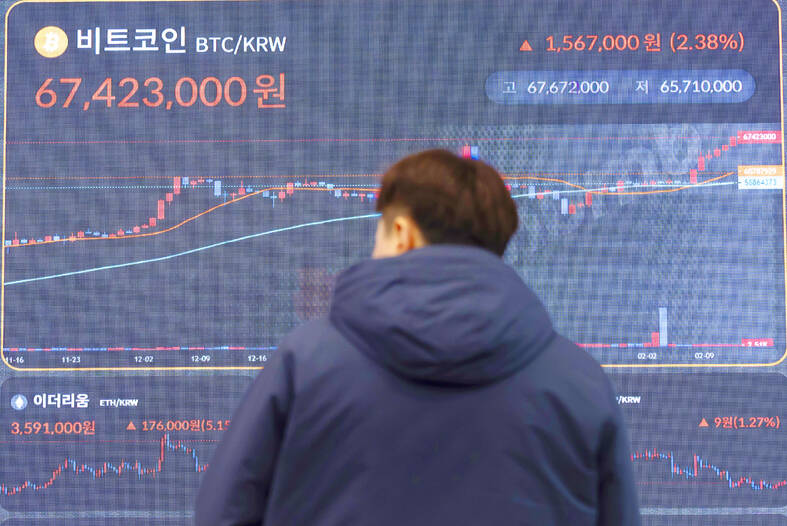
Photo: EPA-EFE
That advance saw it hit as much as US$50,328, according to Bloomberg data, its highest level since late 2021.
And observers were optimistic about the outlook.
“Enthusiast buyers bring in more enthusiast buyers pushing prices further up,” Copper Technologies Ltd research head Fadi Aboualfa said. “The cryptocurrency has momentum on the back of several green weeks and has a large chance of going up further when markets see weekly movements upwards of 10 percent (as we saw last week).”
By 3:30am GMT yesterday, bitcoin had dropped slightly, to US$49,950.
The currency remains well below its record value of almost US$69,000 in 2020, but the rally marks a recovery following a series of high-profile scandals and collapses that rocked the crypto industry.
FTX Trading Ltd, the world’s second-biggest crypto exchange, dramatically went under last year, and its boss Sam Bankman-Fried faces up to 110 years in prison for what prosecutors described as “one of the biggest financial frauds in American history.”
In November, Changpeng “CZ” Zhao (趙長鵬) stepped down as CEO of Binance Holdings Ltd (幣安) — the world’s biggest crypto exchange — after he and the company pleaded guilty to sweeping money laundering violations.
Bitcoin has also been boosted by hopes that the US Federal Reserve will start to cut interest rates this year as inflation eases.
The asset’s value has been driven by the supply crunch expected next year because of an event called “halving.”
Bitcoin is created — or “mined” — as a reward when powerful computers solve complex problems, but the amount of bitcoin is limited and every four years, the reward is halved.
The next “halving” is due in May.
“It’s a really interesting move. The expectation of rate cuts certainly helps, but it doesn’t explain what’s really set fire to bitcoin over the past four, five sessions,” IG Markets Ltd analyst Tony Sycamore said. “In that respect, I think it’s more a focus on the halving ... and some ETFs inflows.”


Taiwanese firms have increased investment in the Philippines in recent years as Manila’s ties with Washington deepen and global supply chains continue to shift away from China, an expert at the Chung-Hua Institution for Economic Research (CIER, 中華經濟研究院) said yesterday. The Philippines had not been among Taiwanese investors’ top choices in Southeast Asia, CIER Taiwan ASEAN Studies Center director Kristy Hsu (徐遵慈) said at a seminar in Taipei. However, Taiwan’s investment in the country has grown significantly since the COVID-19 pandemic, reaching US $257 million last year, a high in recent years, she said. Although Taiwan’s total investment in the Philippines still lags
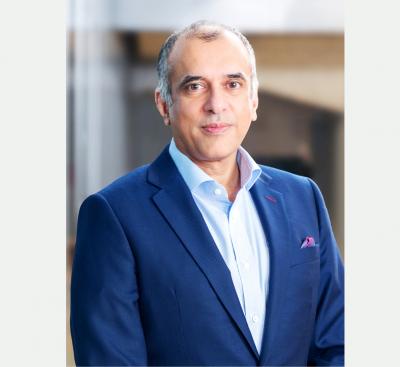
HSBC Holdings PLC is deepening its commitment to Taiwan as the economy emerges as one of the bank’s fastest-growing markets globally, driven by an artificial intelligence (AI) investment boom, expanding cross-border trade, and rising wealth creation. “The advantage that Taiwan has is a growth story linked to the semiconductor and broader AI industries, strong underlying corporate performance, and wealth creation,” said Surendra Rosha, HSBC’s co-chief executive for Asia and the Middle East, in an exclusive interview with the Taipei Times on June 2, during this year’s HSBC Taiwan Conference. That combination has helped HSBC cement its position as the most profitable international

Intel Corp regards Taiwan Semiconductor Manufacturing Co (TSMC, 台積電) as a longstanding partner, as the US chipmaker would continue outsourcing production of advanced chips to TSMC, Intel chief executive officer Lip-Bu Tan (陳立武) said yesterday. “I don’t look at people as competitors. I look at the collaboration... Nvidia is also, you know, a good friend,” Tan told a news conference following his keynote speech at the Computex trade show in Taipei. “It’s a very trusted partnership for us... We are a big, top customer for them, and we’re going to continue doing that,” he said, referring to TSMC, the world’s largest foundry

Hon Hai Precision Industry Co (鴻海精密) yesterday said it would work with US chipmaker Intel Corp to jointly develop and deploy next-generation artificial intelligence (AI) infrastructure and intelligent computing platforms in a move to capture booming demand for AI computing systems. Hon Hai, also known as Foxconn Technology Group (富士康), said in a statement that the partnership would combine its global manufacturing scale, system integration expertise and AI data center deployment capabilities with Intel’s strengths in processor architecture, silicon technologies and software ecosystem. The companies said they plan to work on equipment used in AI data centers, including server racks powered by


 RSS
RSS