


Foreign institutional investors in Taiwan registered a net fund outflow of US$5.81 billion last month, when tech stocks on the local market were encountering headwinds, the Financial Supervisory Commission reported on Tuesday last week.
Last month’s figure was the fifth-largest monthly outflow since 2011 and followed the US$4.7 billion in net outflow in July, the commission said.
Securities and Futures Bureau Chief Secretary Shang Kuang-chi (尚光琪) said the massive fund outflow came after the TAIEX plunged about 511 points, or 2.98 percent, as investors locked in profits made on stocks related to artificial intelligence.
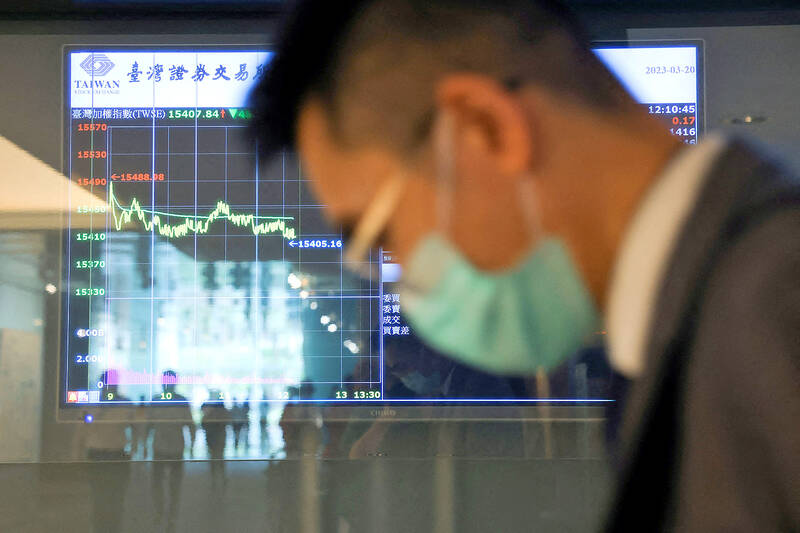
PHOTO: REUTERS
Other contributing factors were the hawkish tone struck by the US Federal Reserve at the annual Jackson Hole Economic Symposium, and the financial woes suffered by several major Chinese property developers, which spooked market sentiment, Shang said.
Last month, foreign institutional investors sold a net NT$123.74 billion (US$3.87 billion) worth of shares on the local stock market, a monthly high so far this year, which led to heavy losses on the TAIEX, the commission said.
In the first eight months of this year, foreign institutional investors registered an aggregate net fund inflow of US$13.83 billion on the back of a strong rebound in tech stocks in line with the global markets, commission data showed.
During the same period, foreign institutional investors bought a net NT$90.995 billion worth of shares on the local market, it said.
The aggregate fund inflow registered by foreign institutional investors showed that they remained confident in the local market, Shang said.
As of the end of last month, foreign institutional investors were holding a 38.2 percent share of the combined market capitalization on the main board and the over-the-counter (OTC) market, the commission said.
Listed companies on the local main board and the OTC market generated NT$2.132 trillion in combined revenue in the first seven months of the year, the third highest in Taiwan’s history, despite weakening global demand, high inflation and aggressive rate hikes by major central banks worldwide, according to Shang.
As of the end of July, the average cash dividend yield in Taiwan was 3.53 percent, one of the highest in the world, while the average price-to-earning ratio , which gauges a company’s valuation by measuring its current share price against its earnings per share, was only 16.8, indicating that the Taiwan stock market remained attractive, Shang said.

The domestic unit of the Chinese-owned, Dutch-headquartered chipmaker Nexperia BV will soon be able to produce semiconductors locally within China, according to two company sources. Nexperia is at the center of a global tug-of-war over critical semiconductor technology, with a Dutch court in February ordering a probe into alleged mismanagement at the company. The geopolitical tussle has disrupted supply chains, with some carmakers reportedly forced to cut production due to chip shortages. Local production would allow Nexperia’s domestic arm, Nexperia Semiconductors (China) Ltd (安世半導體中國), to bypass restrictions in place since October on the supply of silicon wafers — etched with tiny components to

Singapore-based ride-hailing and delivery giant Grab Holdings Ltd has applied for regulatory approval to acquire the Taiwan operations of Germany-based Delivery Hero SE's Foodpanda in a deal valued at about US$600 million. Grab submitted the filing to the Fair Trade Commission on Friday last week, with the transaction subject to regulatory review and approval, the company said in a statement yesterday. Its independent governance structure would help foster a healthy and competitive market in Taiwan if the deal is approved, Grab said. Grab, which is listed on the NASDAQ, said in the filing that US-based Uber Technologies Inc holds about 13 percent of

Taiwan Semiconductor Manufacturing Co (TSMC, 台積電) yesterday received government approval to deploy its advanced 3-nanometer (3nm) process at its second fab currently under construction in Japan, the Ministry of Economic Affairs said in a news release. The ministry green-lit the plan for the facility in Kumamoto, which is scheduled to start installing equipment and come online in 2028 with a monthly production capacity of 15,000 12-inch wafers, the ministry said. The Department of Investment Review in June 2024 authorized a US$5.26 billion investment for the facility, slated to manufacture 6- to 12nm chips, significantly less advanced than 3nm process. At a meeting with

Taiwan’s food delivery market could undergo a major shift if Singapore-based Grab Holdings Ltd completes its planned acquisition of Delivery Hero SE’s Foodpanda business in Taiwan, industry experts said. Grab on Monday last week announced it would acquire Foodpanda’s Taiwan operations for US$600 million. The deal is expected to be finalized in the second half of this year, with Grab aiming to complete user migration to its platform by the first half of next year. A duopoly between Uber Eats and Foodpanda dominates Taiwan’s delivery market, a structure that has remained intact since the Fair Trade Commission (FTC) blocked Uber Technologies Inc’s


 RSS
RSS