


McKinsey & Co is planning to eliminate about 2,000 jobs, one of the consulting company’s biggest rounds of cuts ever.
The move by the firm, known for devising staff-reduction plans for its clients, is expected to focus on support staff in roles that do not have direct contact with clients, people with knowledge of the matter said.
Under a plan dubbed “Project Magnolia,” the management team is hoping the move would help preserve the compensation pool for its partners, the people said.
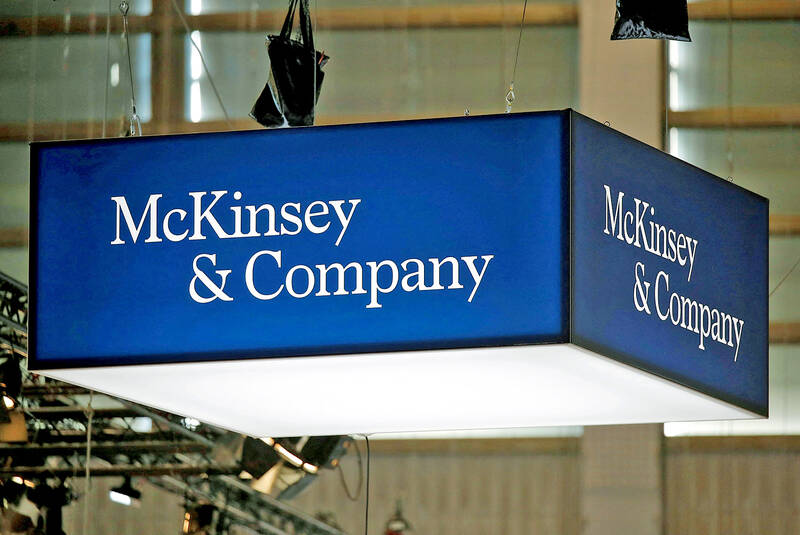
Photo: Reuters
The firm, which has seen rapid growth in its head count during the past decade, is looking to restructure how it organizes its support teams to centralize some of the roles.
The plan is expected to be finalized in the coming weeks, and the final number of roles to be eliminated from its 45,000 workforce could still change, one of the people said.
That head count is up from 28,000 just five years ago and 17,000 in 2012.
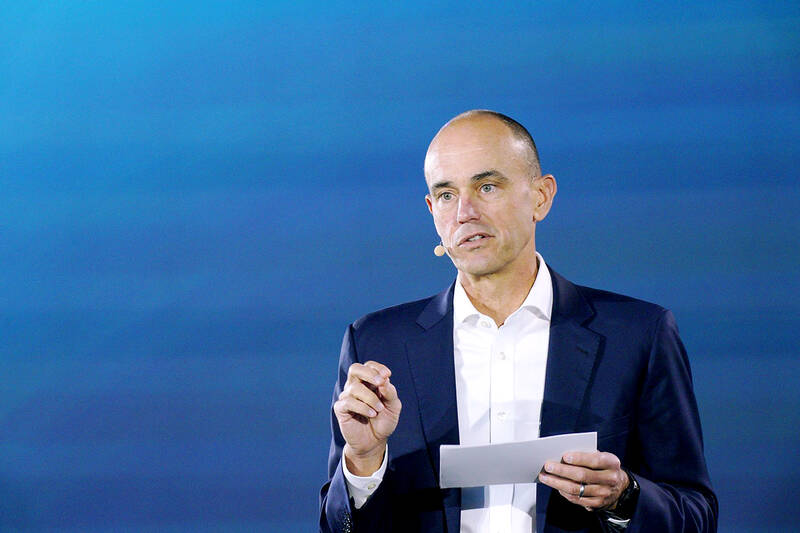
Photo: Bloomberg
“We are redesigning the way our non-client-serving teams operate for the first time in more than a decade, so that these teams can effectively support and scale with our firm,” McKinsey media relations director D.J. Carella said in an e-mailed statement.
Carella said the firm is still hiring professionals who deal directly with clients.
The firm posted a record US$15 billion in revenue in 2021, and surpassed that figure last year, one of the people said.
Companies in industries from finance to technology and retailing are reducing staff amid a slowdown in demand and predictions of a looming recession.
Tech companies, including Amazon.com Inc and Microsoft Corp, have announced plans for deep cuts, and Goldman Sachs Group Inc, Morgan Stanley and other top banks have been eliminating thousands of positions.
McKinsey’s move comes two years after Bob Sternfels took over as global managing partner following a vote by its about 650 senior partners to oust his predecessor, Kevin Sneader.
The management shift was the culmination of a tumultuous period for the firm, which took flak for its role in advising the makers of the painkiller OxyContin and faced scrutiny of various other business ties.
Sneader now helps run Goldman Sachs Group Inc’s Asia-Pacific operations.
McKinsey consultants helped popularize the phrase “war for talent” in the late 1990s, a slogan that has come back into vogue in the past few years as a post-COVID-19 pandemic boom led to a frenzied period of hiring and head count expansion across industries. With that growth now starting to wane, companies battling to preserve profits are turning to job cuts at a scale not seen in more than a decade.
China’s top chipmaker has warned that breakaway spending on artificial intelligence (AI) chips is bringing forward years of future demand, raising the risk that some data centers could sit idle. “Companies would love to build 10 years’ worth of data center capacity within one or two years,” Semiconductor Manufacturing International Corp (SMIC, 中芯) cochief executive officer Zhao Haijun (趙海軍) said yesterday on a call with analysts. “As for what exactly these data centers will do, that hasn’t been fully thought through.” Moody’s Ratings projects that AI-related infrastructure investment would exceed US$3 trillion over the next five years, as developers pour eye-watering sums
Bank of America Corp nearly doubled its forecast for the nation’s economic growth this year, adding to a slew of upgrades even after a rip-roaring last year propelled by demand for artificial intelligence (AI). The firm lifted its projection to 8 percent from 4.5 percent on “relentless global demand” for the hardware that Taiwanese companies make, according to a note dated yesterday by analysts including Xiaoqing Pi (皮曉青). Taiwan’s GDP expanded 8.63 percent last year, the fastest pace since 2010. The increase “reflects our sustained optimism over Taiwan’s technology driven expansion and is reinforced by several recent developments,” including a more stable currency,

NEW IMPORTS: Car dealer PG Union Corp said it would consider introducing US-made models such as the Jeep Grand Cherokee and Stellantis’ RAM 1500 to Taiwan Tesla Taiwan yesterday said that it does not plan to cut its car prices in the wake of Washington and Taipei signing the Agreement on Reciprocal Trade on Thursday to eliminate tariffs on US-made cars. On the other hand, Mercedes-Benz Taiwan said it is planning to lower the price of its five models imported from the US after the zero tariff comes into effect. Tesla in a statement said it has no plan to adjust the prices of the US-made Model 3, Model S and Model X as tariffs are not the only factor the automaker uses to determine pricing policies. Tesla said

OpenAI has warned US lawmakers that its Chinese rival DeepSeek (深度求索) is using unfair and increasingly sophisticated methods to extract results from leading US artificial intelligence (AI) models to train the next generation of its breakthrough R1 chatbot, a memo reviewed by Bloomberg News showed. In the memo, sent on Thursday to the US House of Representatives Select Committee on China, OpenAI said that DeepSeek had used so-called distillation techniques as part of “ongoing efforts to free-ride on the capabilities developed by OpenAI and other US frontier labs.” The company said it had detected “new, obfuscated methods” designed to evade OpenAI’s defenses


 RSS
RSS