


The IMF and ratings agency Moody’s criticized Britain’s new economic strategy, as investors braced for more havoc in bond markets that has already forced the Bank of England (BOE) to promise “significant” action.
The statements overnight from the IMF and Moody’s piled more pressure on new British Chancellor of the Exchequer Kwasi Kwarteng to reassess his policy, which sparked a collapse in the value of British assets in the past few days.
New British Prime Minister Liz Truss of the Conservative Party came into office on Sept. 6 saying she wanted to snap the economy out of years of stagnant growth with deep tax cuts and deregulation.
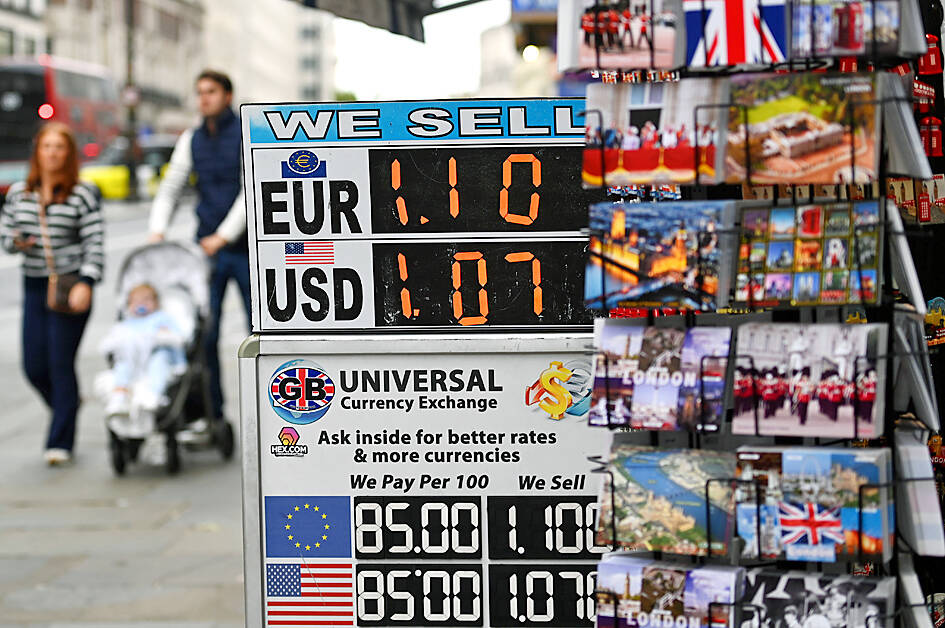
Photo: EPA-EFE
Kwarteng on Friday set out a plan to cut taxes through huge increases in borrowing that he believed would be paid back by doubling Britain’s rate of economic growth.
At the same time, the government is subsidizing energy bills for households and businesses at a cost of £60 billion (US$63.5 billion) in the next six months alone.
The IMF said the proposals, which sent the pound to an all-time low of US$1.0327 on Monday, would likely increase inequality and it questioned their wisdom.
“Given elevated inflation pressures in many countries, including the UK, we do not recommend large and untargeted fiscal packages at this juncture, as it is important that fiscal policy does not work at cross purposes to monetary policy,” an IMF spokesperson said.
Deutsche Bank AG research strategist Jim Reid described the “rebuke” as “quite scathing.”
The IMF holds symbolic importance in British politics: Its bailout of Britain in 1976 following a balance-of-payments crisis has long been regarded as a low point in the kingdom’s modern economic history.
In a blunt release, Moody’s said large unfunded tax cuts were “credit negative” for the UK.
“A sustained confidence shock arising from market concerns over the credibility of the government’s fiscal strategy that resulted in structurally higher funding costs could more permanently weaken the UK’s debt affordability,” Moody’s said.
The IMF said a budget due from Kwarteng on Nov. 23 would provide an “early opportunity for the UK government to consider ways to provide support that is more targeted and re-evaluate the tax measures, especially those that benefit high-income earners.”
Kwarteng has said the government is committed to fiscal responsibility in the medium term and that his full budget in November would set out debt-cutting plans.
On Tuesday, Bank of England chief economist Huw Pill said the central bank was likely to deliver a “significant” rate increase when it meets in November, adding that financial market upheaval would have a big impact on the economy and would be factored into its next forecasts.
British government bonds have sold off at a ferocious pace in the past few days, with 10-year borrowing costs on track for their biggest calendar month rise since at least 1957, according to a Reuters calculation.
The pound was down 0.4 percent to trade at US$1.0690 at 6:28am GMT.
“It is hard not to draw the conclusion that this will require a significant monetary policy response,” Pill told the CEPR Barclays Monetary Policy Forum.
With analysts still speculating about Britain’s future financial direction and markets volatile, a growing number of mortgage providers, unable to price loans, suspended sales.

PATENTS: MediaTek Inc said it would not comment on ongoing legal cases, but does not expect the legal action by Huawei to affect its business operations Smartphone integrated chips designer MediaTek Inc (聯發科) on Friday said that a lawsuit filed by Chinese smartphone brand Huawei Technologies Co (華為) over alleged patent infringements would have little impact on its operations. In an announcement posted on the Taiwan Stock Exchange, MediaTek said that it would not comment on an ongoing legal case. However, the company said that Huawei’s legal action would have little impact on its operations. MediaTek’s statement came after China-based PRIP Research said on Thursday that Huawei filed a lawsuit with a Chinese district court claiming that MediaTek infringed on its patents. The infringement mentioned in the lawsuit likely involved

Taipei is today suspending work, classes and its US$2.4 trillion stock market as Typhoon Gaemi approaches Taiwan with strong winds and heavy rain. The nation is not conducting securities, currency or fixed income trading, statements from its stock and currency exchanges said. Authorities had yesterday issued a warning that the storm could affect people on land and canceled some ship crossings and domestic flights. Taiwan Semiconductor Manufacturing Co (TSMC, 台積電) expects its local chipmaking fabs to maintain normal production, the company said in an e-mailed statement. The main chipmaker for Apple Inc and Nvidia Corp said it has activated routine typhoon alert

GROWTH: TSMC increased its projected revenue growth for this year to more than 25 percent, citing stronger-than-expected demand for AI devices and smartphones The Taiwan Institute of Economic Research (TIER, 台灣經濟研究院) yesterday raised its forecast for Taiwan’s GDP growth this year from 3.29 percent to 3.85 percent, as exports and private investment recovered faster than it predicted three months ago. The Taipei-based think tank also expects that Taiwan would see a 8.19 percent increase in exports this year, better than the 7.55 percent it projected in April, as US technology giants spent more money on artificial intelligence (AI) infrastructure and development. “There will be more AI servers going forward, but it remains to be seen if the momentum would extend to personal computers, smartphones and

Catastrophic computer outages caused by a software update from one company have once again exposed the dangers of global technological dependence on a handful of players, experts said on Friday. A flawed update sent out by the little-known security firm CrowdStrike Holdings Inc brought airlines, TV stations and myriad other aspects of daily life to a standstill. The outages affected companies or individuals that use CrowdStrike on the Microsoft Inc’s Windows platform. When they applied the update, the incompatible software crashed computers into a frozen state known as the “blue screen of death.” “Today CrowdStrike has become a household name, but not in


 RSS
RSS