


The nation’s three major science parks posted record combined revenue of NT$2.05 trillion (US$64.3 billion) for the first half of the year, up 19.63 percent year-on-year, the National Science and Technology Council said in a report yesterday.
The council attributed the robust performance to growing demand for artificial intelligence of things, 5G, high-performance computing and other emerging applications, which lifted the sales of semiconductor companies in the three parks.
Hsinchu Science Park (新竹科學園區) saw first-half revenue rise 10.94 percent annually to NT$825.4 billion, while the Central Taiwan Science Park (中部科學園區) and the Southern Taiwan Science Park (南部科學園區) posted revenue growth of 18.37 percent to NT$571.5 billion and 34.17 percent to NT$652.1 billion respectively during the same period, the report said.
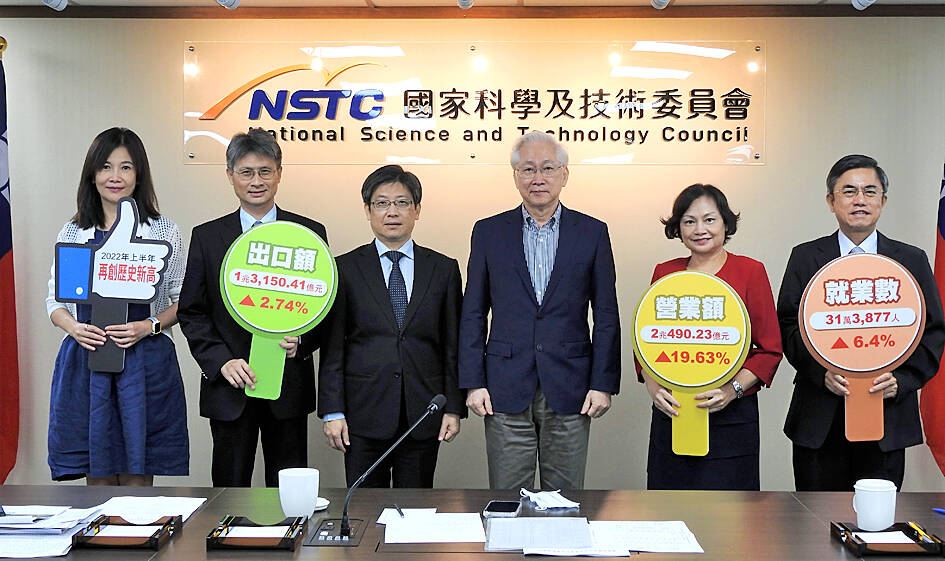
Photo courtesy of National Science and Technology Council
The parks exported a combined NT$1.32 trillion in the first six months of the year, up 2.74 percent from a year earlier, while their combined imports surged 74.28 percent to NT$859.4 billion, as companies continued to build factories and expanded production while increasing purchases of precision machinery and equipment from abroad, the council said.
Overall, the three parks saw two-way trade rise 22.63 percent year-on-year to NT$2.17 trillion in the first half, also a new high, it added.
The three parks employed a record 313,877 people, up 6.4 percent year-on-year, the council said.
“Despite turmoil triggered by the Russian-Ukraine war, China’s [COVID-19] lockdowns and surging inflation, the science parks’ semiconductor clusters — from upstream to midstream and downstream firms — performed strongly in the first half,” the report said.
“Coupled with the excellent performance of the information and communications technology industry, the science parks contributed to the nation’s GDP growth and helped strengthen Taiwan’s indispensable role in the global high-tech industry,” it said.
Of the six major industries in the parks, the integrated circuit industry placed first in terms of revenue growth, rising 28.34 percent year-on-year to NT$1.57 trillion, followed by the computer and peripherals industry with an increase of 27.15 percent to NT$98.19 billion.
The communications industry’s revenue increased 16.26 percent to NT$38.88 billion, the precision machinery industry’s sales rose 14.18 percent to NT$65.7 billion and the biotechnology industry’s sales were up 6.08 percent to NT$19.99 billion, the report showed.
However, the optoelectronics industry’s revenue fell 16.08 percent annually to NT$246 billion due to a relatively higher comparison base last year, falling flat-panel prices, inventory adjustments and cooling demand in the end market, it said.
The council said it still anticipates a mild increase in the parks’ sequential revenue in the second half of the year, despite growing headwinds in terms of persistent inflation, the war in Ukraine, a slowing global economy and the US Federal Reserve’s continued rate hikes.
The three parks’ full-year revenue is forecast to hit NT$4.05 trillion this year, the council said.

PATENTS: MediaTek Inc said it would not comment on ongoing legal cases, but does not expect the legal action by Huawei to affect its business operations Smartphone integrated chips designer MediaTek Inc (聯發科) on Friday said that a lawsuit filed by Chinese smartphone brand Huawei Technologies Co (華為) over alleged patent infringements would have little impact on its operations. In an announcement posted on the Taiwan Stock Exchange, MediaTek said that it would not comment on an ongoing legal case. However, the company said that Huawei’s legal action would have little impact on its operations. MediaTek’s statement came after China-based PRIP Research said on Thursday that Huawei filed a lawsuit with a Chinese district court claiming that MediaTek infringed on its patents. The infringement mentioned in the lawsuit likely involved

Taipei is today suspending work, classes and its US$2.4 trillion stock market as Typhoon Gaemi approaches Taiwan with strong winds and heavy rain. The nation is not conducting securities, currency or fixed income trading, statements from its stock and currency exchanges said. Authorities had yesterday issued a warning that the storm could affect people on land and canceled some ship crossings and domestic flights. Taiwan Semiconductor Manufacturing Co (TSMC, 台積電) expects its local chipmaking fabs to maintain normal production, the company said in an e-mailed statement. The main chipmaker for Apple Inc and Nvidia Corp said it has activated routine typhoon alert

GROWTH: TSMC increased its projected revenue growth for this year to more than 25 percent, citing stronger-than-expected demand for AI devices and smartphones The Taiwan Institute of Economic Research (TIER, 台灣經濟研究院) yesterday raised its forecast for Taiwan’s GDP growth this year from 3.29 percent to 3.85 percent, as exports and private investment recovered faster than it predicted three months ago. The Taipei-based think tank also expects that Taiwan would see a 8.19 percent increase in exports this year, better than the 7.55 percent it projected in April, as US technology giants spent more money on artificial intelligence (AI) infrastructure and development. “There will be more AI servers going forward, but it remains to be seen if the momentum would extend to personal computers, smartphones and

Catastrophic computer outages caused by a software update from one company have once again exposed the dangers of global technological dependence on a handful of players, experts said on Friday. A flawed update sent out by the little-known security firm CrowdStrike Holdings Inc brought airlines, TV stations and myriad other aspects of daily life to a standstill. The outages affected companies or individuals that use CrowdStrike on the Microsoft Inc’s Windows platform. When they applied the update, the incompatible software crashed computers into a frozen state known as the “blue screen of death.” “Today CrowdStrike has become a household name, but not in


 RSS
RSS