


EQUITIES
TAIEX rallies despite war
The TAIEX yesterday made a significant technical comeback after heavy losses last week triggered by Russia’s invasion of Ukraine. Bargain hunters could be found across the board, with the electronics sector — which had been hard hit — in focus. Buying also rotated to raw material stocks on the back of rising product prices, as well as shipping stocks due to hopes of high cash dividends, dealers said. However, the TAIEX failed to reach 18,000 during the session, as high technical hurdles remained above that level, the dealers added. The TAIEX closed up 246.07 points, or 1.39 percent, at 17,898.25. Turnover totaled NT$357.919 billion (US$12.77 billion), with foreign institutional investors buying a net NT$6.33 billion of shares, Taiwan Stock Exchange data showed.
EQUITIES
Foreign buyers offload tech
Foreign investors last week sold a net NT$166.54 billion of local shares after selling NT$6.31 billion a week earlier, the Taiwan Stock Exchange said in a statement yesterday. As of Friday, foreign investors had sold NT$195.02 billion of local shares from the beginning of the year, it said. Last week, the top three shares foreign investors sold were China Airlines Ltd (中華航空), Taiwan Semiconductor Manufacturing Co (台積電) and United Microelectronics Corp (聯電), while the top three bought were Evergreen Marine Corp (長榮海運), Tatung Co (大同) and Macronix International Co (旺宏), the exchange said. The market capitalization of shares held by foreign investors was NT$23.38 trillion, or 42.74 percent of total market capitalization, it said.
SEMICONDUCTORS
Inergy rises 3% on debut
Shares in Inergy Technology Inc (廣閎科技), a fabless IC design firm that provides green energy solutions, yesterday rose 3.02 percent on the firm’s Taipei Exchange trading debut, following a well-received share sale last month. The shares opened at NT$122.5 and rose as high as NT$129.5 in the morning session before paring gains to close the day at NT$119.5, which was 3.02 percent higher than the initial offering price of NT$116 per share. Inergy was established in 2007 and is based in Hsinchu County’s Jhubei City (竹北). It offers integrated power components that are optimized for system applications, as well as integrated power modules for motor drives and hall sensors. It reported net profit of NT$74.093 million in the first three quarters of last year, down from NT$17.613 million a year earlier, or earnings per share of NT$1.82. Revenue last year rose 40.9 percent to NT$1.212 billion from NT$860.44 million in 2020.
INVESTMENTS
Scams rose 72% in 2021
The number of investment scams last year rose 72 percent annually to 4,904 cases, with total financial losses doubling to NT$2.08 billion, the Financial Supervisory Commission (FSC) said on Thursday last week, citing data compiled by the National Policy Agency (NPA). The figure accounted for 19.7 percent of total scams that the Criminal Investigation Bureau addressed last year, second only to online shopping scams at 22.8 percent, NPA data showed. The bureau has categorized three main types of investment scams: online gambling, cryptocurrency investments and overseas investments, Banking Bureau Chief Secretary Phil Tong (童政彰) said. Firms attending a financial crime seminar on Wednesday in Taipei had proposed that the NPA and the commission should have a platform to exchange information and crack down on such scams.

The domestic unit of the Chinese-owned, Dutch-headquartered chipmaker Nexperia BV will soon be able to produce semiconductors locally within China, according to two company sources. Nexperia is at the center of a global tug-of-war over critical semiconductor technology, with a Dutch court in February ordering a probe into alleged mismanagement at the company. The geopolitical tussle has disrupted supply chains, with some carmakers reportedly forced to cut production due to chip shortages. Local production would allow Nexperia’s domestic arm, Nexperia Semiconductors (China) Ltd (安世半導體中國), to bypass restrictions in place since October on the supply of silicon wafers — etched with tiny components to

Singapore-based ride-hailing and delivery giant Grab Holdings Ltd has applied for regulatory approval to acquire the Taiwan operations of Germany-based Delivery Hero SE's Foodpanda in a deal valued at about US$600 million. Grab submitted the filing to the Fair Trade Commission on Friday last week, with the transaction subject to regulatory review and approval, the company said in a statement yesterday. Its independent governance structure would help foster a healthy and competitive market in Taiwan if the deal is approved, Grab said. Grab, which is listed on the NASDAQ, said in the filing that US-based Uber Technologies Inc holds about 13 percent of

Taiwan Semiconductor Manufacturing Co (TSMC, 台積電) yesterday received government approval to deploy its advanced 3-nanometer (3nm) process at its second fab currently under construction in Japan, the Ministry of Economic Affairs said in a news release. The ministry green-lit the plan for the facility in Kumamoto, which is scheduled to start installing equipment and come online in 2028 with a monthly production capacity of 15,000 12-inch wafers, the ministry said. The Department of Investment Review in June 2024 authorized a US$5.26 billion investment for the facility, slated to manufacture 6- to 12nm chips, significantly less advanced than 3nm process. At a meeting with
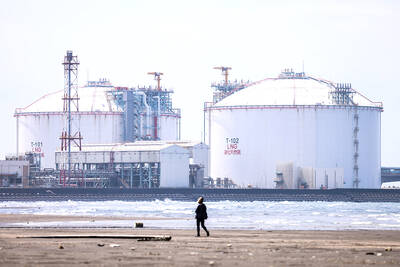
Taiwan is open to joining a global liquefied natural gas (LNG) program if one is created, but on the condition that countries provide delivery even in a scenario where there is a conflict with China, an energy department official said yesterday. While Taiwan’s priority is to have enough LNG at home, the nation is open to exploring potential strategic reserves in other countries such as Japan or South Korea, Energy Administration Deputy Director-General Chen Chung-hsien (陳崇憲) said. While the LNG market does not have a global reserve for emergencies like that of oil, the concept has been raised a few times —


 RSS
RSS