


US Federal Reserve Chair Jerome Powell’s review of internal rules around investments by policymakers is a move in the right direction, but will not stem pressure for more accountability at the US central bank.
“It’s about time,” Roberto Perli, a partner at Cornerstone Macro LLC, said of a Fed statement on Thursday that Powell had ordered a “fresh and comprehensive” study of the ethics rules around permissible financial holdings and activities by senior Fed officials.
“The impression that it gives about the institution is just poor. So yes, it should be changed,” he said.
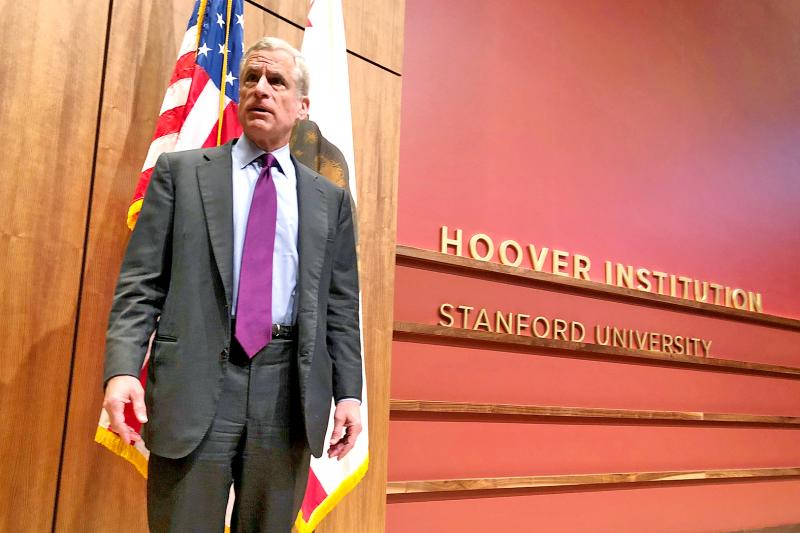
Photo: Reuters
Powell’s move followed revelations last week over investments and trading by two of the central bank’s regional bank presidents. Their actions were criticized for potential conflict of interest at a time when the Fed is under fire for emergency COVID-19 pandemic policies that critics say have elevated stock prices and benefited the wealthy.
Boston Fed President Eric Rosengren and Dallas’ Robert Kaplan on Thursday last week said that they would sell their individual stock holdings by Sept. 30.
Both said that their transactions complied with Fed ethics rules and that they were acting to avoid even the appearance of a conflict of interest.
Critics said the situation should never have arisen in the first place.
“I fear that the Kaplan and Rosengren trades have undermined the Fed’s policy legitimacy, something vital to its ability to succeed at its legislative mandates,” said Peter Conti-Brown, a University of Pennsylvania Wharton School professor of legal studies. “An ethics review is a good start. It cannot be the end.”
The considerable wealth of some US policymakers highlighted in their financial disclosures was also seen as an issue by Benjamin Dulchin, director of the Fed Up campaign at the Center for Popular Democracy.
“The bigger problem is how asset-wealthy the majority of the Fed’s leaders are, and how that creates a natural assumption for them that what’s good for Wall Street is good for the country,” he said. “The Fed can’t prohibit wealthy people from serving in Fed leadership, but the Fed absolutely can implement policies to make their leadership more diverse.”
Greater diversity among top central bankers is a key demand of progressives as US President Joe Biden weighs whether to give Powell — wealthy and white — another four years when his term as Fed chair expires in February.
Critics also focused on the complex nature of the central bank’s structure.
US Senator Elizabeth Warren said in a statement on Thursday that she had written to all 12 regional Fed bosses to urge them to adopt a self-imposed ban on the ownership and trading in individual stocks by senior Fed officials and that they act “within 60 days.”
The role of the regional Fed directors was also under scrutiny. Periodic efforts to revamp the Fed system have a long history in Washington, but rarely get far.

The domestic unit of the Chinese-owned, Dutch-headquartered chipmaker Nexperia BV will soon be able to produce semiconductors locally within China, according to two company sources. Nexperia is at the center of a global tug-of-war over critical semiconductor technology, with a Dutch court in February ordering a probe into alleged mismanagement at the company. The geopolitical tussle has disrupted supply chains, with some carmakers reportedly forced to cut production due to chip shortages. Local production would allow Nexperia’s domestic arm, Nexperia Semiconductors (China) Ltd (安世半導體中國), to bypass restrictions in place since October on the supply of silicon wafers — etched with tiny components to

Singapore-based ride-hailing and delivery giant Grab Holdings Ltd has applied for regulatory approval to acquire the Taiwan operations of Germany-based Delivery Hero SE's Foodpanda in a deal valued at about US$600 million. Grab submitted the filing to the Fair Trade Commission on Friday last week, with the transaction subject to regulatory review and approval, the company said in a statement yesterday. Its independent governance structure would help foster a healthy and competitive market in Taiwan if the deal is approved, Grab said. Grab, which is listed on the NASDAQ, said in the filing that US-based Uber Technologies Inc holds about 13 percent of

Taiwan is open to joining a global liquefied natural gas (LNG) program if one is created, but on the condition that countries provide delivery even in a scenario where there is a conflict with China, an energy department official said yesterday. While Taiwan’s priority is to have enough LNG at home, the nation is open to exploring potential strategic reserves in other countries such as Japan or South Korea, Energy Administration Deputy Director-General Chen Chung-hsien (陳崇憲) said. While the LNG market does not have a global reserve for emergencies like that of oil, the concept has been raised a few times —

Taiwan Semiconductor Manufacturing Co (TSMC, 台積電) yesterday received government approval to deploy its advanced 3-nanometer (3nm) process at its second fab currently under construction in Japan, the Ministry of Economic Affairs said in a news release. The ministry green-lit the plan for the facility in Kumamoto, which is scheduled to start installing equipment and come online in 2028 with a monthly production capacity of 15,000 12-inch wafers, the ministry said. The Department of Investment Review in June 2024 authorized a US$5.26 billion investment for the facility, slated to manufacture 6- to 12nm chips, significantly less advanced than 3nm process. At a meeting with


 RSS
RSS