


Launching one of the richest individuals on Earth into orbit has proved a leap too far for insurers, who are not ready to price the risk of losing Jeff Bezos or his fellow space travelers.
Amazon CEO Bezos, a lifelong space enthusiast, has been vying with Tesla Inc CEO Elon Musk and British billionaire Richard Branson to become the first billionaire to fly beyond the Earth’s atmosphere.
While insurers are well known for offering cover for even the most outlandish of risks, at a price, potential accidents in space are not yet among them.
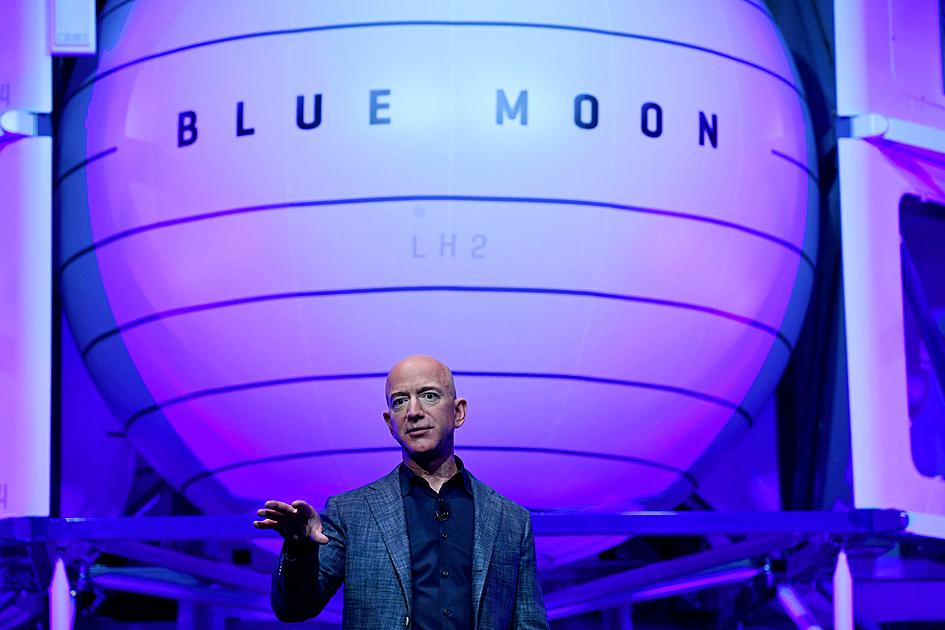
Photo: Reuters
“Space tourism involves significant risk, but is not an issue life insurers specifically ask about as yet because it is so rare for anyone to travel into space,” Insurance Information Institute spokesperson Michael Barry said.
There is a nearly US$500 million market to insure satellites, rockets and uncrewed space flight, but no legal requirement for an operator such as Blue Origin, which Bezos founded, to insure passengers for injury or death or for space tourists to have life cover, brokers and insurers said.
“We’re not aware of a case where anybody is insured against passenger liability,” said Neil Stevens, senior vice president, aviation and space at Marsh, the world’s biggest insurance broker.
Assuming they lift off as planned next month, Bezos and the other wannabe astronauts on Blue Origin’s New Shepard spacecraft would not only spend several minutes 100km above the Earth in a truck-sized capsule, they would also have to get back.
The only group that has regularly flown humans sub-orbitally since the 1960s is Branson’s Virgin Galactic. All have been tests, with one failure in 2014 resulting in a death. Blue Origin has flown 15 uncrewed sub-orbital flights with no failures, Seradata SpaceTrak data showed on June 10.
Bezos, Blue Origin and Virgin Galactic did not respond to requests for comment from Reuters on their insurance plans and flight records.
Being uninsured in space is nothing new. NASA and the US, in general, do not buy liability cover, with government launches basically insured by taxpayers, said Richard Parker of Assure Space, a unit of insurer AmTrust Financial that provides space insurance.
NASA astronauts are eligible for government life insurance programs, a NASA spokesperson said in an e-mailed response.
Charles Wetton, underwriting manager for space policies at insurer Global Aerospace, said astronauts on government-funded missions are carefully selected for their knowledge, skills and fitness and train for several years before blast off.
“They and their families understand the risks of the work they do,” Wetton said.
However, commercial space cadets may only get a few days of training for a sub-orbital flight or a few months for a ride to the International Space Station (ISS), Wetton said, adding: “These represent two very different risk profiles that insurers will take into account.”
Insurers expect ironclad waivers and contracts from commercial space travel firms, stating they will bear no burden if a passenger dies during a flight.
NASA has called for responses from the industry for its plans for a liability framework for privately funded astronaut missions to the ISS. NASA’s plans include requiring private astronauts to buy life insurance.
The only mandatory insurance in place for commercial space operators is third-party liability, mainly to cover property damage on Earth or to a flying aircraft, said Akiko Hama, client executive, space and aerospace underwriting at Global Aerospace.
A key question for how the sector develops is whether risks related to tourism fall under space or aviation insurance lines, insurers and brokers said.
The UN Outer Space Treaty and the Liability Convention of 1972 governs all activities in space and very few countries have a legal framework for commercial human spaceflight, they said.
“The aviation, aircraft insurance market, and the like, are less keen to take on risks that involve spacecraft,” Stevens said, adding that whether space tourism trips fall under aviation or space insurance is a “million dollar question.”


The domestic unit of the Chinese-owned, Dutch-headquartered chipmaker Nexperia BV will soon be able to produce semiconductors locally within China, according to two company sources. Nexperia is at the center of a global tug-of-war over critical semiconductor technology, with a Dutch court in February ordering a probe into alleged mismanagement at the company. The geopolitical tussle has disrupted supply chains, with some carmakers reportedly forced to cut production due to chip shortages. Local production would allow Nexperia’s domestic arm, Nexperia Semiconductors (China) Ltd (安世半導體中國), to bypass restrictions in place since October on the supply of silicon wafers — etched with tiny components to

Taiwan’s foreign exchange reserves fell below the US$600 billion mark at the end of last month, with the central bank reporting a total of US$596.89 billion — a decline of US$8.6 billion from February — ending a three-month streak of increases. The central bank attributed the drop to a combination of factors such as outflows by foreign institutional investors, currency fluctuations and its own market interventions. “The large-scale outflows disrupted the balance of supply and demand in the foreign exchange market, prompting the central bank to intervene repeatedly by selling US dollars to stabilize the local currency,” Department of Foreign
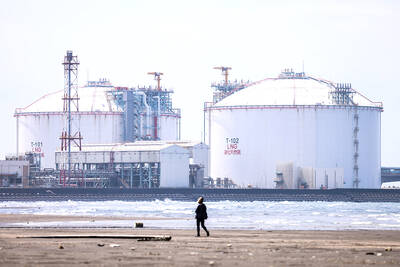
Taiwan is open to joining a global liquefied natural gas (LNG) program if one is created, but on the condition that countries provide delivery even in a scenario where there is a conflict with China, an energy department official said yesterday. While Taiwan’s priority is to have enough LNG at home, the nation is open to exploring potential strategic reserves in other countries such as Japan or South Korea, Energy Administration Deputy Director-General Chen Chung-hsien (陳崇憲) said. While the LNG market does not have a global reserve for emergencies like that of oil, the concept has been raised a few times —
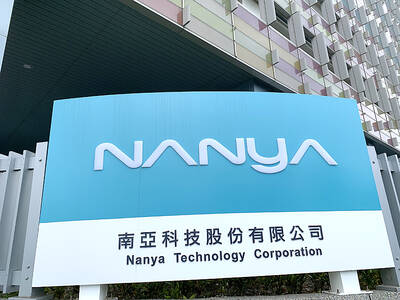
AI-FUELED DEMAND: The company has been benefiting from the skyrocketing prices for DRAM chips amid the AI frenzy, especially its core product — DDR4 DRAM chips DRAM chipmaker Nanya Technology Corp (南亞科技) yesterday reported that its revenue for the first quarter surged 582.91 percent to NT$49.09 billion (US$1.54 billion) from NT$7.19 billion a year earlier, as the supply crunch caused chip price spikes. Last quarter’s figure is the highest on record. On a quarterly basis, revenue jumped 63.14 percent from NT$30.09 billion, the company said. In January, Nanya Technology expected global DRAM supply scarcity to continue through the first half of 2028, thanks to strong demand for artificial intelligence (AI) applications. Market researcher TrendForce Corp (集邦科技) forecast prices of standard DRAM chips would rise between 58 percent and 63


 RSS
RSS