


Foxconn Technology Group (富士康科技集團) is in talks to buy a stake in Malaysian technology firm Dagang NeXchange Bhd (DNeX) after losing to it in bidding for a semiconductor company, people familiar with the matter said.
The main assembler of Apple Inc’s iPhones could take a minority stake in DNeX and help to expand the business of its chipmaker, SilTerra Malaysia Sdn, one of the people said, asking not to be identified as the matter is private.
DNeX in February landed the winning offer in the sale of SilTerra, outbidding Foxconn.
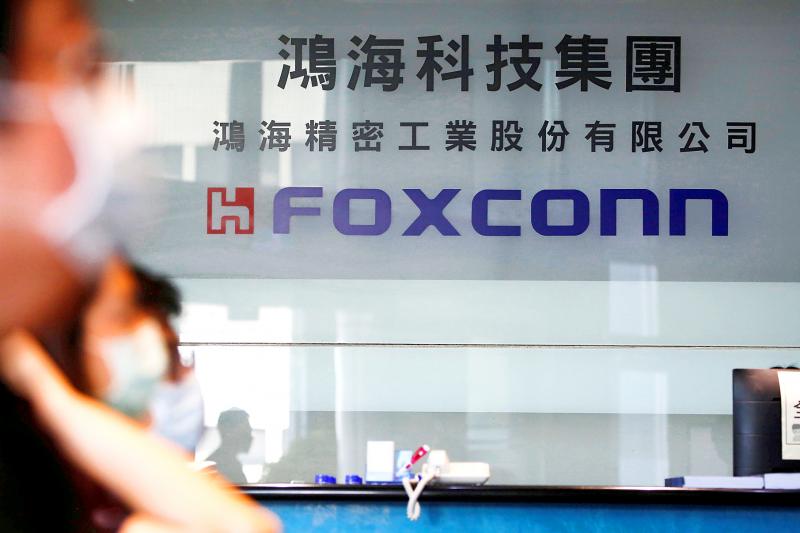
Photo: Ann Wang, Reuters
Talks are ongoing and could fall apart, and there is no certainty that a deal would materialize, the people said.
A representative for DNeX said that the company is always open to discussion with strategic partners and investors, but that it cannot comment on any specific discussion.
A Foxconn representative declined to comment.
Shares in DNeX rose as much as 13.6 percent in Kuala Lumpur following the Bloomberg News report, their highest intraday level in more than a month, giving the company a market value of about US$474 million.
A stake sale would come as the Taiwanese electronics manufacturer, whose primary listed arm is Hon Hai Precision Industry Co (鴻海精密), has been growing its footprint in electric vehicles (EV), issuing a steady stream of announcements beginning with the unveiling of its first-ever EV chassis and a software platform in October last year.
Since then, the company has struck agreements with Chinese firms Zhejiang Geely Holding Group Co (浙江吉利控股) and Byton Ltd (拜騰), the US’ Fisker Inc and European giant Stellantis NV.
DNeX and a Chinese investor won their bid to purchase SilTerra from Malaysian sovereign wealth fund Khazanah Nasional Bhd for 273 million ringgit (US$66 million).
Hon Hai chairman Young Liu (劉揚偉) later told reporters that the company still wanted to secure a partnership with SilTerra.
DNeX has received shareholder approval for a private placement of as much as 30 percent of its shares and will use the proceeds to pay for the SilTerra deal as well as other investments, it said in a statement on Thursday last week.
The Malaysian tech company will acquire 60 percent of SilTerra, while its partner in the deal, Beijing Integrated Circuit Advanced Manufacturing (北京集成電路先進製造) and the High-End Equipment Equity Investment Fund Center (高端設備股權投資基金中心) would buy the remaining 40 percent, it said.
Established in 1970, DNeX’s businesses include information technology and undersea cables for telecommunications, as well as an oil and gas unit, its Web site says.

The domestic unit of the Chinese-owned, Dutch-headquartered chipmaker Nexperia BV will soon be able to produce semiconductors locally within China, according to two company sources. Nexperia is at the center of a global tug-of-war over critical semiconductor technology, with a Dutch court in February ordering a probe into alleged mismanagement at the company. The geopolitical tussle has disrupted supply chains, with some carmakers reportedly forced to cut production due to chip shortages. Local production would allow Nexperia’s domestic arm, Nexperia Semiconductors (China) Ltd (安世半導體中國), to bypass restrictions in place since October on the supply of silicon wafers — etched with tiny components to

Singapore-based ride-hailing and delivery giant Grab Holdings Ltd has applied for regulatory approval to acquire the Taiwan operations of Germany-based Delivery Hero SE's Foodpanda in a deal valued at about US$600 million. Grab submitted the filing to the Fair Trade Commission on Friday last week, with the transaction subject to regulatory review and approval, the company said in a statement yesterday. Its independent governance structure would help foster a healthy and competitive market in Taiwan if the deal is approved, Grab said. Grab, which is listed on the NASDAQ, said in the filing that US-based Uber Technologies Inc holds about 13 percent of

Taiwan Semiconductor Manufacturing Co (TSMC, 台積電) yesterday received government approval to deploy its advanced 3-nanometer (3nm) process at its second fab currently under construction in Japan, the Ministry of Economic Affairs said in a news release. The ministry green-lit the plan for the facility in Kumamoto, which is scheduled to start installing equipment and come online in 2028 with a monthly production capacity of 15,000 12-inch wafers, the ministry said. The Department of Investment Review in June 2024 authorized a US$5.26 billion investment for the facility, slated to manufacture 6- to 12nm chips, significantly less advanced than 3nm process. At a meeting with

Taiwan’s food delivery market could undergo a major shift if Singapore-based Grab Holdings Ltd completes its planned acquisition of Delivery Hero SE’s Foodpanda business in Taiwan, industry experts said. Grab on Monday last week announced it would acquire Foodpanda’s Taiwan operations for US$600 million. The deal is expected to be finalized in the second half of this year, with Grab aiming to complete user migration to its platform by the first half of next year. A duopoly between Uber Eats and Foodpanda dominates Taiwan’s delivery market, a structure that has remained intact since the Fair Trade Commission (FTC) blocked Uber Technologies Inc’s


 RSS
RSS