


The Ministry of Economic Affairs (MOEA) yesterday dismissed reports that the government is planning to replace the third liquified natural gas (LNG) terminal project in Taoyuan with an LNG terminal in Yunlin County’s Mailiao Township (麥寮).
The Chinese-language United Daily News yesterday cited “senior MOEA staff” as saying that President Tsai Ing-wen (蔡英文) had asked Formosa Plastics Group (FPG, 台塑集團) chairman William Wong (王文淵) if the construction of an LNG terminal in Mailiao could be sped up.
The environmental group Air Clean Taiwan also held a press conference yesterday at the Legislative Yuan calling for the swift construction of an LNG terminal in Mailiao to “save the algal reefs and the health of all Taiwanese.”
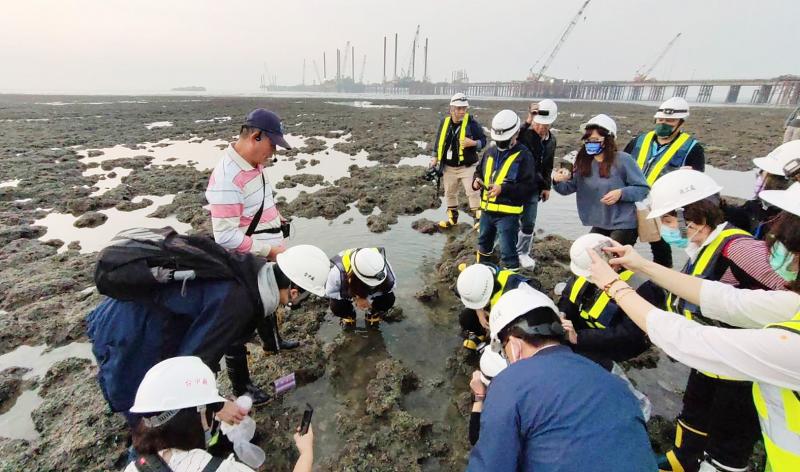
Photo: Cheng Shu-ting, Taipei Times
Minister of Economic Affairs Wang Mei-hua (王美花) said that it is “impossible” for an LNG terminal in Mailiao to replace the proposed third LNG terminal off the coast of Datan Borough (大潭) in Taoyuan’s Guanyin District (觀音).
“Without an environmental impact assessment or agreement from local authorities, an LNG terminal at Mailiao is at least six years away,” Wang said.
“Mailiao is also 180km from the Datan Power Plant where the gas is needed. From previous experience, we know that those pipelines take a long time to build,” she said.
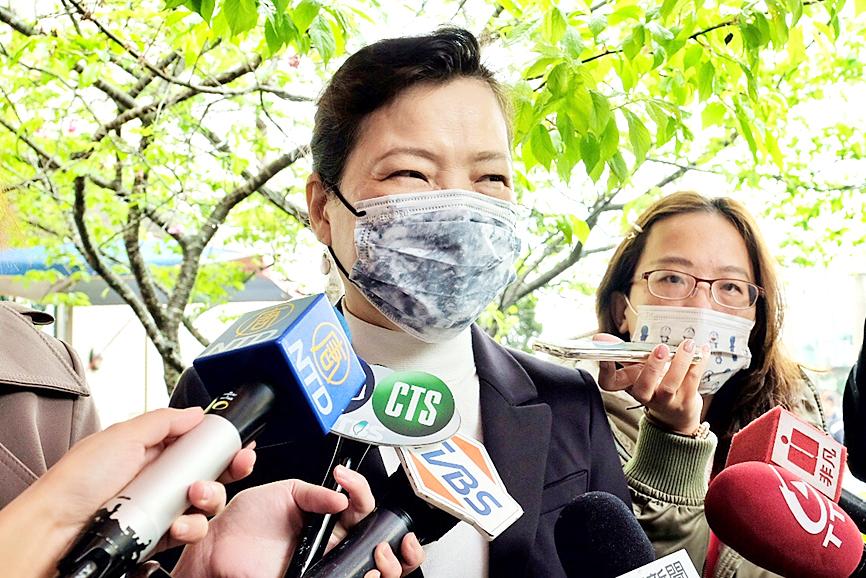
Photo: CNA
Wang said the ministry would “heartily approve” the construction of an LNG power plant and receiving terminal at Mailiao, not to replace the third LNG terminal, but to replace coal-fired plants, which release far more pollutants into the air.
“If we can build an LNG power plant in Mailiao and replace existing coal-fired plants, that would help greatly in our goal of reducing the use of coal and air pollution,” Wang said. “We will be happy to assist FPG in such a project.”
The planned third LNG terminal became controversial after environmental groups started a petition for a referendum blocking its construction in order to protect “algal reefs that are more than 7,500 years old” off Datan.
Taiwanese voters will go to the polls on Aug. 28 to decide the fate of the third LNG terminal. There are to be three other referendums on the ballot, including one calling for the mothballed Fourth Nuclear Power Plant to be activated.
According to the Referendum Act (公民投票法), 25 percent of registered voters must vote “yes” to a proposal, with the “yes” votes outnumbering the “no” votes for the proposal to pass.

Cairo’s new monorail slices across the city skyline, running above the familiar chaos of blaring horns and aging buses’ exhaust fumes that mark rush hour below. The US$4.5 billion monorail, opened this month, is among Egypt’s most prominent new transport projects, part of a debt-funded infrastructure drive criticized for sapping state finances while bringing limited benefits to most of the country’s 109 million people. “It feels like you’re in a different country,” said Ramy Sayed, a restaurant manager, aboard a driverless Innovia 300 train. “No noise, no traffic, we’re not used to this.” The eastern line runs 56km from the bustling middle-class

Taiwanese firms have increased investment in the Philippines in recent years as Manila’s ties with Washington deepen and global supply chains continue to shift away from China, an expert at the Chung-Hua Institution for Economic Research (CIER, 中華經濟研究院) said yesterday. The Philippines had not been among Taiwanese investors’ top choices in Southeast Asia, CIER Taiwan ASEAN Studies Center director Kristy Hsu (徐遵慈) said at a seminar in Taipei. However, Taiwan’s investment in the country has grown significantly since the COVID-19 pandemic, reaching US $257 million last year, a high in recent years, she said. Although Taiwan’s total investment in the Philippines still lags

Intel Corp regards Taiwan Semiconductor Manufacturing Co (TSMC, 台積電) as a longstanding partner, as the US chipmaker would continue outsourcing production of advanced chips to TSMC, Intel chief executive officer Lip-Bu Tan (陳立武) said yesterday. “I don’t look at people as competitors. I look at the collaboration... Nvidia is also, you know, a good friend,” Tan told a news conference following his keynote speech at the Computex trade show in Taipei. “It’s a very trusted partnership for us... We are a big, top customer for them, and we’re going to continue doing that,” he said, referring to TSMC, the world’s largest foundry

Artificial intelligence (AI) agents would supplant smartphones as the center of people’s digital lives, fundamentally reshaping personal devices and driving a major computing upgrade cycle, Qualcomm Inc CEO Cristiano Amon said yesterday. In his keynote speech for this year’s Computex trade show in Taipei, Amon said that the rise of "agentic AI" — AI systems capable of reasoning, planning and carrying out tasks autonomously — would transform how people interact with technology across phones, PCs, vehicles and wearable devices. Describing the technology as the next major evolution in computing, Amon said that "2026 is the year of agents.” For decades, smartphones have sat


 RSS
RSS