


Ken Kutaragi, the legendary inventor of the PlayStation gaming console, is taking on one of the hardest jobs in robotics — and he is getting paid nothing to do it.
The founder of Sony Corp’s gaming business is the new CEO of Ascent Robotics Inc, a Tokyo-based artificial intelligence (AI) start-up.
Kutaragi, 70, wants to make affordable robots that can safely move around and do physical work alongside humans in factories and logistics centers, and aims to have a working prototype in about a year.
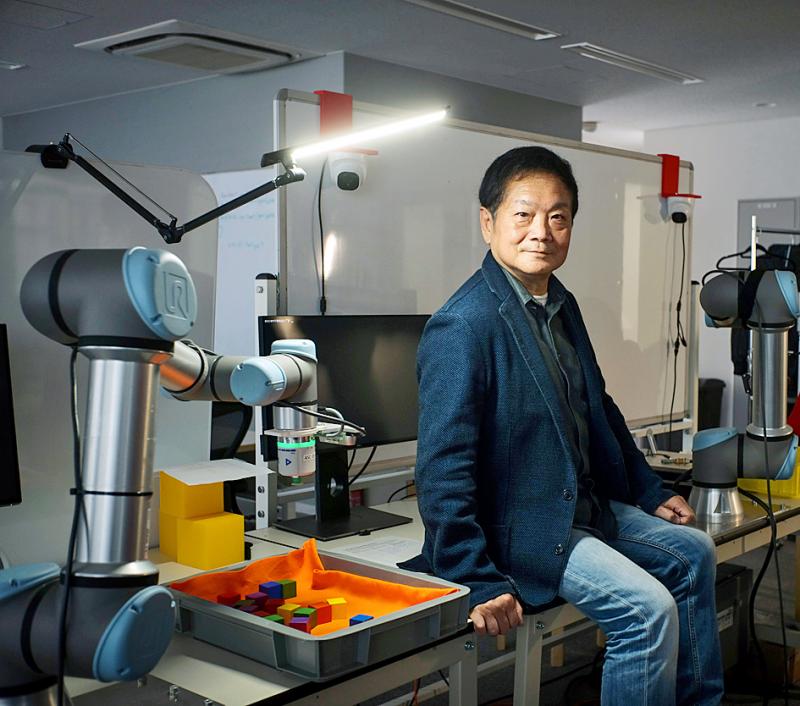
Photo: Bloomberg
He receives no salary to save precious capital, he said.
“The COVID-19 outbreak has turned the old argument about robots taking our jobs on its head,” Kutaragi said in his first interview since taking the helm in August. “It’s pretty clear now that if we want to arrive at a new normal, we need more and more robots in our daily lives.”
The industry veteran is vague about how he plans to accomplish this, other than to say that partnerships would be key to moving forward.
Ascent has worked with Kawasaki Heavy Industries Ltd on a robotic arm that can pick parts out of a jumble using a single camera as input.
It is also developing autonomous driving software in collaboration with an unnamed Japanese automaker. The company uses a combination of data from sensor-studded Lexus hybrids cruising Tokyo’s streets and simulations where the algorithms are trained to handle so-called edge-case scenarios.
The challenge is that he is trying to combine two technologies that have so far overpromised and under-delivered: autonomous driving and collaborative robots.
The biggest industrial automation companies, including Fanuc Corp, ABB Ltd and Kuka AG, have struggled to grow the market for machines that can work alongside humans. At the same time, vehicles that can drive themselves seem to be perennially just over the horizon.
“If you are looking to combine robotics and mobility, you need someone in charge who understands technology,” Kutaragi said. “We are thinking globally, not limiting our sights to Japan.”
Kutaragi has a track record of solving difficult technical and business problems. He started his career at Sony in the 70s, working on some of the electronics giant’s most successful projects, including LCDs and digital cameras.
In the 90s, he revolutionized video gaming by pioneering the loss-leader model of spending billions on developing cutting-edge hardware and then recouping costs through content licensing deals.
Kutaragi also demonstrated a keen sense of technology trends, famously shipping the PlayStation 2 with a DVD player and spurring the adoption of the new laser disc technology.
Since leaving Sony in 2007, he has sat on the boards of e-commerce giant Rakuten Inc, app developer SmartNews Inc and GA Technologies, which runs an AI-powered real-estate listings Web site.
Kutaragi has served as Ascent’s outside board director since 2018 and took over as CEO on Aug. 26. He owns about 22 percent of the company, which he acquired from founder Fred Almeida, who has left the start-up.
Masayuki Ishizaki, who preceded Kutaragi as CEO, has become the company’s chief operating officer.
Founded in 2016, Ascent has raised about US$18 million and employs about 50 engineers, most of whom are foreigners. Kutaragi declined to say how much runway the company has left and whether it plans additional financing.
“If we don’t do it, someone else out there will,” Kutaragi said. “Management is tough, but that’s how it was with PlayStation, too. It’s something I’m good at.”
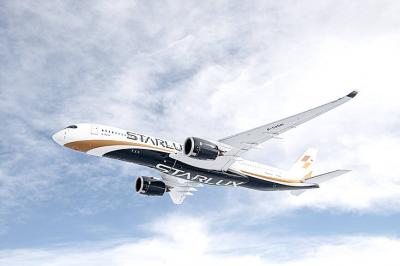
Starlux Airlines Co (星宇航空) today unveiled a long-haul network expansion plan at a shareholders’ meeting in Taipei, including direct flights to Barcelona, Spain, and Zurich, Switzerland, as well as a service connecting Taipei, Sydney and New Zealand. Starlux is to become the first Taiwanese carrier to offer non-stop services to the two European cities, while the inaugural oceanic route is expected to expand transit opportunities within the Australia-New Zealand market, Starlux said. Flight services to Chicago, Dallas, Washington and New York are under evaluation, the airline added. Prior to the shareholders’ meeting, the airline earlier this year announced that it would be

Cairo’s new monorail slices across the city skyline, running above the familiar chaos of blaring horns and aging buses’ exhaust fumes that mark rush hour below. The US$4.5 billion monorail, opened this month, is among Egypt’s most prominent new transport projects, part of a debt-funded infrastructure drive criticized for sapping state finances while bringing limited benefits to most of the country’s 109 million people. “It feels like you’re in a different country,” said Ramy Sayed, a restaurant manager, aboard a driverless Innovia 300 train. “No noise, no traffic, we’re not used to this.” The eastern line runs 56km from the bustling middle-class

Netherlands-based semiconductor equipment supplier ASML Holding NV yesterday said that it is planning to hire an additional 1,000 people in Taiwan this year in response to growing demand from clients. ASML had previously planned to recruit 600 people this year, but that the plan has been adjusted upward, ASML vice president and ASML Taiwan general manager Grace Wang (汪佳慧) told reporters. ASML has a workforce of more than 4,500 in Taiwan, accounting for about 10 percent of its global total, Wang said. This year’s recruitment campaign would focus on adding people in the customer support, manufacturing and supply chain domains to assist ASML

Nvidia Corp yesterday announced that CEO Jensen Huang (黃仁勳) would attend an employee meeting in Taipei tomorrow to celebrate the launch of the company’s Taiwan headquarters project. Huang would attend a gathering at the site of Nvidia’s planned headquarters in Beitou Shilin Technology Park (北投士林科技園區), the company said in a statement. After arriving in Taiwan on Saturday last week, Huang told reporters that he plans to meet with Quanta Computer Inc (廣達) chairman Barry Lam (林百里) and Taiwan Semiconductor Manufacturing Co (TSMC, 台積電) chairman C.C. Wei (魏哲家), and would attend the groundbreaking ceremony for Nvidia’s Taiwan headquarters tomorrow. Nvidia has not yet applied


 RSS
RSS