


Alphabet Inc’s Google is reportedly seekig to buy a plot in Yunlin County to build a new data center, local media reports said yesterday, without citing sources.
Google currently has two data centers already in Asia, one in Singapore and one in Changhua county, Taiwan.
Earlier yesterday, the Chinese-language Economic Daily News cited unnamed county officials as saying that Google had bought a NT$3.64 billion (US$123.33 million) plot at the Yunlin Technology-based Industrial Park (雲林科技工業區).

Photo: AFP
As of press time last night, Google, the county government and China Man-made Fiber Corp (中國人造纖維), the seller of the property, had not made official comments.
The Ministry of Economic Affairs said it would not comment on the investments of individual companies.
“Google’s official response is that they do not comment on this,” Jonathan Seidman of One for All, Google’s public relations agency for Taiwan, said in an e-mailed statement to the Taipei Times.
A regulatory filing by China Man-made Fiber on Wednesday last week said that the 60,000-ping (198,347m2) plot, which consisted of six parcels of land, was sold to Beckett Enterprises LLC.
The Chinese-language Liberty Times (the sister newspaper of the Taipei Times) yesterday quoted Yunlin Technology-based Industrial Park chairman Andy Su (蘇振毅) as saying that “a global, heavyweight tech company” had been at the park to assess its suitability, including its geological structure.
Asked if the buyer was Google, Su told the Liberty Times that he could not answer because of confidentiality reasons.
The report also quoted Yunlin County Commissioner Chang Li-shan (張麗善) as saying that confidentiality agreements might prevent relevant parties from announcing their part in the deal until all the deeds have been transferred.
She added that Yunlin welcomes all investors, the report said.
Google’s potential investment in a new data center, if confirmed, could be as high as NT$20 billion, local media quoted industry sources as saying.
CORRECTION: This story has been modified since it was first published, which incorrectly stated that Google has two data centers in Taiwan. The search engine giant only operates one in the nation’s Changhua County.
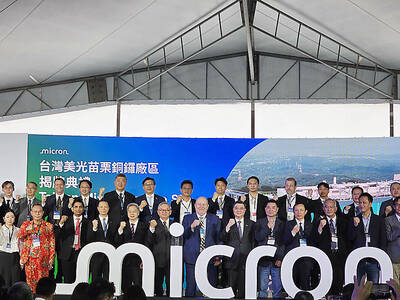
UNPRECEDENTED PACE: Micron Technology has announced plans to expand manufacturing capabilities with the acquisition of a new chip plant in Miaoli Micron Technology Inc unveiled a newly acquired chip plant in Miaoli County yesterday, as the company expands capacity to meet growing demand for advanced DRAM chips, including high-bandwidth memory chips amid the artificial intelligence boom. The plant in Miaoli County’s Tongluo Township (銅鑼), which Micron acquired from Powerchip Semiconductor Manufacturing Corp (力積電) for US$1.8 billion, is expected to make a sizeable capacity contribution to the company from fiscal 2028, the company said in a statement. It would be an extended production site of Micron’s large-scale manufacturing hub in Taichung, the company said. As the global semiconductor industry is racing to reach US$1 trillion

Singapore-based ride-hailing and delivery giant Grab Holdings Ltd has applied for regulatory approval to acquire the Taiwan operations of Germany-based Delivery Hero SE's Foodpanda in a deal valued at about US$600 million. Grab submitted the filing to the Fair Trade Commission on Friday last week, with the transaction subject to regulatory review and approval, the company said in a statement yesterday. Its independent governance structure would help foster a healthy and competitive market in Taiwan if the deal is approved, Grab said. Grab, which is listed on the NASDAQ, said in the filing that US-based Uber Technologies Inc holds about 13 percent of

Taiwan’s food delivery market could undergo a major shift if Singapore-based Grab Holdings Ltd completes its planned acquisition of Delivery Hero SE’s Foodpanda business in Taiwan, industry experts said. Grab on Monday last week announced it would acquire Foodpanda’s Taiwan operations for US$600 million. The deal is expected to be finalized in the second half of this year, with Grab aiming to complete user migration to its platform by the first half of next year. A duopoly between Uber Eats and Foodpanda dominates Taiwan’s delivery market, a structure that has remained intact since the Fair Trade Commission (FTC) blocked Uber Technologies Inc’s

Memory chip stocks extended their losses yesterday after Alphabet Inc’s Google publicized research that could allow more efficient use of the storage needed for artificial intelligence (AI) development. SK Hynix Inc and Samsung Electronics Co, South Korean leaders in the market, fell more than 6 percent and about 5 percent respectively in Seoul. In the US, Micron Technology Inc, Western Digital Corp and Sandisk Corp slid more than 2 percent in pre-market trading, after they all closed lower on Wednesday. Memory companies have been on a tear in recent months as the rapid development of AI infrastructure triggered a spike in chip


 RSS
RSS