


An Indian court has summoned Alibaba Group Holding Ltd (阿里巴巴) and its founder Jack Ma (馬雲) in a case in which a former employee in India said he was wrongfully fired after objecting to what he saw as censorship and fake news on company apps, documents seen by Reuters showed.
The case comes weeks after India cited security concerns in banning Alibaba’s UC News, UC Browser and 57 other Chinese apps, after a clash between the two countries’ forces on their border.
Following the ban, which China has criticized, India sought written answers from all affected companies, including whether they censored content or acted for any foreign government.
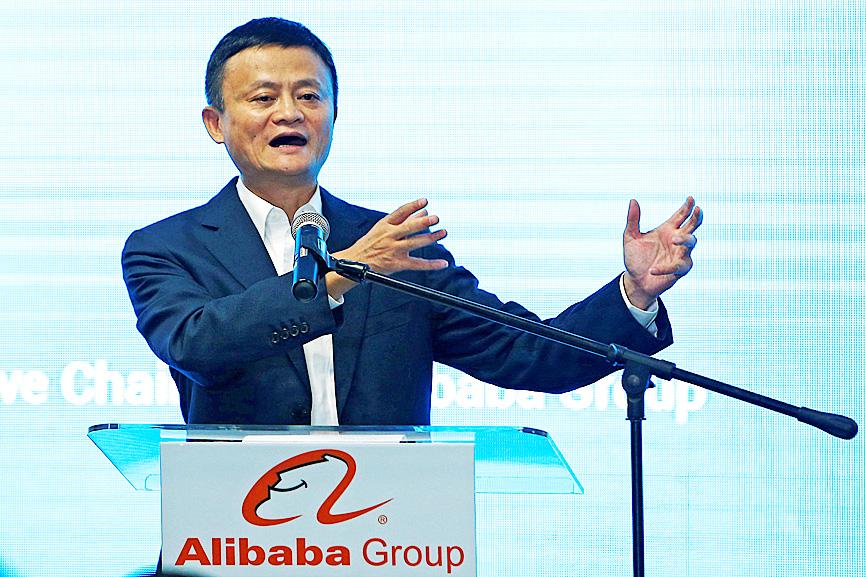
Photo: Reuters
In court filings dated Monday last week and previously not reported, the former employee of Alibaba’s UC Web, Pushpandra Singh Parmar, said that the company used to censor content seen as unfavorable to China, and its apps UC Browser and UC News showcased false news “to cause social and political turmoil.”
Civil Judge Sonia Sheokand of a district court in Gurugram, a satellite city of India’s capital, New Delhi, has issued summonses for Alibaba, Ma and about a dozen individuals or company units, asking them to appear in court or through a lawyer on Wednesday, court documents showed.
The judge has also sought written responses from the company and its executives within 30 days, the summonses showed.
UC India said in a statement that it had been “unwavering in its commitment to the Indian market and the welfare of its local employees, and its policies are in compliance with local laws. We are unable to comment on ongoing litigation.”
Alibaba representatives did not respond to requests for comment from the Chinese company or on behalf of Ma.
Parmar, who worked as an associate director at the UC Web office in Gurugram until October 2017 and is seeking US$268,000 in damages, referred reporters’ queries to his lawyer, Atul Ahlawat, who declined to comment, saying the matter was sub judice.
The court case is the latest hurdle for Alibaba in India after the Indian government’s app ban, following which UC Web has started laying off some staff in India.
Before the apps were banned, the UC Browser had been downloaded at least 689 million times in India, while UC News had 79.8 million downloads — most during 2017 and 2018, data from analytics firm Sensor Tower showed.
India has said that it banned the 59 apps after it received “credible inputs” that such apps posed a threat to India’s sovereignty.
Indian Minister of Electronics and Information Technology Ravi Shankar Prasad said the decision was taken to safeguard citizens’ data and public order.
In more than 200 pages of court filings, former employee Parmar included clippings of some posts showcased on the UC News app that he alleged were false.
One post from 2017 was headlined in Hindi: “2,000-rupee notes to be banned from midnight today.” Another headline of a 2018 post said: “Just now: War broke out between India and Pakistan” and contained a description of firing across the disputed border between the countries.
Reuters could not independently verify the veracity of the claims in the court filing.
India did not ban its 2,000-rupee currency note and no war occurred between India and Pakistan in 2018.
The lawsuit also contains a “sensitive words list” with keywords in Hindi and English such as “India-China border” and “Sino-India war” that the court filing alleges were used by UC Web to censor content on its platforms in India.
“In order to control any news, related content to be published against China was automatically/manually rejected by an audit system evolved for this purpose,” the filing said.
The Chinese Embassy in New Delhi, the Chinese Ministry of Foreign Affairs and the Indian Ministry of Electronics and Information Technology did not respond to requests for comment.

The domestic unit of the Chinese-owned, Dutch-headquartered chipmaker Nexperia BV will soon be able to produce semiconductors locally within China, according to two company sources. Nexperia is at the center of a global tug-of-war over critical semiconductor technology, with a Dutch court in February ordering a probe into alleged mismanagement at the company. The geopolitical tussle has disrupted supply chains, with some carmakers reportedly forced to cut production due to chip shortages. Local production would allow Nexperia’s domestic arm, Nexperia Semiconductors (China) Ltd (安世半導體中國), to bypass restrictions in place since October on the supply of silicon wafers — etched with tiny components to

Singapore-based ride-hailing and delivery giant Grab Holdings Ltd has applied for regulatory approval to acquire the Taiwan operations of Germany-based Delivery Hero SE's Foodpanda in a deal valued at about US$600 million. Grab submitted the filing to the Fair Trade Commission on Friday last week, with the transaction subject to regulatory review and approval, the company said in a statement yesterday. Its independent governance structure would help foster a healthy and competitive market in Taiwan if the deal is approved, Grab said. Grab, which is listed on the NASDAQ, said in the filing that US-based Uber Technologies Inc holds about 13 percent of

Taiwan Semiconductor Manufacturing Co (TSMC, 台積電) yesterday received government approval to deploy its advanced 3-nanometer (3nm) process at its second fab currently under construction in Japan, the Ministry of Economic Affairs said in a news release. The ministry green-lit the plan for the facility in Kumamoto, which is scheduled to start installing equipment and come online in 2028 with a monthly production capacity of 15,000 12-inch wafers, the ministry said. The Department of Investment Review in June 2024 authorized a US$5.26 billion investment for the facility, slated to manufacture 6- to 12nm chips, significantly less advanced than 3nm process. At a meeting with

Taiwan’s food delivery market could undergo a major shift if Singapore-based Grab Holdings Ltd completes its planned acquisition of Delivery Hero SE’s Foodpanda business in Taiwan, industry experts said. Grab on Monday last week announced it would acquire Foodpanda’s Taiwan operations for US$600 million. The deal is expected to be finalized in the second half of this year, with Grab aiming to complete user migration to its platform by the first half of next year. A duopoly between Uber Eats and Foodpanda dominates Taiwan’s delivery market, a structure that has remained intact since the Fair Trade Commission (FTC) blocked Uber Technologies Inc’s


 RSS
RSS