


The controversial Tuofu Bao (託付寶) investment service, relaunched by Jko Fintech Co (街口金融科技) on Monday, has been suspended over claims that the service provides a minimum rate of return, the Financial Supervisory Commission (FSC) said yesterday.
Tuofu Bao allows people to use the electronic payment service of Jkopay Co Ltd (街口支付), fully owned by Jko Fintech, to buy into the “JKO Multi-Asset Fund,” which is managed by Jko Asset Management Co (街口投信).
Jko Fintech chairman Kevin Hu (胡亦嘉) has said that the investment service would generate a return of 1.2 to 2.5 percent.
Photo: Chen Ping-hung, Taipei Times
“Although Jko stressed that it did not offer any guaranteed returns and its expectations are calculated based on its own algorithms, we still have doubts about its claims,” Securities and Futures Bureau Deputy Director-General Tsai Li-ling (蔡麗玲) told a news conference in Taipei.
“Telling investors that they are likely to gain at least 1.2 percent return sounds similar to offering guaranteed returns. Jko apparently misleads its investors,” Tsai added.
Another controversial part of the service is its redemption policy, Tsai said.
Jko Fintech asks investors to agree that when they sell their fund units, the redemption amount would be based on its own algorithms and not the net value of the fund, Tsai said.
The commission would ask the companies to explain the algorithms to see how they work, Tsai said, adding that they should not manipulate algorithms to give a minimum rate of return.
The bureau on Wednesday barred Jko Asset Management from accepting any new capital through Tuofu Bao until the issue is resolved Tsai said.
The fund’s custodian bank, state-run Chang Hwa Bank (彰化銀行), has refused to hold NT$150 million (US$5.1 million) in new investments the service had attracted from 5,000 investors since Monday, Tsai said, adding that Jko must refund the money to investors.
“Although Jko Fintech expects to sidestep FSC regulation, as it is not a financial company, the commission could still address the matter by regulating Jko Asset,” FSC Deputy Chairman Jean Chiu (邱淑貞) said.
Jko Asset has an obligation to ensure the services offered by its partners are legal and compliant, even though the company is 25 percent owned by Jko Fintech, Chiu said.
The commission suggested that the companies apply to enter into the FSC’s regulatory sandbox, where they could conduct an experiment to see if their innovative business model works smoothly, Tsai said.
Hu yesterday told the Taipei Times by telephone that he would continue discussions with the FSC to win approval to offer the financial service.
“I think there are some misunderstandings in our previous communications ... so we are willing to suspend our service to show our sincerity,” Hu said.
The company would soon revise its documentation to prevent any misunderstanding of a guaranteed return, he said.
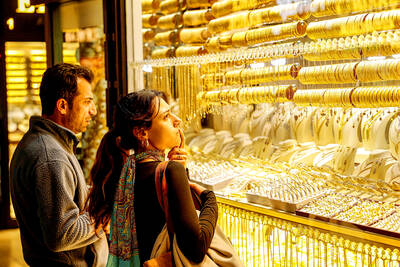
In Italy’s storied gold-making hubs, jewelers are reworking their designs to trim gold content as they race to blunt the effect of record prices and appeal to shoppers watching their budgets. Gold prices hit a record high on Thursday, surging near US$5,600 an ounce, more than double a year ago as geopolitical concerns and jitters over trade pushed investors toward the safe-haven asset. The rally is putting undue pressure on small artisans as they face mounting demands from customers, including international brands, to produce cheaper items, from signature pieces to wedding rings, according to interviews with four independent jewelers in Italy’s main
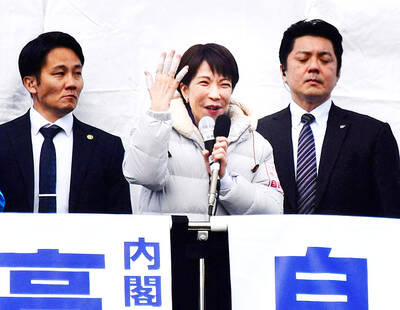
Japanese Prime Minister Sanae Takaichi has talked up the benefits of a weaker yen in a campaign speech, adopting a tone at odds with her finance ministry, which has refused to rule out any options to counter excessive foreign exchange volatility. Takaichi later softened her stance, saying she did not have a preference for the yen’s direction. “People say the weak yen is bad right now, but for export industries, it’s a major opportunity,” Takaichi said on Saturday at a rally for Liberal Democratic Party candidate Daishiro Yamagiwa in Kanagawa Prefecture ahead of a snap election on Sunday. “Whether it’s selling food or

CONCERNS: Tech companies investing in AI businesses that purchase their products have raised questions among investors that they are artificially propping up demand Nvidia Corp chief executive officer Jensen Huang (黃仁勳) on Saturday said that the company would be participating in OpenAI’s latest funding round, describing it as potentially “the largest investment we’ve ever made.” “We will invest a great deal of money,” Huang told reporters while visiting Taipei. “I believe in OpenAI. The work that they do is incredible. They’re one of the most consequential companies of our time.” Huang did not say exactly how much Nvidia might contribute, but described the investment as “huge.” “Let Sam announce how much he’s going to raise — it’s for him to decide,” Huang said, referring to OpenAI
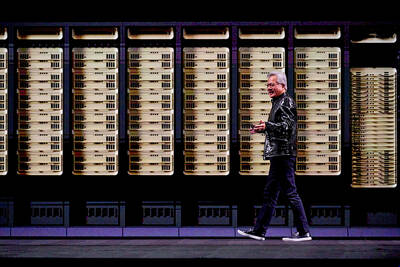
The global server market is expected to grow 12.8 percent annually this year, with artificial intelligence (AI) servers projected to account for 16.5 percent, driven by continued investment in AI infrastructure by major cloud service providers (CSPs), market researcher TrendForce Corp (集邦科技) said yesterday. Global AI server shipments this year are expected to increase 28 percent year-on-year to more than 2.7 million units, driven by sustained demand from CSPs and government sovereign cloud projects, TrendForce analyst Frank Kung (龔明德) told the Taipei Times. Demand for GPU-based AI servers, including Nvidia Corp’s GB and Vera Rubin rack systems, is expected to remain high,


 RSS
RSS