


The Securities and Futures Investors Protection Center would file a lawsuit for an order to dismiss Tatung Co (大同) chairwoman Lin Kuo Wen-yen (林郭文艷), as the firm has severely breached shareholders’ rights, agency chairman Chiou Chin-ting (邱欽庭) said yesterday.
If the center wins the lawsuit, Lin Kuo would be discharged from her position and barred from serving as a board member or supervisor of any firms listed on the Taiwan Stock Exchange, Taipei Exchange or emerging stock market in the next three years, Chiou told a news conference in Taipei.
“That would be a powerful punishment,” he said. “Although we do not know when justice would arrive, we know it will definitely arrive.”
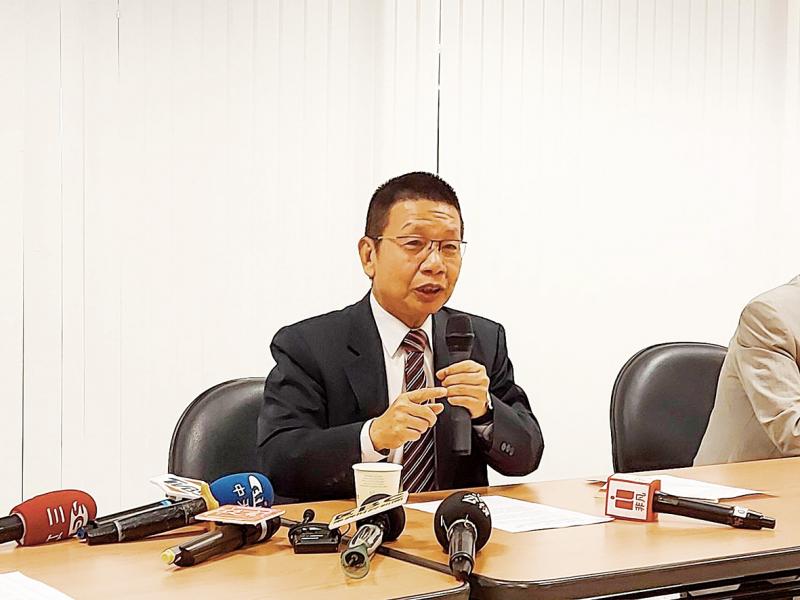
Photo: Chen Yung-chi, Taipei Times
This is the first time that the center has fought a public company solely because it breached shareholders’ rights, as it usually focuses on firms that have engaged in criminal activity, such as falsifying financial reports, he said.
The center filed the suit as Lin Kuo severely breached shareholders’ rights and disrupted market order by revoking the voting rights of 27 shareholders who own a combined 53 percent stake in Tatung, Chiou said.
“We do not represent any side in the dispute over Tatung’s management, but we are here to defend the rights of regular shareholders,” he said.
Shareholders should be able to execute their rights unobstructed, he said.
“What Lin Kuo did was wrong and hence we do not think it was a fair election,” Chiou said.
Although it is the Ministry of Economic Affairs that decides whether to accept Tatung’s registration of its new board members or demand that it holds a new election, the center can do its part by filing the lawsuit, Chiou said, adding that although it might not resolve the situation swiftly, as a decision from a court would take a while, sooner or later Lin Kuo would pay for what she did.
Chiou said he was shocked and frustrated after Tatung held the election on Tuesday evening last week, as he could not imagine that something like this would happen in Taiwan.
“We have seen companies take possession of the ballots or make some votes invalid to win elections, but what Tatung’s management did was something we had never seen before — directly taking away shareholders’ voting rights,” he said.
It was sad to see a public company use “innovative measures” to disrupt corporate governance, he said.
Chiou rejected Tatung’s attorney Lai Chung-chiang’s (賴中強) remark that disputes regarding voting rights are part of a firm’s self-governance.
According to a Tatung filing with the Taiwan Stock Exchange, the company in May asked the Taipei District Court for a temporary injunction to suspend the voting rights of some shareholders, Chiou said.
“That statement clearly indicates that Tatung knew it had no right to cancel the voting rights of its shareholders, so it needed to apply for an injunction,” he said.

PATENTS: MediaTek Inc said it would not comment on ongoing legal cases, but does not expect the legal action by Huawei to affect its business operations Smartphone integrated chips designer MediaTek Inc (聯發科) on Friday said that a lawsuit filed by Chinese smartphone brand Huawei Technologies Co (華為) over alleged patent infringements would have little impact on its operations. In an announcement posted on the Taiwan Stock Exchange, MediaTek said that it would not comment on an ongoing legal case. However, the company said that Huawei’s legal action would have little impact on its operations. MediaTek’s statement came after China-based PRIP Research said on Thursday that Huawei filed a lawsuit with a Chinese district court claiming that MediaTek infringed on its patents. The infringement mentioned in the lawsuit likely involved

Taipei is today suspending work, classes and its US$2.4 trillion stock market as Typhoon Gaemi approaches Taiwan with strong winds and heavy rain. The nation is not conducting securities, currency or fixed income trading, statements from its stock and currency exchanges said. Authorities had yesterday issued a warning that the storm could affect people on land and canceled some ship crossings and domestic flights. Taiwan Semiconductor Manufacturing Co (TSMC, 台積電) expects its local chipmaking fabs to maintain normal production, the company said in an e-mailed statement. The main chipmaker for Apple Inc and Nvidia Corp said it has activated routine typhoon alert

GROWTH: TSMC increased its projected revenue growth for this year to more than 25 percent, citing stronger-than-expected demand for AI devices and smartphones The Taiwan Institute of Economic Research (TIER, 台灣經濟研究院) yesterday raised its forecast for Taiwan’s GDP growth this year from 3.29 percent to 3.85 percent, as exports and private investment recovered faster than it predicted three months ago. The Taipei-based think tank also expects that Taiwan would see a 8.19 percent increase in exports this year, better than the 7.55 percent it projected in April, as US technology giants spent more money on artificial intelligence (AI) infrastructure and development. “There will be more AI servers going forward, but it remains to be seen if the momentum would extend to personal computers, smartphones and

Catastrophic computer outages caused by a software update from one company have once again exposed the dangers of global technological dependence on a handful of players, experts said on Friday. A flawed update sent out by the little-known security firm CrowdStrike Holdings Inc brought airlines, TV stations and myriad other aspects of daily life to a standstill. The outages affected companies or individuals that use CrowdStrike on the Microsoft Inc’s Windows platform. When they applied the update, the incompatible software crashed computers into a frozen state known as the “blue screen of death.” “Today CrowdStrike has become a household name, but not in


 RSS
RSS