


Wind turbine manufacturer Siemens Gamesa Renewable Energy SA (SGRE) yesterday said it plans to expand its production capacity in Taiwan to deliver turbines for the Hai Long 2 wind farm while aiming to capture growing market opportunities in Asia.
After inking a preferred supplier agreement last year with the Hai Long offshore wind farm project (海龍離岸風電計畫), developed by Canada’s Northland Power Inc and Singapore’s Yushan Energy Pte (玉山能源), SGRE is to supply wind turbines for the latter’s 300 megawatt (MW) wind farm 50km off the coast of Changhua County.
Abiding by local content rules, the company is partnering with local suppliers, including casting component maker Yeong Guan Energy Technology Group Co (永冠能源), cable manufacturer Sinbon Electronics Co (信邦電子) and chemical materials specialist Atech Composites Co (先進複材).
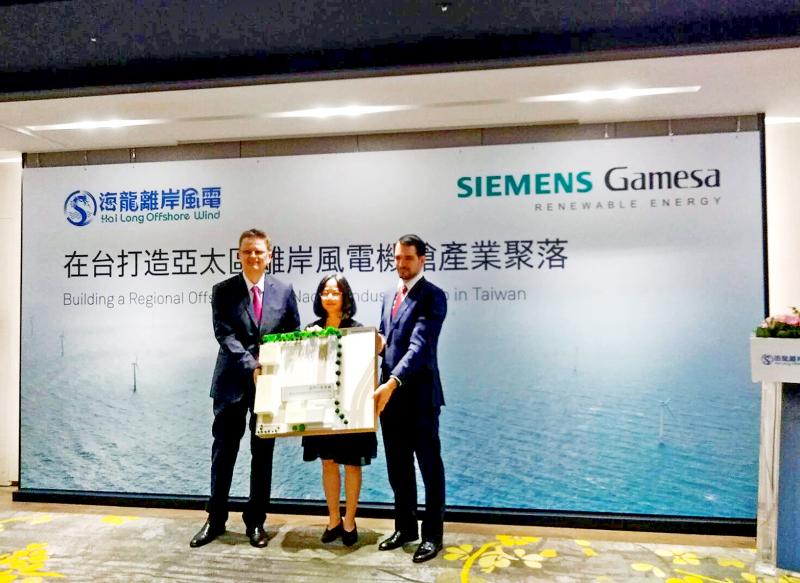
Photo: Natasha Li, Taipei Times
Pointing to its nacelle assembly facility that is under construction at the Port of Taichung, SGRE said that it plans to double the plot size and construction area in Taichung with two new production halls and a warehouse by leasing an additional 3 hectares of land from Taiwan International Ports Corp (TIPC, 台灣港務).
SGRE last year leased 3 hectares from TIPC to deliver 111 8MW wind turbines to Orsted Taiwan Ltd (沃旭能源) for its 900MW offshore wind farm in Changhua.
“We will manufacture bigger and more powerful wind turbines for the Hai Long project ... [of] over 11MW in power capacity,” SGRE chairman and managing director Niels Steenberg told a news conference in Taipei yesterday, adding that the Taichung plant would have an annual output of 2 gigawatts by 2024.
Despite posting losses of 165 million euros (US$178.4 million) last fiscal quarter due to supply chain disruptions caused by the COVID-19 pandemic, the company said that it is more than ever committed to invest in Taiwan.
“Taiwan will become our regional hub for Asia... Besides supplying the Taiwan market, it [the Taichung facility] would also serve markets in Japan and [South] Korea,” Steenberg said, adding that the company would also expand its local workforce from 100 employees to 500 by 2024.
With the Hai Long project still under review by the Industrial Development Bureau, SGRE is betting big on its Taichung plant.
“We are willing to take this risk, because all predictions are showing really big growth here in Asia,” Steenberg told the Taipei Times, hinting that the Taichung plant could potentially supply the company’s upcoming wind project in the Philippines.
Although the wind energy industry is “still very Eurocentric ... there would soon be more turbines installed in Asia than in Europe,” he added.
Having supplied 20 6MW wind turbines for the second phase of Formosa I Wind Power Co’s (海洋風力發電) offshore wind farm project, SGRE is to deliver another 47 8MW turbines for Formosa II Wind Power Co’s (海能風力發電) 376MW project this year.
The company would also install 80 wind turbines off the coast of Yunlin County for Wpd Taiwan Energy Co’s (達能能源) 640MW wind farm by next year.
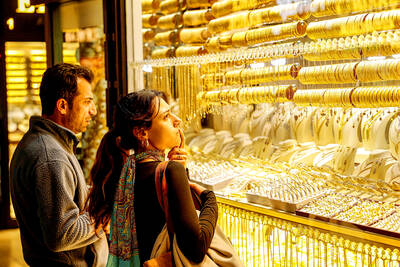
In Italy’s storied gold-making hubs, jewelers are reworking their designs to trim gold content as they race to blunt the effect of record prices and appeal to shoppers watching their budgets. Gold prices hit a record high on Thursday, surging near US$5,600 an ounce, more than double a year ago as geopolitical concerns and jitters over trade pushed investors toward the safe-haven asset. The rally is putting undue pressure on small artisans as they face mounting demands from customers, including international brands, to produce cheaper items, from signature pieces to wedding rings, according to interviews with four independent jewelers in Italy’s main

Japanese Prime Minister Sanae Takaichi has talked up the benefits of a weaker yen in a campaign speech, adopting a tone at odds with her finance ministry, which has refused to rule out any options to counter excessive foreign exchange volatility. Takaichi later softened her stance, saying she did not have a preference for the yen’s direction. “People say the weak yen is bad right now, but for export industries, it’s a major opportunity,” Takaichi said on Saturday at a rally for Liberal Democratic Party candidate Daishiro Yamagiwa in Kanagawa Prefecture ahead of a snap election on Sunday. “Whether it’s selling food or

CONCERNS: Tech companies investing in AI businesses that purchase their products have raised questions among investors that they are artificially propping up demand Nvidia Corp chief executive officer Jensen Huang (黃仁勳) on Saturday said that the company would be participating in OpenAI’s latest funding round, describing it as potentially “the largest investment we’ve ever made.” “We will invest a great deal of money,” Huang told reporters while visiting Taipei. “I believe in OpenAI. The work that they do is incredible. They’re one of the most consequential companies of our time.” Huang did not say exactly how much Nvidia might contribute, but described the investment as “huge.” “Let Sam announce how much he’s going to raise — it’s for him to decide,” Huang said, referring to OpenAI
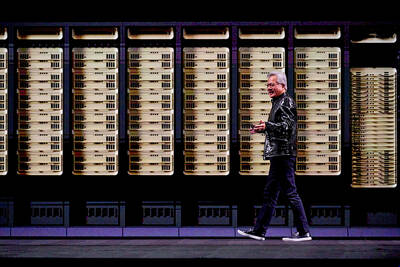
The global server market is expected to grow 12.8 percent annually this year, with artificial intelligence (AI) servers projected to account for 16.5 percent, driven by continued investment in AI infrastructure by major cloud service providers (CSPs), market researcher TrendForce Corp (集邦科技) said yesterday. Global AI server shipments this year are expected to increase 28 percent year-on-year to more than 2.7 million units, driven by sustained demand from CSPs and government sovereign cloud projects, TrendForce analyst Frank Kung (龔明德) told the Taipei Times. Demand for GPU-based AI servers, including Nvidia Corp’s GB and Vera Rubin rack systems, is expected to remain high,


 RSS
RSS