


Enimmune Corp (安特羅生技) plans to apply to the Taiwan Food and Drug Administration for marketing approval for its enterovirus 71 (EV-71) vaccine next quarter after the treatment passed an interim analysis yesterday.
If approved, it would be the nation’s first vaccine for EV-71, which is a common pathogen that causes polio-like syndromes, and mostly infects infants and children aged five and younger.
Although the firm has developed three EV-71 vaccines in China, the latest treatment would have an advantage in the home market, as it is designed to act against genotype B4 of EV-71, which is more widespread in Taiwan and Vietnam, while Chinese vaccines target genotype C4, Enimmune general manager Vic Chang (張哲瑋) told the Taipei Times by telephone.
The interim analysis was conducted by the firm’s independent data monitoring committee comprised of external experts, Chang said.
The experts monitored vaccinated test subjects for at least six months to see if they developed any allergic reactions, but none of them had severe reactions to the vaccine, barring some mild side-effects, such as inflamed skin, he said.
The overall seroprotection rate for the subjects who were given a single dose in the phase-III clinical trial was about 90 percent, higher than the regulatory minimum, Chang added.
“That means that our vaccines had good efficacy,” Chang added.
Enimmune, a subsidiary of Adimmune Corp (國光生技), has over the past decade focused on researching and developing the EV-71 vaccine.
The firm said that it completed a phase-III randomized, double-blind and placebo-controlled trial in April last year with a 1,266 subjects.
Given that there is no medication for EV-71 infection in Taiwan except for supportive therapies, the vaccine would likely qualify to apply to the agency’s accelerated approval mechanism, in which review would be sped up for treatments that satisfy unmet medical needs and greatly advance treatment, Chang said.
“If everything goes smoothly, we anticipate gaining approval in the fourth quarter. Adimmune would help us manufacture the vaccines,” Chang said.
The government is also expected to consider including the vaccine in the National Health Insurance system, he added.
Meanwhile, Medigen Vaccine Biologics Corp (高端疫苗) said that it would conduct an interim analysis of its EV-71 vaccine later this year after enrolling 3,000 subjects for a phase-III trial in December last year, spokesman Leo Lee (李思賢) said.
“We concentrate on developing the world’s first EV-71 vaccine for protecting children two months to six months old, given all existing EV-71 vaccines would be administered to children older than six months,” Lee said.
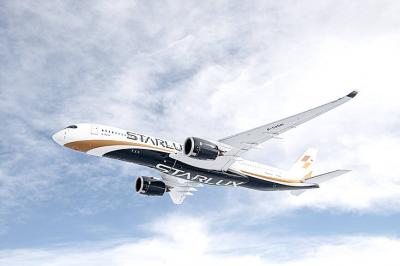
Starlux Airlines Co (星宇航空) today unveiled a long-haul network expansion plan at a shareholders’ meeting in Taipei, including direct flights to Barcelona, Spain, and Zurich, Switzerland, as well as a service connecting Taipei, Sydney and New Zealand. Starlux is to become the first Taiwanese carrier to offer non-stop services to the two European cities, while the inaugural oceanic route is expected to expand transit opportunities within the Australia-New Zealand market, Starlux said. Flight services to Chicago, Dallas, Washington and New York are under evaluation, the airline added. Prior to the shareholders’ meeting, the airline earlier this year announced that it would be

Cairo’s new monorail slices across the city skyline, running above the familiar chaos of blaring horns and aging buses’ exhaust fumes that mark rush hour below. The US$4.5 billion monorail, opened this month, is among Egypt’s most prominent new transport projects, part of a debt-funded infrastructure drive criticized for sapping state finances while bringing limited benefits to most of the country’s 109 million people. “It feels like you’re in a different country,” said Ramy Sayed, a restaurant manager, aboard a driverless Innovia 300 train. “No noise, no traffic, we’re not used to this.” The eastern line runs 56km from the bustling middle-class

Netherlands-based semiconductor equipment supplier ASML Holding NV yesterday said that it is planning to hire an additional 1,000 people in Taiwan this year in response to growing demand from clients. ASML had previously planned to recruit 600 people this year, but that the plan has been adjusted upward, ASML vice president and ASML Taiwan general manager Grace Wang (汪佳慧) told reporters. ASML has a workforce of more than 4,500 in Taiwan, accounting for about 10 percent of its global total, Wang said. This year’s recruitment campaign would focus on adding people in the customer support, manufacturing and supply chain domains to assist ASML

Nvidia Corp yesterday announced that CEO Jensen Huang (黃仁勳) would attend an employee meeting in Taipei tomorrow to celebrate the launch of the company’s Taiwan headquarters project. Huang would attend a gathering at the site of Nvidia’s planned headquarters in Beitou Shilin Technology Park (北投士林科技園區), the company said in a statement. After arriving in Taiwan on Saturday last week, Huang told reporters that he plans to meet with Quanta Computer Inc (廣達) chairman Barry Lam (林百里) and Taiwan Semiconductor Manufacturing Co (TSMC, 台積電) chairman C.C. Wei (魏哲家), and would attend the groundbreaking ceremony for Nvidia’s Taiwan headquarters tomorrow. Nvidia has not yet applied


 RSS
RSS