


Venezuela’s traditional cocuy liquor is making a comeback due to the country’s punishing economic crisis, which has put rum, whiskey and even beer financially out of reach for many.
Agave — which grows in the semi-arid mountains of Bobare and is the main ingredient in cocuy — has been used in Venezuela since before the Spanish conquest, and it is being kept alive by liquor artisans such as 84-year-old Dolores Gimenez.
He began producing cocuy at the age of seven in the eastern state of Lara, but just a few “small jars that were well hidden.”
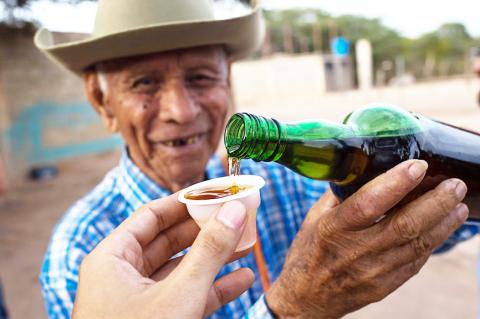
Photo: AFP
“If the police found you with cocuy, they put you in jail and smashed your distillation cylinders,” he said at his still.
Since those days, Gimenez — who has 25 children and 103 grandchildren — has refined the process and now provides joy to those who have seen their favorite alcoholic beverages disappear out of reach thanks to inflation that the IMF predicts would hit 200,000 percent this year.
“It’s three years since I touched a beer,” Nelson Vargas, 66, said.
His pension is barely worth the equivalent of US$3 a month — the price of just two beers.
“Few people drink it. Not us poor,” Vargas said, sipping cocuy as a procession of the Virgin of Guadeloupe passed.
Liquor consumption in Venezuela fell 34 percent this year, according to London-based alcoholic beverage analysts IWSR.
It also fell 37 percent last year, when beer consumption fell by 39 percent.
It is little surprise given that the country’s GDP has shrunk by half since 2013.
People “are migrating from traditional drinks like beer and rum to cheaper spirits like rum derivatives or aguardiente,” said Carlos Salazar, president of the Chamber of Liquors in the capital, Caracas, where sales are down 50 percent this year.
In 1998, a minimum salary could buy 46 cases of beer, but now, you would need five such salaries to purchase just one.
However, the search for cheaper alternatives can be deadly.
One monitor has said there have been 30 deaths this year from drinking alcoholic concoctions.
There was once a time when whiskey was practically Venezuela’s national beverage, even relegating traditional rums — considered some of the best in the world — into its shadow.
Whiskey consumption exploded with the arrival of foreign oil companies about a century ago and even became a status symbol in a country that has the largest proven crude reserves in the world.
In 2014, Venezuela was the second-highest per capita consumer of whiskey in Latin America.
In some restaurants, whiskey bottles stood on tables like water or wine.
About 15 years ago, “good whiskey was served at parties. Twelve-year-old [whiskey] was considered bad. To drink rum was shameful,” said Gabriela Fernandez, 49, who runs a food stall in Maracaibo, once a rich oil city that has been badly hit by Venezuela’s economic crisis.
Whiskey consumption fell by 43 percent in Venezuela between 2013 and last year, according to IWSR.
In a Caracas apartment, Mayerlin and Karen Rivas mixed sugarcane aguardiente with soursop juice and plenty of sugar to produce guarapa, a 40 percent alcohol drink that sells at US$3 a liter.
“The biggest difficulty has been the competition — a lot of people are making it — and a lack of trust,” Karen Rivas, 30, said.
Trust can be a major issue given the number of amateurs cooking up moonshine, which can be poisonous. Police raids in Bobare have even found car batteries inside distillation cylinders.
However, in the case of Gimenez, producing cocuy is more than just a means to make ends meet: It has become a passion.
“I’m not interested in becoming rich with cocuy. I just like producing good cocuy,” he said.

The domestic unit of the Chinese-owned, Dutch-headquartered chipmaker Nexperia BV will soon be able to produce semiconductors locally within China, according to two company sources. Nexperia is at the center of a global tug-of-war over critical semiconductor technology, with a Dutch court in February ordering a probe into alleged mismanagement at the company. The geopolitical tussle has disrupted supply chains, with some carmakers reportedly forced to cut production due to chip shortages. Local production would allow Nexperia’s domestic arm, Nexperia Semiconductors (China) Ltd (安世半導體中國), to bypass restrictions in place since October on the supply of silicon wafers — etched with tiny components to

Singapore-based ride-hailing and delivery giant Grab Holdings Ltd has applied for regulatory approval to acquire the Taiwan operations of Germany-based Delivery Hero SE's Foodpanda in a deal valued at about US$600 million. Grab submitted the filing to the Fair Trade Commission on Friday last week, with the transaction subject to regulatory review and approval, the company said in a statement yesterday. Its independent governance structure would help foster a healthy and competitive market in Taiwan if the deal is approved, Grab said. Grab, which is listed on the NASDAQ, said in the filing that US-based Uber Technologies Inc holds about 13 percent of

Taiwan Semiconductor Manufacturing Co (TSMC, 台積電) yesterday received government approval to deploy its advanced 3-nanometer (3nm) process at its second fab currently under construction in Japan, the Ministry of Economic Affairs said in a news release. The ministry green-lit the plan for the facility in Kumamoto, which is scheduled to start installing equipment and come online in 2028 with a monthly production capacity of 15,000 12-inch wafers, the ministry said. The Department of Investment Review in June 2024 authorized a US$5.26 billion investment for the facility, slated to manufacture 6- to 12nm chips, significantly less advanced than 3nm process. At a meeting with

Taiwan’s food delivery market could undergo a major shift if Singapore-based Grab Holdings Ltd completes its planned acquisition of Delivery Hero SE’s Foodpanda business in Taiwan, industry experts said. Grab on Monday last week announced it would acquire Foodpanda’s Taiwan operations for US$600 million. The deal is expected to be finalized in the second half of this year, with Grab aiming to complete user migration to its platform by the first half of next year. A duopoly between Uber Eats and Foodpanda dominates Taiwan’s delivery market, a structure that has remained intact since the Fair Trade Commission (FTC) blocked Uber Technologies Inc’s


 RSS
RSS