


Tesla Inc plans to double the number of repair and maintenance shops, add about 100 charging stations and revamp showrooms in China as the electric vehicle maker gears up to open its Shanghai plant.
Tesla plans to turn some of its showrooms in China into one-stop shops called “Tesla Centers” that also serve as delivery sites and offer maintenance support, two sources familiar with the matter said.
The sources, who spoke on condition of anonymity because they were not authorized to speak to the media, said the rollout would start in Shanghai and Guangzhou.
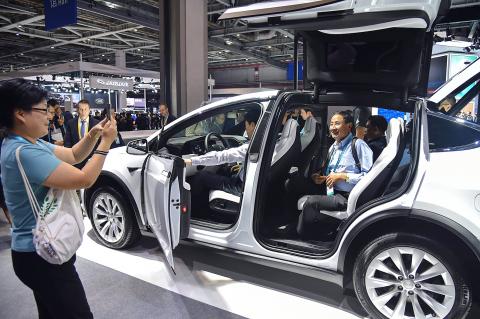
Photo: AFP
In coming months, the company also plans to double its service centers to 63 from 29 and boost fast charging stations by 39 percent to 362, according to Tesla planning documents.
“Expanding the service network is very important to boost customer confidence,” Tesla China general manager Wang Hao (王昊) said, adding that the firm would build more charging stations in China next year at a “faster pace.”
“There is growing sales potential from more inland cities, and a need to prepare for growing repair and maintenance demands to avoid complaints,” one of the sources said.
Tesla, whose service centers are mostly in China’s coastal regions and big provincial capitals, would open new ones in Urumqi, Kunming and Harbin, the documents showed.
The sources cautioned that plans might change depending on the circumstances.
Tesla’s corporate headquarters in the US did not respond to a request for comment.
Its efforts to boost its physical presence in China comes as the automaker has started trial production at the US$2 billion Shanghai plant, its first overseas factory, ahead of mass production by the end of next month.
Tesla has said it should be able to build 3,000 Model 3 sedans a week in its initial phases.
That is nearly four times the number of imported Model 3 vehicles sold in China per month this year, according to figures from research firm LMC Automotive.
It was not immediately clear how much Tesla would need to spend to expand its sales and after-sales network in China.
Maintaining growth momentum in China has become even more crucial to Tesla, as its US revenue tumbled 39 percent in the third quarter, its first decline in more than two years.
By contrast, sales in China rose 64 percent to US$669 million.
Tesla is also expanding its sales and delivery workforce in China: It has held several hiring events in Shanghai, Beijing and Shenzhen for sales and delivery staff in recent months, according to recruitment advertisements posted on social media.
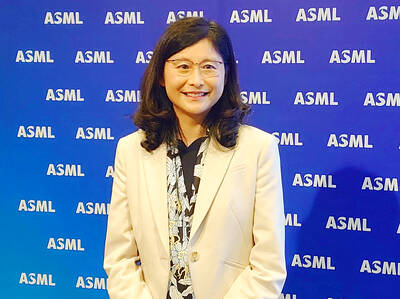
Netherlands-based semiconductor equipment supplier ASML Holding NV yesterday said that it is planning to hire an additional 1,000 people in Taiwan this year in response to growing demand from clients. ASML had previously planned to recruit 600 people this year, but that the plan has been adjusted upward, ASML vice president and ASML Taiwan general manager Grace Wang (汪佳慧) told reporters. ASML has a workforce of more than 4,500 in Taiwan, accounting for about 10 percent of its global total, Wang said. This year’s recruitment campaign would focus on adding people in the customer support, manufacturing and supply chain domains to assist ASML
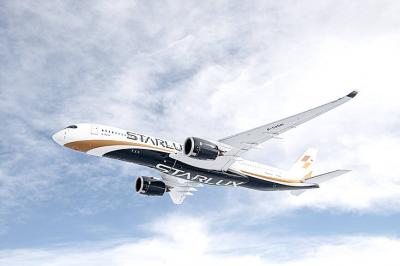
Starlux Airlines Co (星宇航空) today unveiled a long-haul network expansion plan at a shareholders’ meeting in Taipei, including direct flights to Barcelona, Spain, and Zurich, Switzerland, as well as a service connecting Taipei, Sydney and New Zealand. Starlux is to become the first Taiwanese carrier to offer non-stop services to the two European cities, while the inaugural oceanic route is expected to expand transit opportunities within the Australia-New Zealand market, Starlux said. Flight services to Chicago, Dallas, Washington and New York are under evaluation, the airline added. Prior to the shareholders’ meeting, the airline earlier this year announced that it would be
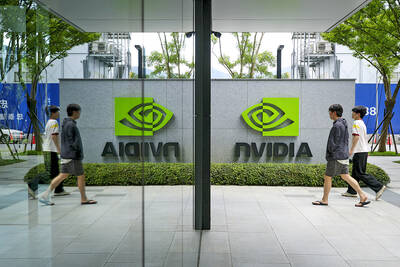
UNDER MICROSCOPE: Taiwan detained three people who allegedly conspired to buy servers in Taiwan and export them using fraudulent documentation, prosecutors said Nvidia Corp chief executive officer Jensen Huang (黃仁勳) on Saturday urged Super Micro Computer Inc to tighten up on compliance after Taiwan detained three people this week for allegedly making fraudulent declarations about artificial intelligence (AI) servers made by its US partner. The development marked the nation’s first crackdown on semiconductor smuggling, which grew after the US slapped restrictions on exports of high-end chips such as Nvidia AI accelerators to China. Nvidia is “rigorous” in explaining regulations to all of its partners, Huang told reporters after arriving in Taipei. “Ultimately Super Micro has to run their own company,” he said in response to
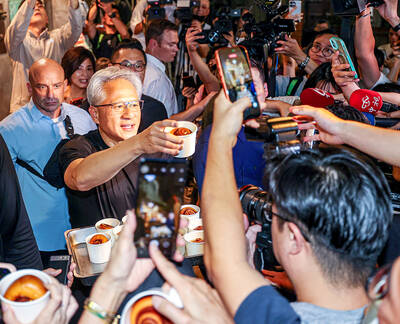
Nvidia Corp yesterday announced that CEO Jensen Huang (黃仁勳) would attend an employee meeting in Taipei tomorrow to celebrate the launch of the company’s Taiwan headquarters project. Huang would attend a gathering at the site of Nvidia’s planned headquarters in Beitou Shilin Technology Park (北投士林科技園區), the company said in a statement. After arriving in Taiwan on Saturday last week, Huang told reporters that he plans to meet with Quanta Computer Inc (廣達) chairman Barry Lam (林百里) and Taiwan Semiconductor Manufacturing Co (TSMC, 台積電) chairman C.C. Wei (魏哲家), and would attend the groundbreaking ceremony for Nvidia’s Taiwan headquarters tomorrow. Nvidia has not yet applied


 RSS
RSS