


Chunghwa Telecom Co (CHT, 中華電信), the nation’s largest telecom operator, yesterday said it has signed an agreement with US video streaming giant Netflix Inc to offer ultra-high-definition, or 4K, content for its Internet TV subscribers by February at the earliest.
Chunghwa Telecom announced the tie-up at a ceremony to celebrate the company reaching its target of 2 million subscribers.
That means its media-on-demand (MOD) business has reached an economic scale and is finally on track to turn a profit.
“We hope the MOD would eke out a profit in the second half of next year,” Chunghwa Telecom chairman David Cheng (鄭優) told reporters.
Turning around the video streaming and Internet TV business has been a priority since Cheng took office in 2016.
The MOD business has lost NT$31.5 billion over the past 13 years.
The company has made the “impossible mission possible” by adding 700,000 new subscribers in more than a year, Cheng said.
It began to see substantial subscriber gains in summer when it won exclusive rights to air the FIFA World Cup.
“Our next step is to further enhance our content. The collaboration with Netflix is an important part of this effort,” Cheng said.
“We believe the introduction of Netflix content would help boost the MOD subscriber number, given its rich content library,” he said.
Longer term, the two companies could deepen their cooperation to produce original titles together, Cheng said.
“It is natural to take that step, but as of now, our cooperation is still in the initial stage,” he said. “This is a win-win situation.”
The collaboration with Chunghwa Telecom gives Netflix, which has more than 130 million subscribers worldwide, access to MOD’s viewer base.
With new titles from Netflix and new value-added services to come online next year, Chunghwa Telecom has set an “aggressive target” of increasing MOD’s average revenue per user (ARPU) by 20 percent, Kao Wu-sung (高武松), vice president of Chunghwa Telecom’s Digital Convergence Business Department, told reporters.
Increasing advertisement income would also provide a boost to ARPU, Kao said.
Chunghwa Telecom is developing a 4K set-top box supporting Netflix’s standard and technology, Kao said. That would give MOD subscribers a better viewing experience than users streaming Netflix on smartphones or laptops, Kao said.
Cheng again urged the government to relax rules to allow Chunghwa Telecom to compete with its local rivals in a fair way.
The company is only allowed to stream movies, TV shows and other content from channel operators. It is banned from creating its own streaming packages.
Cheng said those restrictions are major obstacles to MOD making a profit.
Local rivals with half the size of MOD’s subscriber base have been making generous profits, while the MOD is still making losses, he said.
Commenting on the Ministry of Culture calling on Chunghwa Telecom to create a “national team” in the over-the-top (OTT) video market, Cheng said the company would seriously consider it.

Cairo’s new monorail slices across the city skyline, running above the familiar chaos of blaring horns and aging buses’ exhaust fumes that mark rush hour below. The US$4.5 billion monorail, opened this month, is among Egypt’s most prominent new transport projects, part of a debt-funded infrastructure drive criticized for sapping state finances while bringing limited benefits to most of the country’s 109 million people. “It feels like you’re in a different country,” said Ramy Sayed, a restaurant manager, aboard a driverless Innovia 300 train. “No noise, no traffic, we’re not used to this.” The eastern line runs 56km from the bustling middle-class

Taiwanese firms have increased investment in the Philippines in recent years as Manila’s ties with Washington deepen and global supply chains continue to shift away from China, an expert at the Chung-Hua Institution for Economic Research (CIER, 中華經濟研究院) said yesterday. The Philippines had not been among Taiwanese investors’ top choices in Southeast Asia, CIER Taiwan ASEAN Studies Center director Kristy Hsu (徐遵慈) said at a seminar in Taipei. However, Taiwan’s investment in the country has grown significantly since the COVID-19 pandemic, reaching US $257 million last year, a high in recent years, she said. Although Taiwan’s total investment in the Philippines still lags
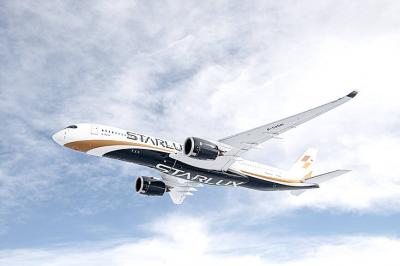
Starlux Airlines Co (星宇航空) today unveiled a long-haul network expansion plan at a shareholders’ meeting in Taipei, including direct flights to Barcelona, Spain, and Zurich, Switzerland, as well as a service connecting Taipei, Sydney and New Zealand. Starlux is to become the first Taiwanese carrier to offer non-stop services to the two European cities, while the inaugural oceanic route is expected to expand transit opportunities within the Australia-New Zealand market, Starlux said. Flight services to Chicago, Dallas, Washington and New York are under evaluation, the airline added. Prior to the shareholders’ meeting, the airline earlier this year announced that it would be

Intel Corp regards Taiwan Semiconductor Manufacturing Co (TSMC, 台積電) as a longstanding partner, as the US chipmaker would continue outsourcing production of advanced chips to TSMC, Intel chief executive officer Lip-Bu Tan (陳立武) said yesterday. “I don’t look at people as competitors. I look at the collaboration... Nvidia is also, you know, a good friend,” Tan told a news conference following his keynote speech at the Computex trade show in Taipei. “It’s a very trusted partnership for us... We are a big, top customer for them, and we’re going to continue doing that,” he said, referring to TSMC, the world’s largest foundry


 RSS
RSS