


Camera lens mold maker Zhong Yang Technology Co Ltd (中揚光電) on Friday said it is seeking an initial public offering in Taiwan this year to fund its capacity expansion to cope with growing demand for camera lenses used in mobile phones and vehicles.
Zhong Yang is the latest in a slew of Hon Hai Precision Industry Co (鴻海精密) subsidiaries debuting their shares in Taiwan or China. Hon Hai holds a share of about 30 percent in the company via its investment arms.
“Our production lines are being fully utilized,” Zhong Yang chairman Cheng Cheng-tien (鄭成田) told an investors’ conference. “We are adding more equipment... We aim to more than double our capacity in the next year or so, as we are also adding new customers.”
Zhong Yang said it has an optimistic view for its outlook.
“Although worldwide sales growth for smartphones is reaching its ceiling, demand for camera lenses are on the rise,” Zhong Yang president Lee Jung-chou (李榮洲) said. “New phones with three or four cameras are to offer improved features for 3D sensing and selfies.”
“On-screen fingerprint recognition is also popular and such features will be available on a lot of smartphones next year,” Lee said. “We have received a lot of orders to supply camera lens molds for fingerprint cameras.”
In the first three quarters, about 85 percent of the company’s revenue came from mobile phone camera lens molds and 10 percent from automotive camera lens molds. In that period, Zhong Yang made NT$939.23 million (US$30.41 million) in revenue, a 30 percent increase from the same period last year.
However, net profit fell 12.46 percent year-on-year to NT$151.64 million, or NT$2.53 per share, due to higher operating costs. The company more than doubled its research and development for the year to Sept. 30, spending NT$59.73 million, up from NT$21.3 million in the same period last year.
The Taichung-based firm supplies molds to the world’s major camera lens suppliers, including China’s Sunny Optical Technology (Group) Co (舜宇光學) and Kantatsu Co, a handset camera lends manufacturing arm of Sharp Corp.
The company started as a supplier of plastic molds and has gradually increased its reach to supply glass molds and to make handset camera lenses.
Last year, the company began supplying glass molds after merging with lens maker Eterge Opto-Electronics Co (紘立光電) to make inroads into molds for vehicles and smart-city surveillance systems.
Zhong Yang expects its automotive molds to grow by between 50 and 60 percent annually next year and by a higher rate in 2020, as its products have been adopted by the world’s major car brands from Germany, France and Japan for advanced driver-assistance systems.
The company plans to auction 60 million shares to investors at a floor price of NT$58 each from Thursday to Monday next week ahead of its debut.
It also plans to offer 8 million shares to existing stakeholders from Friday next week to Dec. 4 at a starting price of NT$50 each.
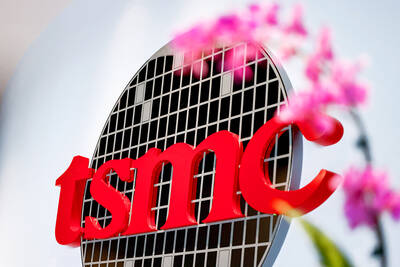
Taiwan Semiconductor Manufacturing Co (TSMC, 台積電) has approved a capital budget of US$31.28 billion for production expansion to meet long-term development needs during the artificial intelligence (AI) boom. The company’s board meeting yesterday approved the capital appropriation plan for purposes such as the installation of advanced technology capacity and fab construction, the world’s largest contract chipmaker said in a statement. At an earnings conference last month, TSMC forecast that its capital expenditure for this year would be at the higher end of the US$52 billion to US$56 billion range it forecast in January in response to robust demand for 5G, AI and
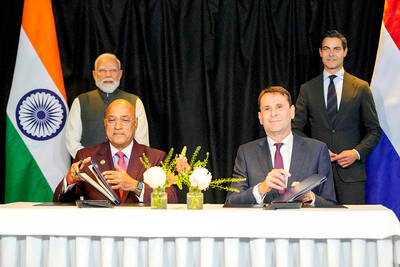
NEW MARKET: The partnership opens up India to the Dutch company, which already has a strong hold in the semiconductor market of South Korea, Taiwan and China ASML Holding NV entered into a partnership agreement with Tata Electronics Pvt Ltd aimed at ramping up India’s goal to develop domestic chip-manufacturing capabilities. The Dutch company’s technology would help power Tata Electronics’ planned 300 millimeter (mm) semiconductor foundry in Gujarat, according to a joint statement from the two companies on Saturday. The signing of a memorandum of understanding coincides with a visit by Indian Prime Minister Narendra Modi to the Netherlands, which is looking to deepen bilateral relations with New Delhi. ASML, whose top customers include Taiwan Semiconductor Manufacturing Co (台積電) and Samsung Electronics Co, makes lithography machines that can print
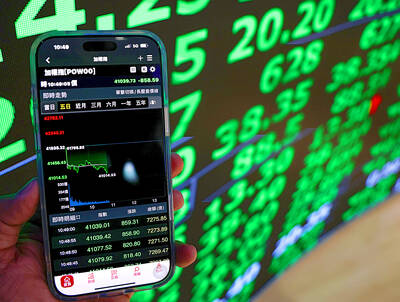
PORTFOLIO REBALANCING: The adjustments in three global equity indices reflect rising investor appetite for semiconductor and artificial intelligence-related stocks Taiwan’s weighting in major global equity indices compiled by MSCI Inc is to rise modestly following the latest quarterly review, underscoring the market’s expanding role in emerging-market portfolios, as global investors continue to favor the nation’s technology sector. Taiwan’s weighting in the MSCI Emerging Markets Index is to increase by 0.30 percentage points to 23.76 percent, after the changes take effect at the close of the May 29 session. Its weighting in the MSCI All-Country Asia ex-Japan Index is to rise 0.37 percentage points to 27.16 percent, while that in the MSCI All Country World Index is to edge up slightly to
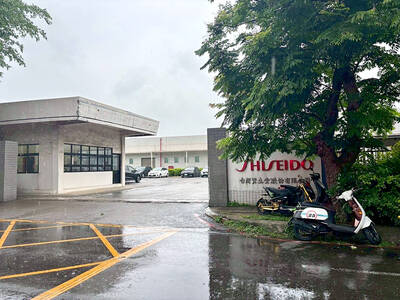
The Hsinchu County Government’s Labor Affairs Department yesterday said that it has received a plan from cosmetics brand Taiwan Shiseido Co (台灣資生堂) detailing mass layoffs at its plant in Hukou Township (湖口). While the labor authorities did not disclose the number of employees to be laid off, Japanese news media earlier in the day reported that the closure of the company’s factory in Hukou would result in 170 employees losing their jobs. Shiseido followed the law by reporting its layoff plan, the department said, adding that authorities would closely monitor negotiations between the management and affected employees and step in if any


 RSS
RSS