


Nova Technology Corp (朋億), which supplies chemical dispensing and waste chemical collection systems to chip and LCD companies, yesterday said its revenue is expected to break a new record this year, benefiting from a continuing semiconductor expansion spree in China.
The Hsinchu-based company’s optimism is based on the orders it has received since the end of last year, which will contribute to its revenue in the first half of this year.
More than 70 percent of the new orders are from China, the world’s biggest semiconductor market, Nova said.
“These orders will help boost our equipment utilization rate to 100 percent this year,” Nova said in a statement yesterday.
Last year, Nova saw its revenue jump 26.07 percent to a historical high of NT$3.34 billion (US$113.49 million), compared with NT$2.65 billion in 2016, thanks to new plant construction projects launched by Chinese chipmakers and LCD panelmakers, including China Star Optoelectronics Technology Co (華星光電) and China Electronics Panda Crystal Technology Corp (中電熊貓).
“This year, most of our growth will come from the semiconductor sector,” Oliver Ou (歐俊彥), a manager in Nova’s financial department, told reporters during a media gathering.
“We have secured record-high orders in US dollar terms from Chinese chipmakers,” Ou said, while declining to disclose detailed figures.
The new orders would help expand the revenue share of its semiconductor equipment to 60 percent this year, from last year’s 52 percent, the company said.
Nova counts Semiconductor Manufacturing International Corp (中芯) and United Microelectronics Corp (UMC, 聯電) as its major customers. Both companies are expanding capacity in Beijing and in Xiamen respectively this year.
Nova has also clinched supply contracts from two of China’s top three memory chip manufacturers, one of which is Fujian Jin Hua Integrated Circuit (JHICC, 晉華電子), Ou said, declining to name the other.
JHICC, Innotron Memory Co (合肥長鑫) and Yangtze Memory Technologies Co (YMTC, 長江存儲), a memory manufacturing arm of Tsinghua Unigroup (紫光集團), are the other manufacturers in the top three.
China’s top three memory chipmakers are rapidly boosting memory chip capacity under the Chinese government’s bankroll, market researcher TrendForce Corp (集邦科技) said in a report.
JHICC focuses on producing DRAM chips used in consumer electronics, while Innotron and YMTC make mobile DRAM and 3D NAND flash memory chips, TrendForce said.
Commenting on the effect of China’s recent clampdown on factory pollution and toxic emissions, Ou said it would provide a boon for the company in the long term if China’s local governments extend the curb, as that would require more firms to add new equipment to clean, collect or recycle used chemicals and waste water.
The pollution curbs are largely limited to factories in Jianshu Province’s Kunshan, he said.
Shares of Nova yesterday rallied 5.85 percent to NT$181 on the Taipei Exchange, while the over-the-counter benchmark declined 0.01 percent.
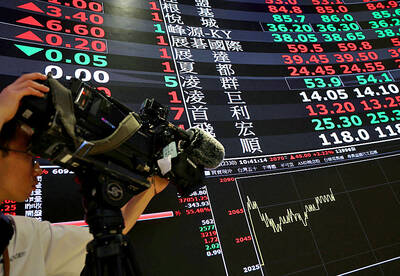
After several years flying high as Asia’s best Nvidia Corp proxy, Taiwan Semiconductor Manufacturing Co (TSMC, 台積電) is increasingly vying with other artificial intelligence (AI) stocks for investor attention. Stock traders are chasing a wider array of beneficiaries as mainstream usage of AI creates demand for hardware beyond the most-advanced chips TSMC makes for Nvidia. Subthemes from the deepening memory crunch to advances in robotics are also luring bids. At the same time, investment caps on single stocks are pushing funds to diversify, while retail investors long familiar with TSMC through its US depositary receipts are being offered a broader set of

Netherlands-based semiconductor equipment supplier ASML Holding NV yesterday said that it is planning to hire an additional 1,000 people in Taiwan this year in response to growing demand from clients. ASML had previously planned to recruit 600 people this year, but that the plan has been adjusted upward, ASML vice president and ASML Taiwan general manager Grace Wang (汪佳慧) told reporters. ASML has a workforce of more than 4,500 in Taiwan, accounting for about 10 percent of its global total, Wang said. This year’s recruitment campaign would focus on adding people in the customer support, manufacturing and supply chain domains to assist ASML

UNDER MICROSCOPE: Taiwan detained three people who allegedly conspired to buy servers in Taiwan and export them using fraudulent documentation, prosecutors said Nvidia Corp chief executive officer Jensen Huang (黃仁勳) on Saturday urged Super Micro Computer Inc to tighten up on compliance after Taiwan detained three people this week for allegedly making fraudulent declarations about artificial intelligence (AI) servers made by its US partner. The development marked the nation’s first crackdown on semiconductor smuggling, which grew after the US slapped restrictions on exports of high-end chips such as Nvidia AI accelerators to China. Nvidia is “rigorous” in explaining regulations to all of its partners, Huang told reporters after arriving in Taipei. “Ultimately Super Micro has to run their own company,” he said in response to

Nvidia Corp yesterday announced that CEO Jensen Huang (黃仁勳) would attend an employee meeting in Taipei tomorrow to celebrate the launch of the company’s Taiwan headquarters project. Huang would attend a gathering at the site of Nvidia’s planned headquarters in Beitou Shilin Technology Park (北投士林科技園區), the company said in a statement. After arriving in Taiwan on Saturday last week, Huang told reporters that he plans to meet with Quanta Computer Inc (廣達) chairman Barry Lam (林百里) and Taiwan Semiconductor Manufacturing Co (TSMC, 台積電) chairman C.C. Wei (魏哲家), and would attend the groundbreaking ceremony for Nvidia’s Taiwan headquarters tomorrow. Nvidia has not yet applied


 RSS
RSS