

Aerospace Industrial Development Corp (AIDC, 漢翔航空工業), the nation’s largest civilian and military aircraft manufacturer, yesterday said it has formed an alliance with Mirle Automation Co (盟立) to develop robotics and tap into the industrial automation market.
The two companies are to jointly develop high-precision robotic arms based on the etherCAT-Motion Intelligence Orchestration (eMIO) control platform developed by the Industrial Technology Research Institute (ITRI).
To meet the stringent standards of the aerospace sector, the partnership aims to improve the capabilities of locally made robotic arms to work with heavier loads, as well as enhance their precision by 20-fold to achieve a deviation of less than 0.25 millimeters.
Prompted by major aerospace customers, suppliers across the world have begun to shift toward using robotic arms to overcome the lack of flexibility of conventional five-axis computerized numerical control (CNC) machines, ITRI executive vice president Liu Chun-ting (劉軍廷) said, adding that maintaining movement precision remains a bottleneck for systems and calibration providers of high weight-bearing robotic arms.
Robotic arms are ideal for the aerospace industry, where suppliers face the challenges of producing small volumes of a large variety of components, Liu said.
As opposed to the closed systems sold by foreign solution providers, the eMIO platform allows users to create their control algorithms to ensure that robotic arms achieve the desired motions and torque, while creating continuous sensor data collection achieves continuous improvements in accuracy, the institute said.
AIDC chairman Anson Liao (廖榮鑫) hopes to see the improved robotic arms cut production equipment costs by up to 60 percent and expand the scope of the nation’s aerospace sector to include automated manufacturing.
Mirle Automation president Fang Yu-gang (方玉崗) said that eMIO is expected to improve the precision of locally made robotic arms that are capable of bearing loads of more than 100kg, as their deviation average between 1mm and 10mm, which exceed the tolerance levels for the aerospace industry.
AIDC first-half net income dipped 49.2 percent annually to NT$541 million (US$17.94 million), or earnings per share of NT$0.57.
Mirle Automation’s first-half net income dropped 50.6 percent annually to NT$1.21 billion, or earnings per share of NT$0.62.
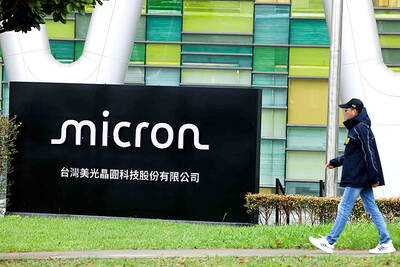
Micron Technology Inc has suspended plans for a memory chip plant in Taiwan due to a protracted labor dispute, according to people familiar with the matter, throwing into question the fate of a major production base for crucial artificial intelligence (AI) components. The US company has all but halted construction of a plant in Taoyuan, said the people, who asked not to be identified because the deliberations are private. Executives are concerned about mounting uncertainties, including the risk that an agreement with a local labor union will get overturned. Micron has informed Taiwanese officials and a supplier about its plans to

SPILLOVER: With foreign capital continuing to leave the market, traders expect the NT dollar, which fell NT$0.168, to face further depreciation pressure, an analyst said Taiwanese stocks yesterday plunged 3.59 percent, with the TAIEX recording its seventh-largest single-day point loss, while the New Taiwan dollar slid to a more than 18-month low against the US dollar, as a global technology sell-off and accelerating foreign fund withdrawals battered local financial markets. The benchmark TAIEX fell 1,612.6 points to close at 43,307.54, with turnover reaching NT$928.058 billion (US$28.33 billion) and more than 1,000 listed stocks declining. Concerns over returns on massive artificial intelligence (AI) investments have triggered a global retreat from technology shares, particularly US chipmakers, while uncertainty surrounding US midterm elections has added to investor caution. In Asia, the

US chipmaking giant Nvidia is ordering its data center partners to scale back work with Chinese customers, the Financial Times reported yesterday. Nvidia’s cloud computing customers must sell at least 51 percent of their services to non-Chinese companies, the FT reported, citing five people with knowledge of the matter. The new rules only affect future contracts and not existing agreements, the report said. Nvidia neither confirmed nor denied the report, but said in a statement that “datacenters and clouds built on American chips are the foundation that American model and application makers need to compete worldwide.” “Longstanding US policy encourages every cloud to build
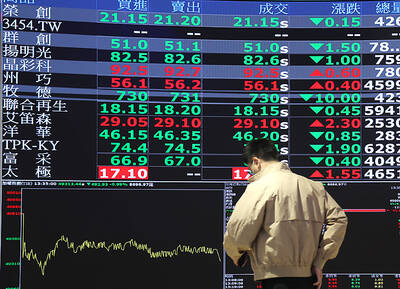
OUTLOOK: Tech stocks worldwide have come under selling pressure ever since last month, and Taiwan’s stock market is not expected to be spared, an analyst said The TAIEX is expected to face heavy downward pressure today after American depositary receipts of contract chipmaker Taiwan Semiconductor Manufacturing Co (TSMC, 台積電) on Friday plunged 5.95 percent, tracking a broader sell-off in US tech stocks on Wall Street amid concerns over massive artificial intelligence (AI) spending. Disappointing sales at some US technology companies spurred the worst drop for stocks since June, with the tech-heavy NASDAQ Composite Index falling 2.86 percent on Friday, while the Philadelphia Semiconductor Index plunged 7.20 percent and the S&P 500 fell 1.8 percent, breaching its 100-day moving average. Chipmaker Intel Corp and social media firm


 RSS