


Chinese shoppers spent more than US$1 billion in the first five minutes of Singles’ Day yesterday, e-commerce giant Alibaba Group Holding Ltd (阿里巴巴) said, in the world’s biggest online shopping promotion.
Singles’ Day — named after the repeated digit 1 in the date Nov. 11 — was created by Alibaba in 2009.
Now in just 24 hours it surpasses the main US online spending spree, the five days from Thanksgiving to CyberMonday.

Photo: Reuters
Shortly after noon, gross merchandise volume — Alibaba’s key measure of online sales — had reached 82.4 billion yuan (US$12.1 billion), the firm said, already closing in on last year’s total.
It had overtaken the 2014 figure by 6:54am, the firm said, with rival e-commerce giant JD.com Inc (京東), which focuses more on electronics, similarly receiving more orders by 9:14am than it had done on the whole of Singles’ Day in 2014.
In the US, total online sales for the five days from Thanksgiving through CyberMonday last year stood at US$11.1 billion, according to Adobe Digital Index.
Alibaba’s New York-listed stock has been buoyant this year in spite of worries over slowing growth in China, as consumer spending has expanded, while the old industrial economy struggles due to overcapacity and sluggish demand.
Alibaba launched this year’s event with a gala in the southern city of Shenzhen on Thursday night, inviting international and domestic stars, including Hollywood actress Scarlett Johansson, sports celebrity David Beckham, basketball player Kobe Bryant and pop band One Republic. Pop star Katy Perry pulled out at the last minute because of a family emergency.
Analysts said the event, which has gained more and more traction in the past few years, is key for Alibaba.
The day’s turnover was only “a very small fraction of its total annual sales,” independent e-commerce analyst Li Chengdong (李成東) said, but was “a confidence index for the firm.”
“If they do well in this, it is a boost to investors’ confidence,” Li said.
However, sales growth might not match last year’s 60 percent rise, he warned, in the face of economic worries and stricter regulation.
Commerce watchdog the Chinese State Administration for Industry and Commerce summoned Alibaba and 14 other e-commerce companies earlier this week, banning them from making up fake orders and lifting prices before giving out discounts.
Alibaba itself has sought to downplay the importance of the turnover statistic.
“I don’t have any requirement for the sales figure,” Alibaba quoted chairman Jack Ma (馬雲) as saying in a statement, adding that the day was all about “happiness and joy.”
Online shopping is a bright spot in Beijing’s efforts to transform the economy, growing 26.1 percent in the first nine months of the year, according to the Chinese National Bureau of Statistics.
That outstripped both overall retail growth of 10.4 percent in the period and official GDP expansion of 6.7 percent in each of the first three quarters.
The Chinese State Post Bureau has estimated the nation will handle more than 1 billion packages during the six days from yesterday, Xinhua news agency reported.
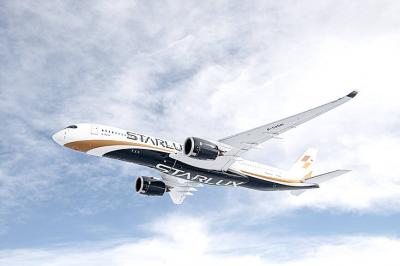
Starlux Airlines Co (星宇航空) today unveiled a long-haul network expansion plan at a shareholders’ meeting in Taipei, including direct flights to Barcelona, Spain, and Zurich, Switzerland, as well as a service connecting Taipei, Sydney and New Zealand. Starlux is to become the first Taiwanese carrier to offer non-stop services to the two European cities, while the inaugural oceanic route is expected to expand transit opportunities within the Australia-New Zealand market, Starlux said. Flight services to Chicago, Dallas, Washington and New York are under evaluation, the airline added. Prior to the shareholders’ meeting, the airline earlier this year announced that it would be

Cairo’s new monorail slices across the city skyline, running above the familiar chaos of blaring horns and aging buses’ exhaust fumes that mark rush hour below. The US$4.5 billion monorail, opened this month, is among Egypt’s most prominent new transport projects, part of a debt-funded infrastructure drive criticized for sapping state finances while bringing limited benefits to most of the country’s 109 million people. “It feels like you’re in a different country,” said Ramy Sayed, a restaurant manager, aboard a driverless Innovia 300 train. “No noise, no traffic, we’re not used to this.” The eastern line runs 56km from the bustling middle-class

Netherlands-based semiconductor equipment supplier ASML Holding NV yesterday said that it is planning to hire an additional 1,000 people in Taiwan this year in response to growing demand from clients. ASML had previously planned to recruit 600 people this year, but that the plan has been adjusted upward, ASML vice president and ASML Taiwan general manager Grace Wang (汪佳慧) told reporters. ASML has a workforce of more than 4,500 in Taiwan, accounting for about 10 percent of its global total, Wang said. This year’s recruitment campaign would focus on adding people in the customer support, manufacturing and supply chain domains to assist ASML

Nvidia Corp yesterday announced that CEO Jensen Huang (黃仁勳) would attend an employee meeting in Taipei tomorrow to celebrate the launch of the company’s Taiwan headquarters project. Huang would attend a gathering at the site of Nvidia’s planned headquarters in Beitou Shilin Technology Park (北投士林科技園區), the company said in a statement. After arriving in Taiwan on Saturday last week, Huang told reporters that he plans to meet with Quanta Computer Inc (廣達) chairman Barry Lam (林百里) and Taiwan Semiconductor Manufacturing Co (TSMC, 台積電) chairman C.C. Wei (魏哲家), and would attend the groundbreaking ceremony for Nvidia’s Taiwan headquarters tomorrow. Nvidia has not yet applied


 RSS
RSS