


State-run First Commercial Bank (第一銀行) yesterday denied allegations that its employees were involved in last week’s automatic teller machine (ATM) hacking incident, which led to the theft of more than NT$83 million (US$2.5 million).
“An internal probe by the company did not reveal evidence suggesting that the theft was an inside job,” First Commercial Bank president Chou Po-chaio (周伯蕉) said at a news conference following a question-and-answer session with the legislature’s Finance Committee.
The allegations that rogue employees were involved in the hack arose because First Commercial Bank was the only institution targeted among the many banks that use the same Wincor Nixdorf ATM model.
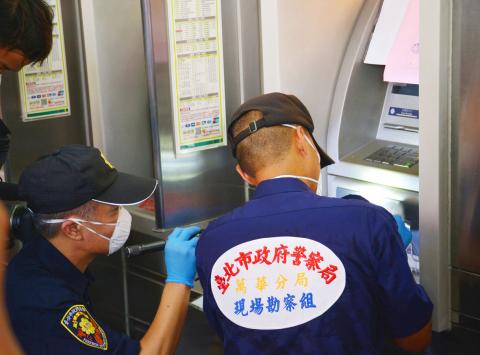
Photo: CNA
Chou said the company respects prosecutors’ efforts in investigating the case and that it has been cooperating with authorities.
Based on the bank’s latest tallies, suspects involved in the ATM heist had tampered with 41 machines and made off with NT$83.27 million in cash, higher than the NT$70 million it had estimated earlier.
Chou said it took the bank some time to tally losses at ATMs not installed at the bank’s branches, as the process must be conducted with the company’s security and surveillance service provider.
The bank did not attempt to downplay the severity of the heist, he said.
Taipei police on Thursday said they were looking at the possibility that an international organized crime ring was involved in the ATM hacking.
The police said they were tracking down six suspects, most of whom were from Eastern Europe.
There are no Taiwanese on the list of suspects, they said.
The modus operandi was similar to another heist carried out several years ago in Europe by an international organized crime ring, the police said, adding that there is a possibility of a link between the two cases.
The police said two of the suspects — identified only as Russian nationals Berezovskiy, 34, and Berkman, 28 — have already left Taiwan, while a third suspect, whose nationality is not yet known, has also left the nation.
Since no large amounts of cash were found in the luggage of the two Russians at Taiwan’s customs, police believe that the stolen money is in the hands of a Latvian suspect identified as Andrenjes and others who are likely still in Taiwan.
First Commercial Bank said that an internal probe found that the heist was committed without “inserting cards” or “handling the ATMs in any incorrect or illegal way,” but the machines were simply “spitting out” a steady stream of bills.
Chou said suspects had implanted a self-deleting software virus into the ATMs, which has made subsequent forensic investigations more difficult.
However, investigators might be able to find clues from two of the ATMs, as a passerby had alerted bank security of suspicious activity, forcing the suspects to flee before they finished collecting the cash, Chou said.
Chou apologized to the public and reiterated that an internal audit showed that the heist did not affect customers’ deposits and accounts, and that the company would take full responsibility if discrepancies are found.
Additional reporting by CNA

PATENTS: MediaTek Inc said it would not comment on ongoing legal cases, but does not expect the legal action by Huawei to affect its business operations Smartphone integrated chips designer MediaTek Inc (聯發科) on Friday said that a lawsuit filed by Chinese smartphone brand Huawei Technologies Co (華為) over alleged patent infringements would have little impact on its operations. In an announcement posted on the Taiwan Stock Exchange, MediaTek said that it would not comment on an ongoing legal case. However, the company said that Huawei’s legal action would have little impact on its operations. MediaTek’s statement came after China-based PRIP Research said on Thursday that Huawei filed a lawsuit with a Chinese district court claiming that MediaTek infringed on its patents. The infringement mentioned in the lawsuit likely involved

Taipei is today suspending work, classes and its US$2.4 trillion stock market as Typhoon Gaemi approaches Taiwan with strong winds and heavy rain. The nation is not conducting securities, currency or fixed income trading, statements from its stock and currency exchanges said. Authorities had yesterday issued a warning that the storm could affect people on land and canceled some ship crossings and domestic flights. Taiwan Semiconductor Manufacturing Co (TSMC, 台積電) expects its local chipmaking fabs to maintain normal production, the company said in an e-mailed statement. The main chipmaker for Apple Inc and Nvidia Corp said it has activated routine typhoon alert

GROWTH: TSMC increased its projected revenue growth for this year to more than 25 percent, citing stronger-than-expected demand for AI devices and smartphones The Taiwan Institute of Economic Research (TIER, 台灣經濟研究院) yesterday raised its forecast for Taiwan’s GDP growth this year from 3.29 percent to 3.85 percent, as exports and private investment recovered faster than it predicted three months ago. The Taipei-based think tank also expects that Taiwan would see a 8.19 percent increase in exports this year, better than the 7.55 percent it projected in April, as US technology giants spent more money on artificial intelligence (AI) infrastructure and development. “There will be more AI servers going forward, but it remains to be seen if the momentum would extend to personal computers, smartphones and

Catastrophic computer outages caused by a software update from one company have once again exposed the dangers of global technological dependence on a handful of players, experts said on Friday. A flawed update sent out by the little-known security firm CrowdStrike Holdings Inc brought airlines, TV stations and myriad other aspects of daily life to a standstill. The outages affected companies or individuals that use CrowdStrike on the Microsoft Inc’s Windows platform. When they applied the update, the incompatible software crashed computers into a frozen state known as the “blue screen of death.” “Today CrowdStrike has become a household name, but not in


 RSS
RSS