


That virtual reality (VR) and augmented reality (AR) technologies are to transform life experiences and make the impossible possible was the message of chip designer ARM Holdings PLC, headset supplier HTC Corp (宏達電) and computer maker Quanta Computer Inc (廣達) at this year’s Computex Taipei.
In a demonstration room run by Britian-based ARM Holdings, visitors are able to explore an icy alien cave by using a smartphone equipped with VR goggles.
At HTC’s booth, guests can fly like a bird over Manhattan in New York by trying out the Vive headset and flying simulator Birdly.
VR technologies are not new, but they are becoming more affordable and better supported by an extended ecosystem, which industry watchers said has become a fledging growth area for electronics companies.
MediaTek Inc (聯發科), which competes with Qualcomm Inc in the mobile phone chip market, said it has about 100 employees developing VR solutions in different business divisions, almost equal to its Internet of Thing (IoT) business group.
“There is a good chance that the first adoption of VR technologies will be in gaming and social networking areas,” MediaTek co-operating executive Joe Chen (陳冠洲) said. “Our VR productions will be available soon, especially those for VR viewing on mobile phones and cardboards without causing nausea.”
MediaTek is to participate in Google’s Daydream VR project and plans to launch its VR-enabled chips, based on ARM’s CoretexA73 processor, in the first half of next year, Chen said.
At the annual Computex, Quanta is showcasing its new 360° VR camera, which allows users to easily take VR photographs and videos on their smartphones.
Touchpad controller chipmaker Elan Microelectronics Corp (義隆電子) is also exhibiting its first processors for 360° VR camera, developed by the US company Memora Inc, and plans to introduce a ball-shaped VR camera, called Luna, in the fourth quarter.
Meanwhile, chipmaker ChipSiP Technology Co (鉅景) is exhibiting its latest chips used in smart glasses for AR viewing for extreme sports, surgery and the industrial segment.
Global shipments of VR hardware are expected to reach 9.6 million units this year, led by key products from Samsung Electronics Co, Sony Corp, HTC and Oculus VR Inc, market researcher International Data Corp (IDC) projected.
Total VR hardware revenues are expected to total US$4.3 billion this year and VR software revenues are to reach US$800 million, Taipei-based market researcher TrendForce Corp (集邦科技) forecast.
With new and more sophisticated VR and AR hardware devices poised to change people’s daily lives, CIMB Securities Ltd’s Taipei-based analyst Felix Pan (潘俊宏) said “price and applications are still key for VR demand to take off.”
Given that current VR products still require high-end PCs costing between US$1,000 and US$2,000, the total costs including PC and VR could total between US$1,800 and US$2,500, which might limit the users to hardcore gamers only, Pan said.
Shanghai-based Lexiang Technology Co (樂相科技), which offers VR devices under the DeePoon (大朋) brand, has launched versatile and affordable VR cardboards to cater to price-sensitive consumers, said an ARM official, who wished to remain anonymous.
Some VR cardboards are used in playing games and some are for construction workers, without the need of applying to phones or PCs, another company official said.
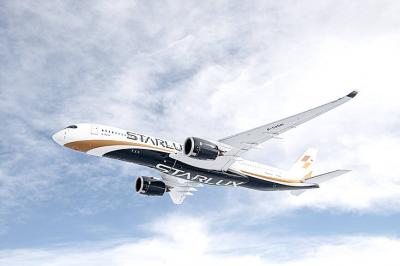
Starlux Airlines Co (星宇航空) today unveiled a long-haul network expansion plan at a shareholders’ meeting in Taipei, including direct flights to Barcelona, Spain, and Zurich, Switzerland, as well as a service connecting Taipei, Sydney and New Zealand. Starlux is to become the first Taiwanese carrier to offer non-stop services to the two European cities, while the inaugural oceanic route is expected to expand transit opportunities within the Australia-New Zealand market, Starlux said. Flight services to Chicago, Dallas, Washington and New York are under evaluation, the airline added. Prior to the shareholders’ meeting, the airline earlier this year announced that it would be
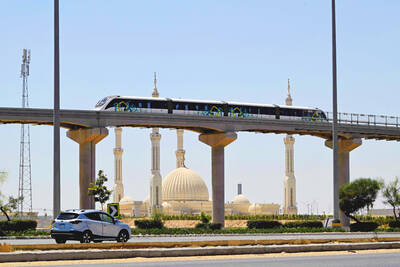
Cairo’s new monorail slices across the city skyline, running above the familiar chaos of blaring horns and aging buses’ exhaust fumes that mark rush hour below. The US$4.5 billion monorail, opened this month, is among Egypt’s most prominent new transport projects, part of a debt-funded infrastructure drive criticized for sapping state finances while bringing limited benefits to most of the country’s 109 million people. “It feels like you’re in a different country,” said Ramy Sayed, a restaurant manager, aboard a driverless Innovia 300 train. “No noise, no traffic, we’re not used to this.” The eastern line runs 56km from the bustling middle-class

Netherlands-based semiconductor equipment supplier ASML Holding NV yesterday said that it is planning to hire an additional 1,000 people in Taiwan this year in response to growing demand from clients. ASML had previously planned to recruit 600 people this year, but that the plan has been adjusted upward, ASML vice president and ASML Taiwan general manager Grace Wang (汪佳慧) told reporters. ASML has a workforce of more than 4,500 in Taiwan, accounting for about 10 percent of its global total, Wang said. This year’s recruitment campaign would focus on adding people in the customer support, manufacturing and supply chain domains to assist ASML
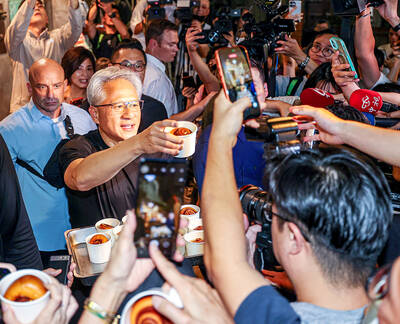
Nvidia Corp yesterday announced that CEO Jensen Huang (黃仁勳) would attend an employee meeting in Taipei tomorrow to celebrate the launch of the company’s Taiwan headquarters project. Huang would attend a gathering at the site of Nvidia’s planned headquarters in Beitou Shilin Technology Park (北投士林科技園區), the company said in a statement. After arriving in Taiwan on Saturday last week, Huang told reporters that he plans to meet with Quanta Computer Inc (廣達) chairman Barry Lam (林百里) and Taiwan Semiconductor Manufacturing Co (TSMC, 台積電) chairman C.C. Wei (魏哲家), and would attend the groundbreaking ceremony for Nvidia’s Taiwan headquarters tomorrow. Nvidia has not yet applied


 RSS
RSS