


In a bid to maintain market order and improve the financial industry’s quality, the Financial Supervisory Commission (FSC) is set to amend the Banking Act (銀行法) to add penalty provisions on domestic banks that launch price wars.
The move is part of a plan proposed by the commission yesterday to strengthen the nation’s financial infrastructure and raise the industry’s competitiveness.
“Under the fast-changing external environment, domestic financial institutions have to improve their conditions to further develop in Asia,” commission Chairman William Tseng (曾銘宗) told a news conference in Taipei.
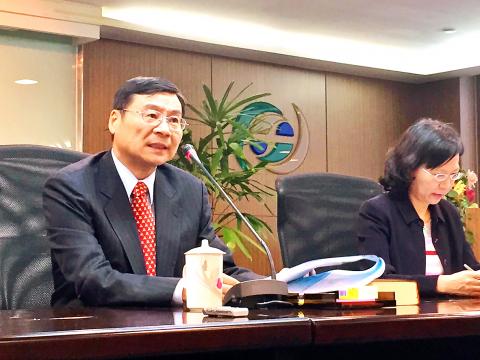
Photo: Wang Menglun, Taipei Times
The commission’s plan has 12 initiatives, which include various expectations for local players and a few mandatory regulations.
One of the initiatives is to ask domestic financial institutions to set reasonable prices for their products and services to avoid a destructive competition in the market and to enhance their risk management capability, Tseng said.
After reviewing current laws and discussions with the Fair Trade Commission, the FSC found there are punitive provisions for insurance companies and brokerage houses, but not for banks, Tseng said.
As a result, the FSC said it decided to draft an amendment to the Banking Act and develop a clear standard to punish companies that have engaged in unreasonable price-cutting, he said.
Tseng also reiterated his commission’s plan to adjust some regulations to allow private financial institutions to buy their peers through public tenders.
However, it will only allow tender offers for the purpose of mergers and acquisitions (M&A), with an interested player having to promise to receive a 50 percent stake in the merged company.
The FSC will also consider provisions to protect small retail shareholders’ rights, the eligibility of the players, freedom from shareholding controversies and the transparent funding resources, Tseng added.
Tseng said he hoped local players would be able to expand thei capital and asset scale through M&A, which may effectively reduce the number of financial institutions in Taiwan and resolving the over-banking issue.
In the meantime, the government is targeting 15 percent in return on equity (ROE) and 1 percent in return on assets (ROA) averagely for the financial industry in the long term, as the effect driven by these initiatives, Tseng said.
Although the financial industry saw its profitability rise to a record-high level last year, the sector’s ROE and ROA averaged 11.65 percent and 0.79 percent, respectively, FSC data showed.

PATENTS: MediaTek Inc said it would not comment on ongoing legal cases, but does not expect the legal action by Huawei to affect its business operations Smartphone integrated chips designer MediaTek Inc (聯發科) on Friday said that a lawsuit filed by Chinese smartphone brand Huawei Technologies Co (華為) over alleged patent infringements would have little impact on its operations. In an announcement posted on the Taiwan Stock Exchange, MediaTek said that it would not comment on an ongoing legal case. However, the company said that Huawei’s legal action would have little impact on its operations. MediaTek’s statement came after China-based PRIP Research said on Thursday that Huawei filed a lawsuit with a Chinese district court claiming that MediaTek infringed on its patents. The infringement mentioned in the lawsuit likely involved

Taipei is today suspending work, classes and its US$2.4 trillion stock market as Typhoon Gaemi approaches Taiwan with strong winds and heavy rain. The nation is not conducting securities, currency or fixed income trading, statements from its stock and currency exchanges said. Authorities had yesterday issued a warning that the storm could affect people on land and canceled some ship crossings and domestic flights. Taiwan Semiconductor Manufacturing Co (TSMC, 台積電) expects its local chipmaking fabs to maintain normal production, the company said in an e-mailed statement. The main chipmaker for Apple Inc and Nvidia Corp said it has activated routine typhoon alert

GROWTH: TSMC increased its projected revenue growth for this year to more than 25 percent, citing stronger-than-expected demand for AI devices and smartphones The Taiwan Institute of Economic Research (TIER, 台灣經濟研究院) yesterday raised its forecast for Taiwan’s GDP growth this year from 3.29 percent to 3.85 percent, as exports and private investment recovered faster than it predicted three months ago. The Taipei-based think tank also expects that Taiwan would see a 8.19 percent increase in exports this year, better than the 7.55 percent it projected in April, as US technology giants spent more money on artificial intelligence (AI) infrastructure and development. “There will be more AI servers going forward, but it remains to be seen if the momentum would extend to personal computers, smartphones and

Catastrophic computer outages caused by a software update from one company have once again exposed the dangers of global technological dependence on a handful of players, experts said on Friday. A flawed update sent out by the little-known security firm CrowdStrike Holdings Inc brought airlines, TV stations and myriad other aspects of daily life to a standstill. The outages affected companies or individuals that use CrowdStrike on the Microsoft Inc’s Windows platform. When they applied the update, the incompatible software crashed computers into a frozen state known as the “blue screen of death.” “Today CrowdStrike has become a household name, but not in


 RSS
RSS