


Collaborative robots and intelligent machinery might have wowed the crowds at this year’s Hannover Fair, but experts see German industry as having some way to go toward incorporating them on factory floors in what could become the fourth industrial revolution.
The undoubted star of the world’s largest industrial trade fair, which closed its doors in the northern German city on Friday, was YuMi, a collaborative, dual-armed robot made by Swiss-based automation technology group ABB Ltd.
ABB said it developed YuMi primarily for the consumer electronics industry and it is capable of handling items ranging from the delicate and precise parts of a wristwatch to the components used in mobile phones, tablets and desktop PCs.
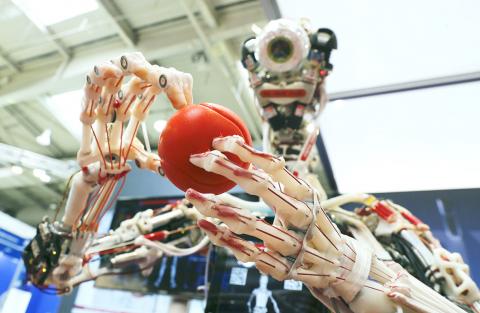
Photo: Reuters
However, it is expected to be rolled out to other market sectors as well, the company said.
YuMi and human coworkers can work side-by-side on shared tasks without protective fencing or cages, the company added. German Chancellor Angela Merkel tested its safety features when she visited the stand by placing her finger inside the gripper on YuMi’s right arm, causing it to stop.
At another stand, German firm Beckhoff Automation GmbH & Co KG showed off an automated assembly line, which it said is able to seamlessly adapt itself to handle different parts according to their shape, size and color, while human coworkers are equipped with a special smartwatch to monitor the process and can intervene if necessary.
Industry views the merging of production and online technology as the way forward for manufacturing, where “smart” factories use information and communications technologies to digitize their processes, boosting quality and efficiency while cutting costs.
Digitization is being heralded as the fourth industrial revolution — hence Merkel’s “Industry 4.0” initiative — following the invention of the steam engine, mass production and automation.
With nothing less than Germany’s mighty industrial prowess at stake, German politicians and business leaders are keen to wave the Industry 4.0 flag.
Berlin has even launched a new working group of businesses, unions and researchers to look into ways of moving digitization forward, which is to present its ideas and findings later this year.
However, German companies still have a long way to go, experts said.
A recent survey by the BITKOM trade group for information technology, telecommunications and new media found that, four out of 10 companies in key industrial sectors use Industry 4.0 applications.
The automobile sector is leading the pack, with 53 percent of companies using such applications, followed by electrical engineering, the chemicals sector and mechanical engineering.
“Digitization of German factories is in full swing, but still has a long way to go,” BITKOM board member Winfried Holz said. “In view of the fierce international competition, say from China and the US, companies must invest massively in the digitization of their processes and products if Germany wants to hold on to its leading position in the manufacturing sector.”
However, German companies still have some catching up to do.
The BITKOM survey found that about one in four companies have no Industry 4.0 strategy, even if they insist it is on their radar in the future.
However, up to 14 percent of companies said digitization is not an issue for them at all.
Over all, 80 percent of companies said they felt that industry was too reticent about digitization, with 72 percent saying they were put off by the investment costs and 56 percent by the complexity of the issue, the survey showed. Another 56 percent said they saw a lack of specialist personnel as a problem.
If digitization “is to lead the way for the next 10 to 15 years, we only partially know exactly how to implement it,” said Wolfgang Dorst, who heads BITKOM’s own Industry 4.0 department.
While many large companies have sufficient financial and human resources to digitize production, frequently it is the small and medium-sized companies who are not so well off financially that have the creative ideas, Dorst said.
Bernhard Juchheim, the head of Jumo, a family-run company that specializes in industrial sensor and automation technology, told reporters that his company would start building its own smart factory in Fulda, Germany, next year.
Critics fear digitization could render human workers obsolete in the manufacturing process.
However, the process will actually create new jobs, the Boston Consulting Group’s Michael Ruessmann said.
He wrote a study that found that 390,000 new jobs and an additional 30 billion euros (US$32.4 billion) in GDP could be created in Germany over the next 10 years as companies switch to intelligent factories.

PATENTS: MediaTek Inc said it would not comment on ongoing legal cases, but does not expect the legal action by Huawei to affect its business operations Smartphone integrated chips designer MediaTek Inc (聯發科) on Friday said that a lawsuit filed by Chinese smartphone brand Huawei Technologies Co (華為) over alleged patent infringements would have little impact on its operations. In an announcement posted on the Taiwan Stock Exchange, MediaTek said that it would not comment on an ongoing legal case. However, the company said that Huawei’s legal action would have little impact on its operations. MediaTek’s statement came after China-based PRIP Research said on Thursday that Huawei filed a lawsuit with a Chinese district court claiming that MediaTek infringed on its patents. The infringement mentioned in the lawsuit likely involved

Taipei is today suspending work, classes and its US$2.4 trillion stock market as Typhoon Gaemi approaches Taiwan with strong winds and heavy rain. The nation is not conducting securities, currency or fixed income trading, statements from its stock and currency exchanges said. Authorities had yesterday issued a warning that the storm could affect people on land and canceled some ship crossings and domestic flights. Taiwan Semiconductor Manufacturing Co (TSMC, 台積電) expects its local chipmaking fabs to maintain normal production, the company said in an e-mailed statement. The main chipmaker for Apple Inc and Nvidia Corp said it has activated routine typhoon alert

GROWTH: TSMC increased its projected revenue growth for this year to more than 25 percent, citing stronger-than-expected demand for AI devices and smartphones The Taiwan Institute of Economic Research (TIER, 台灣經濟研究院) yesterday raised its forecast for Taiwan’s GDP growth this year from 3.29 percent to 3.85 percent, as exports and private investment recovered faster than it predicted three months ago. The Taipei-based think tank also expects that Taiwan would see a 8.19 percent increase in exports this year, better than the 7.55 percent it projected in April, as US technology giants spent more money on artificial intelligence (AI) infrastructure and development. “There will be more AI servers going forward, but it remains to be seen if the momentum would extend to personal computers, smartphones and

Catastrophic computer outages caused by a software update from one company have once again exposed the dangers of global technological dependence on a handful of players, experts said on Friday. A flawed update sent out by the little-known security firm CrowdStrike Holdings Inc brought airlines, TV stations and myriad other aspects of daily life to a standstill. The outages affected companies or individuals that use CrowdStrike on the Microsoft Inc’s Windows platform. When they applied the update, the incompatible software crashed computers into a frozen state known as the “blue screen of death.” “Today CrowdStrike has become a household name, but not in


 RSS
RSS