


The ongoing water shortage poses a serious downside risk to the economy, which has achieved stability as cheaper fuel expenses boost corporate profits and consumer spending, Yuanta-Polaris Research Institute (元大寶華研究院) said yesterday.
Water rationing could affect the output of major industries by up to 20 percent, removing as much as 0.825 percentage point from GDP growth this year — if the water shortage persists, institute chairman Liang Kuo-yuan (梁國源) said on the sidelines of a quarterly news conference.
However, the chances of that outcome coming to pass are diminishing amid this week’s precipitation and the upcoming monsoon season, the economist said.

Photo: Yang Chin-cheng, Taipei Times
Manufacturers across sectors including metals, petrochemicals, textiles and paper products, as well as critical electronic components, are more vulnerable to water rationing, he said, adding that they account for 16.7 percent of GDP.
However, a more likely scenario this year is a 5 percent decline in total output due to the water shortage, with GDP growth softened by 0.2 percentage points, Liang said.
“That means the nation’s economy may manage to stay above 3.5 percent this year,” he said.
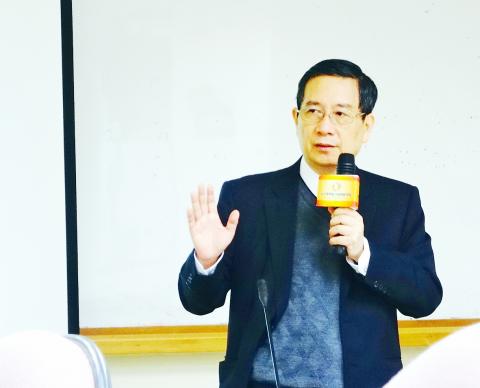
Photo: Wang Meng-lun, Taipei Times
The Taipei-based think tank yesterday raised its forecast for GDP growth to 3.66 percent for this year, from 3.45 percent it projected three months earlier, citing stronger private consumption and net exports attributable mainly to cheaper fuel and electricity costs.
Global trade improved in the second half of last year and the trend is expected to continue this year, although the volume has yet to recover to the levels seen before the global financial crisis in 2008, the institute said.
Exports contracted 1.3 percent for the first two months of this year, but cheaper crude prices helped lower imports by a faster pace and therefore widened trade surpluses, government data showed.
Energy cost savings allow companies to post stronger earnings and individuals to buy more non-fuel items, the institutes said.
International researchers report that demand for Apple Inc’s iPhone and other electronic devices remain strong and local companies in the supply chain may continue to thrive, Liang said.
Companies involved in non-tech sector exports could extend a lackluster performance from last year as crude prices might not stage a comeback soon, he said.
Given that, Yuanta-Polaris cut its forecast for consumer price growth to a record low of 0.1 percent this year.
Liang dismissed deflation concerns, saying that prices for food and non-fuel consumption continue to climb.
The pace of interest rate hikes by the US is likely to pose another headwind for the local economy, as global fund movements could hit the local bourse more intensely, the economist said.
The central bank may step in to stabilize the local currency, which may trade at an average of NT$31.9 against its US counterpart this year, the institute said.

PATENTS: MediaTek Inc said it would not comment on ongoing legal cases, but does not expect the legal action by Huawei to affect its business operations Smartphone integrated chips designer MediaTek Inc (聯發科) on Friday said that a lawsuit filed by Chinese smartphone brand Huawei Technologies Co (華為) over alleged patent infringements would have little impact on its operations. In an announcement posted on the Taiwan Stock Exchange, MediaTek said that it would not comment on an ongoing legal case. However, the company said that Huawei’s legal action would have little impact on its operations. MediaTek’s statement came after China-based PRIP Research said on Thursday that Huawei filed a lawsuit with a Chinese district court claiming that MediaTek infringed on its patents. The infringement mentioned in the lawsuit likely involved

Taipei is today suspending work, classes and its US$2.4 trillion stock market as Typhoon Gaemi approaches Taiwan with strong winds and heavy rain. The nation is not conducting securities, currency or fixed income trading, statements from its stock and currency exchanges said. Authorities had yesterday issued a warning that the storm could affect people on land and canceled some ship crossings and domestic flights. Taiwan Semiconductor Manufacturing Co (TSMC, 台積電) expects its local chipmaking fabs to maintain normal production, the company said in an e-mailed statement. The main chipmaker for Apple Inc and Nvidia Corp said it has activated routine typhoon alert

GROWTH: TSMC increased its projected revenue growth for this year to more than 25 percent, citing stronger-than-expected demand for AI devices and smartphones The Taiwan Institute of Economic Research (TIER, 台灣經濟研究院) yesterday raised its forecast for Taiwan’s GDP growth this year from 3.29 percent to 3.85 percent, as exports and private investment recovered faster than it predicted three months ago. The Taipei-based think tank also expects that Taiwan would see a 8.19 percent increase in exports this year, better than the 7.55 percent it projected in April, as US technology giants spent more money on artificial intelligence (AI) infrastructure and development. “There will be more AI servers going forward, but it remains to be seen if the momentum would extend to personal computers, smartphones and

Catastrophic computer outages caused by a software update from one company have once again exposed the dangers of global technological dependence on a handful of players, experts said on Friday. A flawed update sent out by the little-known security firm CrowdStrike Holdings Inc brought airlines, TV stations and myriad other aspects of daily life to a standstill. The outages affected companies or individuals that use CrowdStrike on the Microsoft Inc’s Windows platform. When they applied the update, the incompatible software crashed computers into a frozen state known as the “blue screen of death.” “Today CrowdStrike has become a household name, but not in


 RSS
RSS