


The last vestige of the Motorola empire is on the block after struggling with stagnant earnings.
Motorola Solutions Inc, a US$15.6 billion maker of two-way radios and other communications equipment, is exploring a possible sale, according to people familiar with the matter. Potential buyers could include private equity firms or companies such as Raytheon Co, Honeywell International Inc and General Dynamics Corp, said one of the people, asking not to be named because the information is confidential.
A sale could mark the final step in the dismantling of Motorola Inc, which was split up four years ago into Motorola Solutions and a handset unit after a campaign by billionaire investor Carl Icahn.
The handset business was sold to Google Inc, which then sold pieces of it to Lenovo Group Ltd (聯想).
Motorola Solutions is working with financial advisers as it seeks a buyer, the sources said. A transaction is not imminent, although a sale process has been under way for several months, one said.
Motorola Solutions spokesman Kurt Ebenhoch told reporters that the company does not comment on rumors and speculation.
Motorola Inc was founded in Chicago in 1928 as Galvin Manufacturing Corp to make a device that allowed battery-powered radios to run on household electricity. The company started producing car radios and expanded into communications with public safety radios. That led to the two-way walkie-talkie and carphones. In 1973, the company began research on a portable telephone prototype, using a concept for a cellular network developed by the former AT&T Corp.
Motorola Solutions, based in Schaumburg, Illinois, makes radio equipment for emergency workers. It has struggled with earnings performance, with last year’s adjusted earnings per share from continuing operations dropping 33 percent as sales declined 6 percent. The outlook for this year remains stagnant — the company projects revenue this year will be flat to slightly lower.
At their closing price of US$64.66 on Friday last week in New York trading, the shares had gained 2 percent in the past year. The stock jumped as much as 8.3 percent to US$70 in after-hours trading on Friday.
Motorola Solutions also offers technology services to clients including Prince George’s County in Maryland and the Las Vegas Metropolitan Police Department.
Motorola Inc first announced a plan to spin off its mobile phone business in March 2008, amid market share losses and pressure from Icahn. The company delayed the move during the recession, completing the split in January 2011.
The deal for Google’s US$12.4 billion purchase of Motorola Mobility, announced just months after the split, marked an end as an independent company that helped pioneer mobile phones and introduced its first consumer handset in the early 1980s.
Google, after subsequently selling off the set-top business, said last year that it would sell the remains of Motorola Mobility — excluding the majority of the patents — to Chinese PC maker Lenovo.
In February 2012, Motorola Solutions bought US$1.17 billion of its shares from Icahn, and said that his representative on its board would step down. Existing shareholders include ValueAct Capital Management and Blackrock Inc.
Raytheon in November last year acquired Blackbird Technologies, a surveillance and cybersecurity company, for US$420 million to bolster its intelligence business. In a Jan. 29 interview, Raytheon chief financial officer Dave Wajsgras said the Waltham, Massachusetts-based company would pursue other deals, with an emphasis on expanding its cybercapabilities and electronic warfare business.
“We will continue to focus on technology-based acquisitions in areas that we see we can expand our markets and build off of our technology foundation,” he said.

The domestic unit of the Chinese-owned, Dutch-headquartered chipmaker Nexperia BV will soon be able to produce semiconductors locally within China, according to two company sources. Nexperia is at the center of a global tug-of-war over critical semiconductor technology, with a Dutch court in February ordering a probe into alleged mismanagement at the company. The geopolitical tussle has disrupted supply chains, with some carmakers reportedly forced to cut production due to chip shortages. Local production would allow Nexperia’s domestic arm, Nexperia Semiconductors (China) Ltd (安世半導體中國), to bypass restrictions in place since October on the supply of silicon wafers — etched with tiny components to

Singapore-based ride-hailing and delivery giant Grab Holdings Ltd has applied for regulatory approval to acquire the Taiwan operations of Germany-based Delivery Hero SE's Foodpanda in a deal valued at about US$600 million. Grab submitted the filing to the Fair Trade Commission on Friday last week, with the transaction subject to regulatory review and approval, the company said in a statement yesterday. Its independent governance structure would help foster a healthy and competitive market in Taiwan if the deal is approved, Grab said. Grab, which is listed on the NASDAQ, said in the filing that US-based Uber Technologies Inc holds about 13 percent of

Taiwan Semiconductor Manufacturing Co (TSMC, 台積電) yesterday received government approval to deploy its advanced 3-nanometer (3nm) process at its second fab currently under construction in Japan, the Ministry of Economic Affairs said in a news release. The ministry green-lit the plan for the facility in Kumamoto, which is scheduled to start installing equipment and come online in 2028 with a monthly production capacity of 15,000 12-inch wafers, the ministry said. The Department of Investment Review in June 2024 authorized a US$5.26 billion investment for the facility, slated to manufacture 6- to 12nm chips, significantly less advanced than 3nm process. At a meeting with
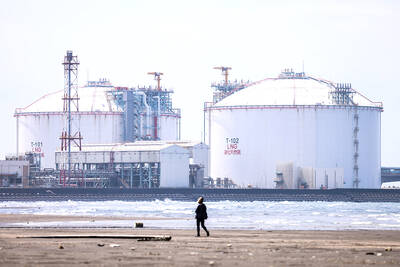
Taiwan is open to joining a global liquefied natural gas (LNG) program if one is created, but on the condition that countries provide delivery even in a scenario where there is a conflict with China, an energy department official said yesterday. While Taiwan’s priority is to have enough LNG at home, the nation is open to exploring potential strategic reserves in other countries such as Japan or South Korea, Energy Administration Deputy Director-General Chen Chung-hsien (陳崇憲) said. While the LNG market does not have a global reserve for emergencies like that of oil, the concept has been raised a few times —


 RSS
RSS