


Intel Corp chief executive Brian Krzanich on Tuesday said that computing is being “unleashed” by the move to wearables as the tech giant unveiled a button-sized device for new connectivity.
Speaking at a keynote at the huge Consumer Electronics Show (CES) in Las Vegas, Nevada, Krzanich said he sees wearables and similar technology taking computing power out of the constraints of the traditional screen and keyboard.
“We’re going from a two-dimensional world to a three-dimensional world,” he told a CES crowd. “So computing becomes unwired, and everything becomes smart and connected.”
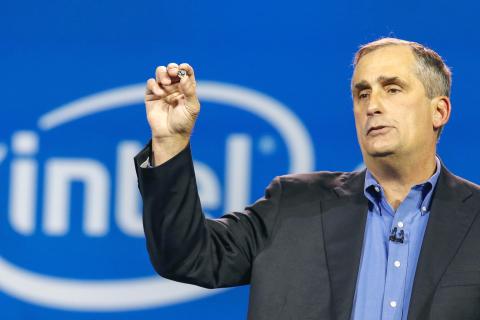
Photo: Bloomberg
Krzanich unveiled the Intel Curie module, a device the size of a button that is essentially a system chip for smart garments, glasses and other wearables.
“Curie is the next generation of computing,” he said at the presentation, where he outlined plans for connected eyewear, garments and drones.
The new trend offers a whole new range or intuitive computing without keyboard or screens or mice.
“It can unleash us,” Krzanich said.
Meanwhile, MediaTek Inc (聯發科) yesterday said that its new chipset has been certified by Google Inc for use in the world’s first ultra-HD television running on the Android TV platform.
The MT5595 system-on-chip (SoC) has been installed in Sony Corp’s latest generation of Bravia TVs showcased at the CES, which consumers can use to watch movies and shows from the Google Play online store, stream their favorite app and play Android games, the company said in a statement.
The MT5595 has already entered mass production, MediaTek said, adding that consumers can expect MediaTek-powered Android TV devices to be commercially available by March this year.
Google introduced Android TV late last year. While the California-based Internet titan has taken stabs at television through boxes that connect to sets, coming TV models will have Android software built-in so only a single remote control is involved.
Android televisions boast features such as voice search and automatically synching with Google Cast that lets content from smartphones or tablets be channeled to the bigger screens.
They are being demonstrated at the annual trade show from Tuesday through tomorrow.
“All of our 2015 televisions will run on the new Android TV platform,” Sony Electronics chief operating officer Mike Fasulo said while presenting coming products at CES.
“Android is such a widely accepted operating system in the mobile space; you can enjoy content on your smartphone, tablet and TV seamlessly,” he added.
Sony, Sharp Corp and Royal Philips NV smart televisions using the Android operating platform are slated to begin shipping by the middle of this year, Google vice president of engineering Hiroshi Lockheimer said in a blog post.
Popular mobile device operating systems such as those fielded by Google and Apple Inc are seen by analysts as well-positioned to serve as platforms tying together the myriad smart devices in what has come to be referred to as the Internet of Things.
“It is a challenge to make the Internet of Things work,” Reticle Reseach analyst Ross Rubin said. “Apple is making a play there and Google is making a play there because one place for access is certainly in the smartphone that is always whith you.”
Additional reporting by CNA
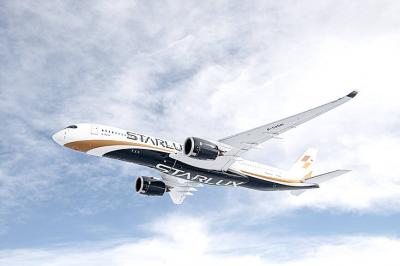
Starlux Airlines Co (星宇航空) today unveiled a long-haul network expansion plan at a shareholders’ meeting in Taipei, including direct flights to Barcelona, Spain, and Zurich, Switzerland, as well as a service connecting Taipei, Sydney and New Zealand. Starlux is to become the first Taiwanese carrier to offer non-stop services to the two European cities, while the inaugural oceanic route is expected to expand transit opportunities within the Australia-New Zealand market, Starlux said. Flight services to Chicago, Dallas, Washington and New York are under evaluation, the airline added. Prior to the shareholders’ meeting, the airline earlier this year announced that it would be

Cairo’s new monorail slices across the city skyline, running above the familiar chaos of blaring horns and aging buses’ exhaust fumes that mark rush hour below. The US$4.5 billion monorail, opened this month, is among Egypt’s most prominent new transport projects, part of a debt-funded infrastructure drive criticized for sapping state finances while bringing limited benefits to most of the country’s 109 million people. “It feels like you’re in a different country,” said Ramy Sayed, a restaurant manager, aboard a driverless Innovia 300 train. “No noise, no traffic, we’re not used to this.” The eastern line runs 56km from the bustling middle-class

Netherlands-based semiconductor equipment supplier ASML Holding NV yesterday said that it is planning to hire an additional 1,000 people in Taiwan this year in response to growing demand from clients. ASML had previously planned to recruit 600 people this year, but that the plan has been adjusted upward, ASML vice president and ASML Taiwan general manager Grace Wang (汪佳慧) told reporters. ASML has a workforce of more than 4,500 in Taiwan, accounting for about 10 percent of its global total, Wang said. This year’s recruitment campaign would focus on adding people in the customer support, manufacturing and supply chain domains to assist ASML
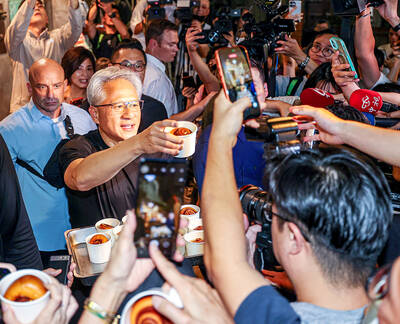
Nvidia Corp yesterday announced that CEO Jensen Huang (黃仁勳) would attend an employee meeting in Taipei tomorrow to celebrate the launch of the company’s Taiwan headquarters project. Huang would attend a gathering at the site of Nvidia’s planned headquarters in Beitou Shilin Technology Park (北投士林科技園區), the company said in a statement. After arriving in Taiwan on Saturday last week, Huang told reporters that he plans to meet with Quanta Computer Inc (廣達) chairman Barry Lam (林百里) and Taiwan Semiconductor Manufacturing Co (TSMC, 台積電) chairman C.C. Wei (魏哲家), and would attend the groundbreaking ceremony for Nvidia’s Taiwan headquarters tomorrow. Nvidia has not yet applied


 RSS
RSS