


The S&P 500 managed a minute weekly gain on Friday after two straight weeks lower, but headwinds for blue chips left the Dow lower for the period, extending its losses for a third week.
Company and sector reports were increasingly shaping the direction of stocks, with a number of retailers, especially popular fashion chains, showing vulnerability.
However, the theme of the week overall remained rising US Treasury yields that were attracting money out of foreign emerging markets — sending emerging market funds and exchange-traded funds plunging — and the guessing game on whether the US Federal Reserve would begin to pull in its stimulus program next month.
The Fed’s policy-setting Federal Open Market Committee (FOMC) has signaled since May that it would begin to taper its US$85 billion a month bond-buying program late this year, as long as economic growth remained on track.
However, data continued to present a mixed picture, with the minutes to the FOMC’s meeting late last month showing the policymakers themselves uncertain about the overall trajectory.
The broad-based S&P 500 added 0.5 percent for the week, finishing at 1,663.50. The Dow Jones Industrial Average lost 0.5 percent to 15,010.51. The NASDAQ Composite added 1.53 percent to 3,657.79, as the market itself shrugged off a three-hour shutdown on Thursday due to technical problems.
The Dow was pulled lower by poor performances in stocks tied to consumer spending such as Coke and Walmart and in big banks. However, Hewlett-Packard stood out as a loser, plunging 15.2 percent on another poor quarter as PC sales continued to sink.
Microsoft acted as a bit of a counterbalance, gaining 9.3 percent, most of that from a 7.3 percent leap on Friday in reaction to the announcement that chief executive Steve Ballmer would retire within the next 12 months. No replacement was named.
The week ended on a soft note, data wise, that for many analysts and traders pointed to the continuation of Fed bond-buying for the next few months at least.
The US Department of Commerce reported an unexpected downturn in new home sales in June and last month, likely the result of higher mortgage interest rates.
Paul Edelstein of IHS Global Insight said that was enough to keep the Fed from taking any tapering action yet.
“The labor market was too uncertain for the Fed to taper in late-July and developments since then haven’t settled the matter,” he said.
“The July employment report ... showed a decline in the unemployment rate, but slower payroll growth and downward revisions to May and June,” he said. “So, we don’t expect tapering at the September meeting.”
However, others believe the Fed will make the move, after flagging it for months.
“We still think that the most likely outcome is that the FOMC will take the first step to reduce the pace of asset purchases in September, but it is not yet a done deal,” Nomura economists said in their weekly review.
Trade is still likely to be under the drag of summer holidays in the coming week, with guideposts set by reports on last month’s durable goods orders tomorrow, home prices and consumer confidence on Tuesday, a fresh update of the estimate for second quarter GDP growth on Thursday and personal incomes on Friday.

AI SERVER DEMAND: ‘Overall industry demand continues to outpace supply and we are expanding capacity to meet it,’ the company’s chief executive officer said Hon Hai Precision Industry Co (鴻海精密) yesterday reported that net profit last quarter rose 27 percent from the same quarter last year on the back of demand for cloud services and high-performance computing products. Net profit surged to NT$44.36 billion (US$1.48 billion) from NT$35.04 billion a year earlier. On a quarterly basis, net profit grew 5 percent from NT$42.1 billion. Earnings per share expanded to NT$3.19 from NT$2.53 a year earlier and NT$3.03 in the first quarter. However, a sharp appreciation of the New Taiwan dollar since early May has weighed on the company’s performance, Hon Hai chief financial officer David Huang (黃德才)
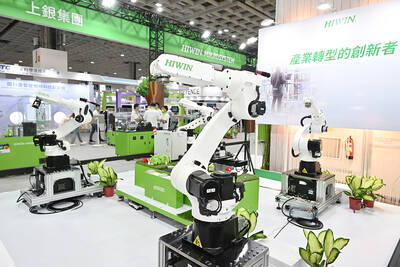
The Taiwan Automation Intelligence and Robot Show, which is to be held from Wednesday to Saturday at the Taipei Nangang Exhibition Center, would showcase the latest in artificial intelligence (AI)-driven robotics and automation technologies, the organizer said yesterday. The event would highlight applications in smart manufacturing, as well as information and communications technology, the Taiwan Automation Intelligence and Robotics Association said. More than 1,000 companies are to display innovations in semiconductors, electromechanics, industrial automation and intelligent manufacturing, it said in a news release. Visitors can explore automated guided vehicles, 3D machine vision systems and AI-powered applications at the show, along
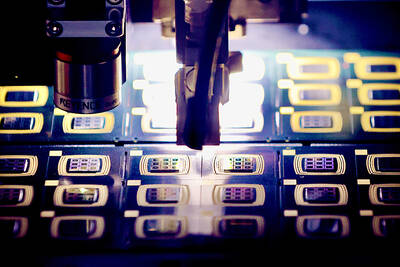
FORECAST: The greater computing power needed for emerging AI applications has driven higher demand for advanced semiconductors worldwide, TSMC said The government-supported Industrial Technology Research Institute (ITRI) has raised its forecast for this year’s growth in the output value of Taiwan’s semiconductor industry to above 22 percent on strong global demand for artificial intelligence (AI) applications. In its latest IEK Current Quarterly Model report, the institute said the local semiconductor industry would have output of NT$6.5 trillion (US$216.6 billion) this year, up 22.2 percent from a year earlier, an upward revision from a 19.1 percent increase estimate made in May. The strong showing of the local semiconductor industry largely reflected the stronger-than-expected performance of the integrated circuit (IC) manufacturing segment,
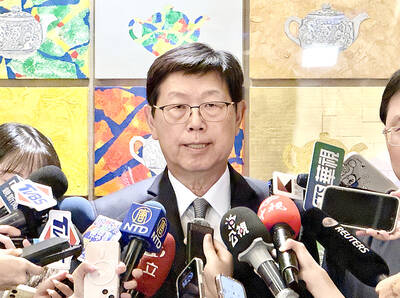
COLLABORATION: Softbank would supply manufacturing gear to the factory, and a joint venture would make AI data center equipment, Young Liu said Hon Hai Precision Industry Co (鴻海精密) would operate a US factory owned by Softbank Group Corp, setting up what is in the running to be the first manufacturing site in the Japanese company’s US$500 billion Stargate venture with OpenAI and Oracle Corp. Softbank is acquiring Hon Hai’s electric-vehicle plant in Ohio, but the Taiwanese company would continue to run the complex after turning it into an artificial intelligence (AI) server production plant, Hon Hai chairman Young Liu (劉揚偉) said yesterday. Softbank would supply manufacturing gear to the factory, and a joint venture between the two companies would make AI data


 RSS
RSS