


Taipei Times (TT): Why did Gigabyte Technology Corp (技嘉科技) organize this contest?
Eddie Lin (Lin, 林英宇): Over the past five to seven years, Gigabyte’s product design team has faced difficulties finding new talent. The team also found it hard to develop products that fully suit customers’ needs.
By organizing this challenge, we hope to solve those problems and to get inspiration from young participants and their innovative ideas for our products.
TT: How did the challenge turn out?
Lin: The event was better than we expected it would be. We received more than 141 entries within less than two months after our Web site opened for submissions in April. That was a lot more than we anticipated.
We were touched to see so many college students spend days and nights working on their projects.
Although many of the designs looked more like artworks than product designs, a great deal of them contained complete structures, which are the result of thoughtful product design skills.
These young designers are far more creative than we had anticipated, and such an outcome is really positive not only to Gigabyte as a company, but to the PC industry as a whole.
TT: The PC industry went through a revolutionary change after Apple Inc launched its popular iPhones. What are your thoughts on product design in the post-PC era?
Richard Ma (Ma, 馬孟明): As PC companies are looking to differentiate their products from those of their rivals, Gigabyte aims to be more innovative in its product design and to create niche products to compete with rivals such as Apple.
Here are our product strategies: In addition to enhancing the quality of our motherboards and graphics card product lines, we are expanding in product areas such as desktop computers for PC gamers, routers, tablets and smartphones.
Gigabyte now defines itself as a gaming PC brand and aims to become a leader in this segment.
TT: Asustek Computer Inc recently cut its annual notebook shipment target for this year. How is Gigabyte’s notebook business faring? Does Asustek’s forecast downgrade affect Gigabyte in anyway?
Ma: We see such revision as a norm. No one should be shocked by Asustek’s downward revision as it reflects the current [weak] PC market condition.
Gigabyte’s laptop shipments last quarter fell more than expected from the first quarter of this year, as tablets and smartphones are gradually replacing laptops and consumers are switching to smartphones and tablets.
However, PC companies should keep their faith as people will still need PCs to handle large volume data and complicated tasks.
As Microsoft Corp is introducing an upgraded version of its Windows 8 operating system, the traditional PC market should still see some growth momentum.
We expect to see this happen next year, when more PCs powered by Windows 8.1 will be put on the market.
TT: Some companies lowered their prices of Windows 8-based PC products from last quarter. Will Gigabyte adopt the same pricing strategy to compete with lower-priced tablets or smartphones running Google Inc’s Android system?
Ma: Trimming prices is not a good strategy for securing a share in the market because that will only lead to manufacturing lower-quality products. As a result, no company can improve its margin by selling such products.
Gigabyte is currently working on projects to manufacture more smartphones.
Specifically, we plan to make large smartphones with 5-inch to 6-inch displays and powered by Android.
Since many firms have entered the Android market, Gigabyte needs to find its own niche for Android-based products to survive in this competitive market.
In line with our desktop and laptop product strategy, we aim to make more gaming smartphones. According to our research, gamers actually need more than one mobile device to hone their gaming skills, so we are confident our mobile product strategy is viable.
TT: How does Gigabyte foresee its profitability during the second half of the year? What kind of smartphones can the market expect to see from Gigabyte over the next six months?
Ma: We expect our net profit this year will remain flattish compared with last year. [Gigabye made NT$1.55 billion (US$51.3 million), or NT$2.48 per share, last year.]
Despite the notebook market contracting, increased numbers of new tablets and smartphones are expected to offset our loss in selling laptops this year. However, given that average selling prices of tablets and smartphones are decreasing, we remain cautiously optimistic toward our profitability.
As for products, consumers can expect to see Gigabyte launch two 5-inch Android smartphones during the second half of the year. One will be equipped with a MediaTek Inc (聯發科) quad-core chip and another will be equipped with a Qualcomm Inc dual-core chip. Both will be priced at between US$250 and US$300.
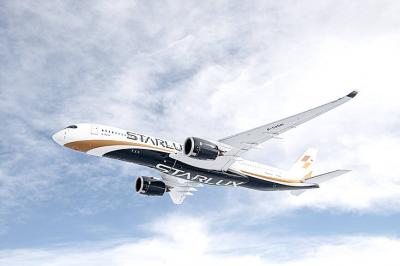
Starlux Airlines Co (星宇航空) today unveiled a long-haul network expansion plan at a shareholders’ meeting in Taipei, including direct flights to Barcelona, Spain, and Zurich, Switzerland, as well as a service connecting Taipei, Sydney and New Zealand. Starlux is to become the first Taiwanese carrier to offer non-stop services to the two European cities, while the inaugural oceanic route is expected to expand transit opportunities within the Australia-New Zealand market, Starlux said. Flight services to Chicago, Dallas, Washington and New York are under evaluation, the airline added. Prior to the shareholders’ meeting, the airline earlier this year announced that it would be

Cairo’s new monorail slices across the city skyline, running above the familiar chaos of blaring horns and aging buses’ exhaust fumes that mark rush hour below. The US$4.5 billion monorail, opened this month, is among Egypt’s most prominent new transport projects, part of a debt-funded infrastructure drive criticized for sapping state finances while bringing limited benefits to most of the country’s 109 million people. “It feels like you’re in a different country,” said Ramy Sayed, a restaurant manager, aboard a driverless Innovia 300 train. “No noise, no traffic, we’re not used to this.” The eastern line runs 56km from the bustling middle-class
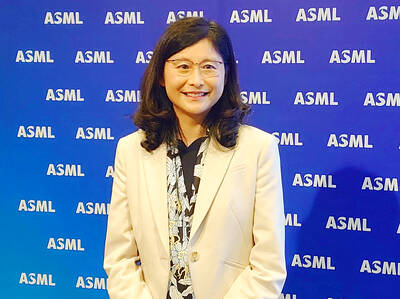
Netherlands-based semiconductor equipment supplier ASML Holding NV yesterday said that it is planning to hire an additional 1,000 people in Taiwan this year in response to growing demand from clients. ASML had previously planned to recruit 600 people this year, but that the plan has been adjusted upward, ASML vice president and ASML Taiwan general manager Grace Wang (汪佳慧) told reporters. ASML has a workforce of more than 4,500 in Taiwan, accounting for about 10 percent of its global total, Wang said. This year’s recruitment campaign would focus on adding people in the customer support, manufacturing and supply chain domains to assist ASML

Nvidia Corp yesterday announced that CEO Jensen Huang (黃仁勳) would attend an employee meeting in Taipei tomorrow to celebrate the launch of the company’s Taiwan headquarters project. Huang would attend a gathering at the site of Nvidia’s planned headquarters in Beitou Shilin Technology Park (北投士林科技園區), the company said in a statement. After arriving in Taiwan on Saturday last week, Huang told reporters that he plans to meet with Quanta Computer Inc (廣達) chairman Barry Lam (林百里) and Taiwan Semiconductor Manufacturing Co (TSMC, 台積電) chairman C.C. Wei (魏哲家), and would attend the groundbreaking ceremony for Nvidia’s Taiwan headquarters tomorrow. Nvidia has not yet applied


 RSS
RSS