


Apple Inc’s distribution practices for iPhones and iPad tablets are being examined by EU antitrust regulators, who said they will act if they see any behavior harmful to customers.
The European Commission is “currently looking at this situation and, more generally, is actively monitoring market developments,” Antoine Colombani, a spokesman for the Brussels-based authority, said in an e-mail.
While regulators were “made aware” of Apple’s distribution methods, they have not received any formal complaints, he said.
“We will intervene if there are indications of anti-competitive behavior to the detriment of consumers,” Colombani said.
Several phone carriers sent the EU information on their distribution contracts with Apple to check whether any terms restricted competition, the New York Times reported on Friday, citing a person briefed on the situation.
While the EU is focusing its inquiries on French phone operators, others elsewhere in Europe may also be involved, the newspaper said.
Apple, the world’s largest technology company, last year settled an EU antitrust probe into e-books pricing after it agreed to change agreements with four publishers.
It previously ended another antitrust case by pledging to reduce prices for UK iTunes music downloads. The EU closed a probe over restrictions on iPhone applications in 2010.
Cupertino, California-based Apple’s contracts “fully comply with local laws wherever we do business, including in the EU,” said Alan Hely, a spokesman for the company in London.
Samsung Electronics Co’s growing market position and the success of Google Inc’s Android mobile-phone operating system “are good reasons to believe that competition is strong in the markets for smartphones and tablets,” Colombani said.
France Telecom SA, whose Orange brand is the country’s biggest mobile operator, and Bouygues Telecom SA, the third largest, declined to comment on the report.

IN THE AIR: While most companies said they were committed to North American operations, some added that production and costs would depend on the outcome of a US trade probe Leading local contract electronics makers Wistron Corp (緯創), Quanta Computer Inc (廣達), Inventec Corp (英業達) and Compal Electronics Inc (仁寶) are to maintain their North American expansion plans, despite Washington’s 20 percent tariff on Taiwanese goods. Wistron said it has long maintained a presence in the US, while distributing production across Taiwan, North America, Southeast Asia and Europe. The company is in talks with customers to align capacity with their site preferences, a company official told the Taipei Times by telephone on Friday. The company is still in talks with clients over who would bear the tariff costs, with the outcome pending further
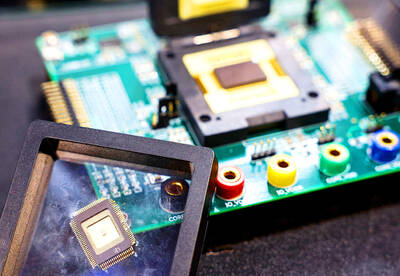
NEGOTIATIONS: Semiconductors play an outsized role in Taiwan’s industrial and economic development and are a major driver of the Taiwan-US trade imbalance With US President Donald Trump threatening to impose tariffs on semiconductors, Taiwan is expected to face a significant challenge, as information and communications technology (ICT) products account for more than 70 percent of its exports to the US, Chung-Hua Institution for Economic Research (CIER, 中華經濟研究院) president Lien Hsien-ming (連賢明) said on Friday. Compared with other countries, semiconductors play a disproportionately large role in Taiwan’s industrial and economic development, Lien said. As the sixth-largest contributor to the US trade deficit, Taiwan recorded a US$73.9 billion trade surplus with the US last year — up from US$47.8 billion in 2023 — driven by strong

AI: Softbank’s stake increases in Nvidia and TSMC reflect Masayoshi Son’s effort to gain a foothold in key nodes of the AI value chain, from chip design to data infrastructure Softbank Group Corp is building up stakes in Nvidia Corp and Taiwan Semiconductor Manufacturing Co (TSMC, 台積電), the latest reflection of founder Masayoshi Son’s focus on the tools and hardware underpinning artificial intelligence (AI). The Japanese technology investor raised its stake in Nvidia to about US$3 billion by the end of March, up from US$1 billion in the prior quarter, regulatory filings showed. It bought about US$330 million worth of TSMC shares and US$170 million in Oracle Corp, they showed. Softbank’s signature Vision Fund has also monetized almost US$2 billion of public and private assets in the first half of this year,
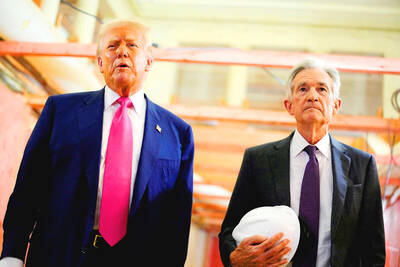
POWELL SUCCESSOR: US Fed Governor Adriana Kugler’s resignation gives Donald Trump an opening on the board, potentially accelerating his decision on the next chair US President Donald Trump suddenly has a chance to fill an opening at the US Federal Reserve earlier than expected, after Fed Governor Adriana Kugler announced her resignation on Friday. It might also force him to pick the next Fed chair months sooner than he had anticipated. “The ball is now in Trump’s court,” LH Meyer/Monetary Policy Analytics Inc economist Derek Tang said. “Trump is the one who’s been putting pressure on the Fed to do this and that, and Trump says he wants to have his own people on. So now he has the opportunity.” Kugler’s exit unfolds amid unprecedented public pressure


 RSS
RSS