


China’s exports rose more than forecast last month and a broad measure of credit surged 28 percent, helping the nation’s new leaders sustain a pickup in economic growth after a seven-quarter slowdown.
Overseas shipments increased 14.1 percent from a year earlier, the most since May, customs administration data showed yesterday, compared with the 5 percent median forecast in a Bloomberg News survey of 40 economists.
Aggregate financing of 1.63 trillion yuan (US$262 billion), which includes bank and non-bank lending, was up from 1.27 trillion yuan a year earlier, according to the central bank.
Asian stocks extended gains and the Australian dollar strengthened after the reports spurred confidence that the recovery in the world’s second-largest economy is gaining traction and global demand is stabilizing.
A subdued US recovery and European austerity measures may restrain China’s trade this year, while growth in non-bank financing threatens to increase debt risks.
“This improves the sequential momentum after weakness earlier in 2012,” said Louis Kuijs, chief China economist at Royal Bank of Scotland Plc in Hong Kong, who previously worked for the World Bank in Beijing.
Strength in imports last quarter is also “indicative of a further recovery” in GDP from the previous period, Kuijs said.
Imports for last month grew 6 percent after being unchanged the previous month. The trade surplus almost doubled from a year earlier to US$31.6 billion.
China’s exports rose 7.9 percent for all of last year while imports gained 4.3 percent, missing the government’s target of 10 percent growth in combined trade.
Overseas shipments increased 20.3 percent in 2011 and imports advanced 24.9 percent.
The worst year for trade in the past decade was 2009, when exports fell 16 percent and imports tumbled 11.2 percent.
Shipments to the EU rose 2.3 percent last month, the first gain since May, on demand from the UK and the Netherlands. Exports to the US, Canada, South Korea and India also accelerated.
Even so, the US replaced the EU last year as China’s largest export market, Zheng Yuesheng (鄭躍聲), head of the customs agency’s statistics department, said at a press briefing yesterday. Sales to the bloc fell 6.2 percent last year.
The two markets together accounted for one-third of China’s exports last year, customs data showed.
Last month’s exports may have been boosted by the impact of a strike at California ports that ended on Dec. 4 last year.
Rushed shipments and even faked exports to secure tax refunds may also have contributed to the stronger growth, said Alistair Thornton, a Beijing-based economist at IHS Inc.
China’s Ministry of Commerce, which oversees trade policies, said in a statement last month that it will seek to stabilize the scale of exports and improve support for trade growth this year.
Minister of Commerce Chen Deming (陳德銘) said in November last year that China’s trade will be “slightly better” this year than last year, and the second half of this year will be better than the first half.
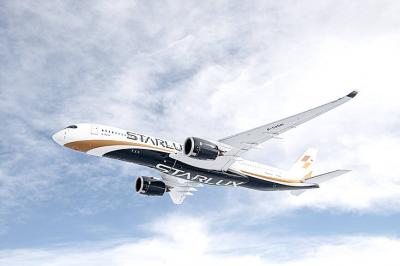
Starlux Airlines Co (星宇航空) today unveiled a long-haul network expansion plan at a shareholders’ meeting in Taipei, including direct flights to Barcelona, Spain, and Zurich, Switzerland, as well as a service connecting Taipei, Sydney and New Zealand. Starlux is to become the first Taiwanese carrier to offer non-stop services to the two European cities, while the inaugural oceanic route is expected to expand transit opportunities within the Australia-New Zealand market, Starlux said. Flight services to Chicago, Dallas, Washington and New York are under evaluation, the airline added. Prior to the shareholders’ meeting, the airline earlier this year announced that it would be

Cairo’s new monorail slices across the city skyline, running above the familiar chaos of blaring horns and aging buses’ exhaust fumes that mark rush hour below. The US$4.5 billion monorail, opened this month, is among Egypt’s most prominent new transport projects, part of a debt-funded infrastructure drive criticized for sapping state finances while bringing limited benefits to most of the country’s 109 million people. “It feels like you’re in a different country,” said Ramy Sayed, a restaurant manager, aboard a driverless Innovia 300 train. “No noise, no traffic, we’re not used to this.” The eastern line runs 56km from the bustling middle-class

Netherlands-based semiconductor equipment supplier ASML Holding NV yesterday said that it is planning to hire an additional 1,000 people in Taiwan this year in response to growing demand from clients. ASML had previously planned to recruit 600 people this year, but that the plan has been adjusted upward, ASML vice president and ASML Taiwan general manager Grace Wang (汪佳慧) told reporters. ASML has a workforce of more than 4,500 in Taiwan, accounting for about 10 percent of its global total, Wang said. This year’s recruitment campaign would focus on adding people in the customer support, manufacturing and supply chain domains to assist ASML

Nvidia Corp yesterday announced that CEO Jensen Huang (黃仁勳) would attend an employee meeting in Taipei tomorrow to celebrate the launch of the company’s Taiwan headquarters project. Huang would attend a gathering at the site of Nvidia’s planned headquarters in Beitou Shilin Technology Park (北投士林科技園區), the company said in a statement. After arriving in Taiwan on Saturday last week, Huang told reporters that he plans to meet with Quanta Computer Inc (廣達) chairman Barry Lam (林百里) and Taiwan Semiconductor Manufacturing Co (TSMC, 台積電) chairman C.C. Wei (魏哲家), and would attend the groundbreaking ceremony for Nvidia’s Taiwan headquarters tomorrow. Nvidia has not yet applied


 RSS
RSS