


As Britain loses faith in its banks and feels shockwaves from the euro crisis, one city is trying to keep local wealth in local pockets with the launch of its own currency.
The Bristol pound — usable only with member businesses in the city in southwest England — is to launch next month, and organizers are deluged with local firms wanting to sign up.
“The perception of banking and money is that it’s a very ruthless system: People are out for what they can get,” cofounder Ciaran Mundy said.
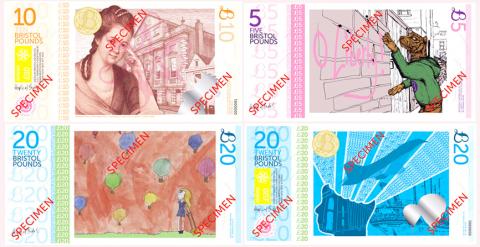
Photo: AFP
“This is about saying yes to something new. It’s tapping into a different set of values about money,” he said.
The scheme has “captured people’s imaginations,” he added, in a recession-hit year when British banks have been beset by scandals and ministers talked openly of a possible euro collapse.
Hundreds of businesses have joined — from the acclaimed Arnolfini arts center to the Chandos deli chain — and the launch had to be postponed from May to Sept. 19 because of the level of interest.
Security professional Richard Wright signed up his company Wright Guard as soon as he heard about the Bristol pound, hoping it would help him fight back against encroaching security giants.
“I’m Bristol born and bred, and I always want to support local businesses,” he said. “I’ll want to keep the Bristol pound flowing.”
The notes feature symbols of local pride from 19th-century religious writer Hannah More to the Concorde aircraft, partly developed in Bristol, and images of the St Paul’s Carnival Caribbean street festival.
Evoking a long history of dissent, one side of the £5 note shows a tiger writing on a wall in graffiti: “O Liberty!”
Other British towns have launched local currencies, but Bristol, home to half a million people, is the first big city and its scheme is ambitious.
Businesses can pay local taxes in Bristol pounds and the council has offered its 17,000 staff the option of receiving part of their pay in the currency.
Mundy’s team — funded initially by grants — have designed an electronic system for payments by text message, plus what they say are forgery-proof notes.
Stores selling products from cider to skate shoes said they were considering joining the scheme, which Mundy believes will have a tangible economic effect.
“Eighty percent of the money leaves the area if it is spent with a multinational — but 80 percent stays if it is spent at a local trader,” he said.
Such localism might seem strange in a city that grew to prosperity as an international port and is now a center for aircraft manufacture.
However, Bristol is also a left-wing haven with an activist tradition. The People’s Republic of Stokes Croft, an urban renewal group, made headlines last year with a campaign that became a riot in protest at the opening of a Tesco supermarket.
They have greeted the Bristol pound warmly.
“We need to run things from the bottom up and from the grassroots, so that people have control over how things happen where they live,” spokesman Chris Chalkley said.
However, Louisa Jones and Joh Rindom, co-owners of Stokes Croft vintage clothing store Shop Dutty, thought the scheme would just add to their administrative burden.
“We’re skeptical that having a microeconomy within a macroeconomy is a bit backward,” Rindom said.
Ben Yearsley, investment manager at Bristol-based financial services firm Hargreaves Lansdown, also won’t be rushing to convert his sterling.
“It’s just a big gift voucher scheme ... I’m skeptical that it’s going to make any difference,” he said.
“Local businesses need to compete on quality and service,” he added.
The Bristol pound will not be legal tender and must be exchanged through the Bristol Credit Union, with a 3 percent charge for conversion back to sterling.
This and charges on electronic transactions will pay its running costs.
Despite the naysayers, Mundy hopes hundreds of thousands of Bristol pounds will be traded in its first year, increasing to “double figures of millions” by the third.
His model is the Chiemgauer, a German complementary currency of which millions of euros’ worth is traded yearly.
Online database complementarycurrency.org lists more than 225 such minority currencies worldwide, of which 102 are in Europe.
They have won a high-profile advocate in Bernard Lietaer, a Belgian economist who helped design and implement the convergence mechanism for the euro.
“We will never have a stable, sustainable monetary system with a single monopoly of a single type of currency, whoever manages it,” he said in a lecture in Brussels.
“Everybody can do something at their own scale ... sustainability requires diversity,” he added.
Mundy said that the ultimate test of his system would be the market.
“If people freely decide to market and trade with each other [in the currency], they should be able to do it,” he said.
“If we’re not doing a good job they won’t use the system. Consumers will decide,” he said.

Cairo’s new monorail slices across the city skyline, running above the familiar chaos of blaring horns and aging buses’ exhaust fumes that mark rush hour below. The US$4.5 billion monorail, opened this month, is among Egypt’s most prominent new transport projects, part of a debt-funded infrastructure drive criticized for sapping state finances while bringing limited benefits to most of the country’s 109 million people. “It feels like you’re in a different country,” said Ramy Sayed, a restaurant manager, aboard a driverless Innovia 300 train. “No noise, no traffic, we’re not used to this.” The eastern line runs 56km from the bustling middle-class

Taiwanese firms have increased investment in the Philippines in recent years as Manila’s ties with Washington deepen and global supply chains continue to shift away from China, an expert at the Chung-Hua Institution for Economic Research (CIER, 中華經濟研究院) said yesterday. The Philippines had not been among Taiwanese investors’ top choices in Southeast Asia, CIER Taiwan ASEAN Studies Center director Kristy Hsu (徐遵慈) said at a seminar in Taipei. However, Taiwan’s investment in the country has grown significantly since the COVID-19 pandemic, reaching US $257 million last year, a high in recent years, she said. Although Taiwan’s total investment in the Philippines still lags

Intel Corp regards Taiwan Semiconductor Manufacturing Co (TSMC, 台積電) as a longstanding partner, as the US chipmaker would continue outsourcing production of advanced chips to TSMC, Intel chief executive officer Lip-Bu Tan (陳立武) said yesterday. “I don’t look at people as competitors. I look at the collaboration... Nvidia is also, you know, a good friend,” Tan told a news conference following his keynote speech at the Computex trade show in Taipei. “It’s a very trusted partnership for us... We are a big, top customer for them, and we’re going to continue doing that,” he said, referring to TSMC, the world’s largest foundry

Artificial intelligence (AI) agents would supplant smartphones as the center of people’s digital lives, fundamentally reshaping personal devices and driving a major computing upgrade cycle, Qualcomm Inc CEO Cristiano Amon said yesterday. In his keynote speech for this year’s Computex trade show in Taipei, Amon said that the rise of "agentic AI" — AI systems capable of reasoning, planning and carrying out tasks autonomously — would transform how people interact with technology across phones, PCs, vehicles and wearable devices. Describing the technology as the next major evolution in computing, Amon said that "2026 is the year of agents.” For decades, smartphones have sat


 RSS
RSS