


Boeing is set to hit back in its orders battle with rival Airbus at the upcoming Farnborough airshow, looking to take the lead in the key short-haul plane market despite a weak global economic outlook.
“The wide consensus is that this will be a Boeing show,” said Christophe Menard, an analyst at financial group Kepler Capital Markets.
US giant Boeing is looking to steal a march against European rival Airbus in the market for single-aisle, fuel-efficient commercial planes, touting its upgraded 737 MAX workhorse against the new, more fuel-efficient A320neo series.
“Boeing will definitely announce more aircraft than we do at Farnborough but I would only ask everybody ... not to just look at this year’s orders,” Airbus chief commercial officer John Leahy said last week as the group unveiled plans to build its first ever US assembly plant in a bid to keep up the pressure on Boeing.
“Look at the two years 2011 and 2012. We’ll out-sell Boeing in total in those two years. We’ll out-sell Boeing in the neo versus the Max in those two years in which both have been offered to sell — and that will keep us in a very good position,” Leahy said.
Boeing’s 737 MAX is an upgraded and more fuel efficient version of the 737, the world’s best-selling commercial airplane. The first 737 MAX is scheduled to be delivered in 2017 and is a response to the Airbus A320neo.
Airbus says the A320neo, due to enter service in late 2015, will use 15 percent less fuel than its current best-performing A320 model.
“The short-haul arena will be very interesting ... because Boeing is going to reveal more information about their plans for the 737 MAX family,” independent commercial aviation expert John Strickland said.
“In some ways, they were put on the back foot because Airbus announced the neo, which went for stunning orders at the Paris airshow last year,” Strickland said.
“Whether it’s long-haul or short-haul, in a climate of weak economic demand, especially led by Europe, and with fuel prices remaining stubbornly high, airlines are always looking at ways to improve fuel efficiency. So aircraft that deliver that are going to be really, really key,” he added.
Ahead of the UK’s biennial Farnborough show, Australian budget carrier Virgin ordered 23 of Boeing’s 737 MAX8 jets to replace the aging 737-700 portion of its fleet.
Airbus also had some good news of its own ahead of the show with its plans to open a factory on Boeing’s home turf, a gambit that would see the firm roll out its first US-built plane by 2016.
The new US$600 million assembly plant, to be built in the southern port city of Mobile, Alabama, on the Gulf of Mexico, will produce the mainstay A320 family of passenger planes.
Airbus estimates 4,600 new single-aisle aircraft will be needed in the US over the next 20 years.
Boeing has raised its 20-year forecast for global demand for airliners by US$500 billion, with the market doubling to 34,000 aircraft worth US$4.5 billion.
At Farnborough, the long-haul commercial sector will also be in focus, as Boeing seeks to counter Airbus’ A380 superjumbo offer with its 747-8, an extended version of the successful 747.
Airbus will also be looking to seal more orders for its A350, its response to the 787 Dreamliner, which is now flying after long technical delays.
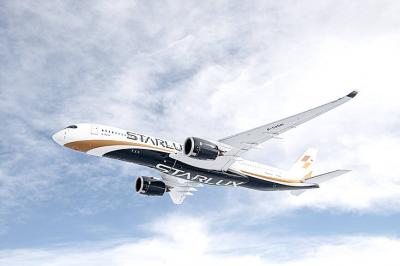
Starlux Airlines Co (星宇航空) today unveiled a long-haul network expansion plan at a shareholders’ meeting in Taipei, including direct flights to Barcelona, Spain, and Zurich, Switzerland, as well as a service connecting Taipei, Sydney and New Zealand. Starlux is to become the first Taiwanese carrier to offer non-stop services to the two European cities, while the inaugural oceanic route is expected to expand transit opportunities within the Australia-New Zealand market, Starlux said. Flight services to Chicago, Dallas, Washington and New York are under evaluation, the airline added. Prior to the shareholders’ meeting, the airline earlier this year announced that it would be
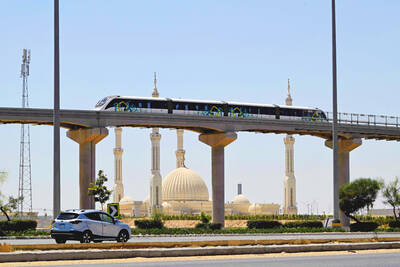
Cairo’s new monorail slices across the city skyline, running above the familiar chaos of blaring horns and aging buses’ exhaust fumes that mark rush hour below. The US$4.5 billion monorail, opened this month, is among Egypt’s most prominent new transport projects, part of a debt-funded infrastructure drive criticized for sapping state finances while bringing limited benefits to most of the country’s 109 million people. “It feels like you’re in a different country,” said Ramy Sayed, a restaurant manager, aboard a driverless Innovia 300 train. “No noise, no traffic, we’re not used to this.” The eastern line runs 56km from the bustling middle-class
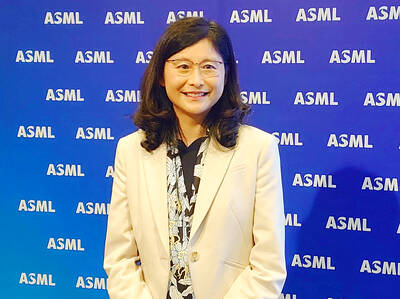
Netherlands-based semiconductor equipment supplier ASML Holding NV yesterday said that it is planning to hire an additional 1,000 people in Taiwan this year in response to growing demand from clients. ASML had previously planned to recruit 600 people this year, but that the plan has been adjusted upward, ASML vice president and ASML Taiwan general manager Grace Wang (汪佳慧) told reporters. ASML has a workforce of more than 4,500 in Taiwan, accounting for about 10 percent of its global total, Wang said. This year’s recruitment campaign would focus on adding people in the customer support, manufacturing and supply chain domains to assist ASML
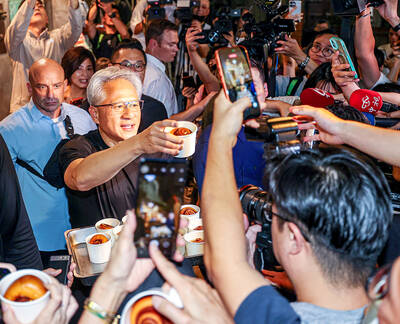
Nvidia Corp yesterday announced that CEO Jensen Huang (黃仁勳) would attend an employee meeting in Taipei tomorrow to celebrate the launch of the company’s Taiwan headquarters project. Huang would attend a gathering at the site of Nvidia’s planned headquarters in Beitou Shilin Technology Park (北投士林科技園區), the company said in a statement. After arriving in Taiwan on Saturday last week, Huang told reporters that he plans to meet with Quanta Computer Inc (廣達) chairman Barry Lam (林百里) and Taiwan Semiconductor Manufacturing Co (TSMC, 台積電) chairman C.C. Wei (魏哲家), and would attend the groundbreaking ceremony for Nvidia’s Taiwan headquarters tomorrow. Nvidia has not yet applied


 RSS
RSS