


Asian currencies completed the worst week in a month, led by India’s rupee, as concern that the region’s economic growth is faltering prompted global funds to withdraw cash.
Data this week showed China’s GDP rose at the slowest pace in two years.
Bank of Thailand Governor Prasarn Trairatvorakul said on Thursday that the Thai economy may contract this quarter as the worst floods in five decades disrupt production.
The Bloomberg-JPMorgan Asia Dollar Index fell 0.4 percent, the first decline since the week ended Sept. 30, before Europe’s finance ministers meet in Brussels today. The rupee fell past 50 per US dollar for the first time since 2009.
“Growth outlook has weakened and inflation remains stubbornly high” in the region, said Jonathan Cavenagh, a Singapore-based senior currency strategist at Westpac Banking Corp.
The New Taiwan dollar fell for a second day on Friday after data showed that export orders rose at the slowest pace in two years. Government bonds were steady with yields at the lowest level this week.
Overseas orders, an indication of shipments in the next one to three months, grew 2.72 percent last month from a year earlier, the government reported toward the end of currency trading on Friday. The median estimate of economists in a Bloomberg survey was for a 3.46 percent increase.
“The weak export orders data just adds to more and more evidence that Taiwan’s economy will slow,” said James Wang, a fixed-income trader at Yuanta Securities Co (元大證券) in Taipei.
The NT dollar weakened 0.1 percent to NT$30.299 against its US counterpart this week, according to Taipei Forex Inc. It touched NT$30.351 on Friday, the lowest level this week.
The rupee slumped 2 percent this week to 50.0250 per US dollar in Mumbai and touched 50.3238 earlier, the weakest level since April 2009. Thailand’s baht retreated 0.7 percent to 31.01 per US dollar and Malaysia’s ringgit lost 0.6 percent to 3.1498 per US dollar.
China’s yuan gained 0.1 percent to 6.3840 per US dollar. Indonesia’s rupiah slipped 0.2 percent to 8,863 per US dollar and the Philippine peso retreated 0.2 percent to 43.44 per US dollar. South Korea’s won appreciated 0.8 percent to 1,147.50 per US dollar.

Real estate agent and property developer JSL Construction & Development Co (愛山林) led the average compensation rankings among companies listed on the Taiwan Stock Exchange (TWSE) last year, while contract chipmaker Taiwan Semiconductor Manufacturing Co (TSMC, 台積電) finished 14th. JSL Construction paid its employees total average compensation of NT$4.78 million (US$159,701), down 13.5 percent from a year earlier, but still ahead of the most profitable listed tech giants, including TSMC, TWSE data showed. Last year, the average compensation (which includes salary, overtime, bonuses and allowances) paid by TSMC rose 21.6 percent to reach about NT$3.33 million, lifting its ranking by 10 notches
SEASONAL WEAKNESS: The combined revenue of the top 10 foundries fell 5.4%, but rush orders and China’s subsidies partially offset slowing demand Taiwan Semiconductor Manufacturing Co (TSMC, 台積電) further solidified its dominance in the global wafer foundry business in the first quarter of this year, remaining far ahead of its closest rival, Samsung Electronics Co, TrendForce Corp (集邦科技) said yesterday. TSMC posted US$25.52 billion in sales in the January-to-March period, down 5 percent from the previous quarter, but its market share rose from 67.1 percent the previous quarter to 67.6 percent, TrendForce said in a report. While smartphone-related wafer shipments declined in the first quarter due to seasonal factors, solid demand for artificial intelligence (AI) and high-performance computing (HPC) devices and urgent TV-related orders
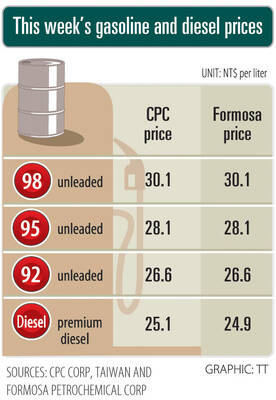
Prices of gasoline and diesel products at domestic fuel stations are this week to rise NT$0.2 and NT$0.3 per liter respectively, after international crude oil prices increased last week, CPC Corp, Taiwan (台灣中油) and Formosa Petrochemical Corp (台塑石化) said yesterday. International crude oil prices last week snapped a two-week losing streak as the geopolitical situation between Russia and Ukraine turned increasingly tense, CPC said in a statement. News that some oil production facilities in Alberta, Canada, were shut down due to wildfires and that US-Iran nuclear talks made no progress also helped push oil prices to a significant weekly gain, Formosa said
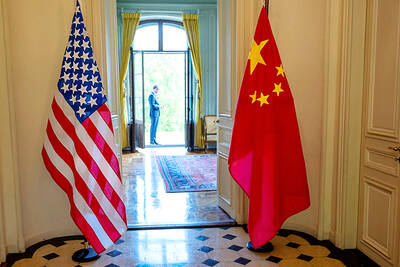
MINERAL DIPLOMACY: The Chinese commerce ministry said it approved applications for the export of rare earths in a move that could help ease US-China trade tensions Chinese Vice Premier He Lifeng (何立峰) is today to meet a US delegation for talks in the UK, Beijing announced on Saturday amid a fragile truce in the trade dispute between the two powers. He is to visit the UK from yesterday to Friday at the invitation of the British government, the Chinese Ministry of Foreign Affairs said in a statement. He and US representatives are to cochair the first meeting of the US-China economic and trade consultation mechanism, it said. US President Donald Trump on Friday announced that a new round of trade talks with China would start in London beginning today,


 RSS
RSS