


An organic food boom in Germany is creating demand for flour ground the old way, but the country only has one person left with the skills needed to carve and maintain millstones.
According to the German organic food industry body, the BOeLW, sales of organic food in Europe’s biggest economy have tripled since 2000 and are on course to exceed 6 billion euros (US$8.4 billion) this year.
However, not only do health-conscious consumers like their food chemical-free, they also want the flour for their bread ground using traditional millstones, believing this helps retain vitamins and other important ingredients.
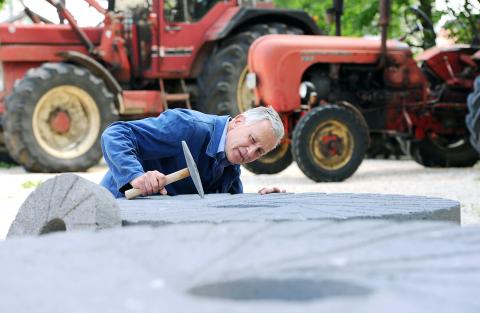
Photo: AFP
This has led to many old windmills being cranked back into operation and to a growing number of farmers and organic food stores making their own flour on site.
However, the only person in Germany who can help them set up is Wolfgang Strakosch, a 58-year-old hewing and maintaining millstones for them in the village of Zusamaltheim in Bavaria, southern Germany.
The stone that Strakosch uses is basalt from the Eifel region of western Germany. Its ideal properties mean it has been used to grind wheat and other cereals into flour for more than 2,000 years.
“We find millstones made from this basalt as far away as England,” and dating back to Roman times, said Ursula Heimes from the restored Saalburg Roman Fort and museum near Frankfurt in western Germany.
The dark, fine-grained volcanic rock is perfect for making flour because the grinding is relatively “soft” and erosion of the millstone minimal, Zusamaltheim farmer Joseph Ilg says.
Ilg grinds the spelt wheat he grows — a wholesome variety used in ancient times and now increasingly back in vogue — at his farm to make organic bread that he then sells.
“It conserves the vitamins and the enzymes in the cereal grains,” Ilg said.
“This is our selling point to customers. It only works with these millstones,” he said.
Strakosch says that the basalt’s porosity is also vital.
“Air locked inside the stone created pores. When I work the stone, I cut the pores and this creates very sharp edges, which help grind the grain and hardly ever become blunt,” Strakosch said.
“I used to work in a mill with millstones and I wanted to know how they worked. After a long search and speaking to lots people I ended up finding the last two millstone master craftsmen,” Strakosch said.
However, there is no written manual or textbook.
“They told me they had learned the trade working with their fathers and grandfathers, and that this was the only way to learn,” he said.
To fashion the stones, Strakosch is armed with two special hammers, his ears and a whole lot of patience.
With a slow, rhythmic knocking, he roughens the rock using a special diamond-headed hammer before painstakingly cutting grooves at a 45? angle.
A large millstone of two tonnes requires at least a week’s work.
There are thought to be more than 1,800 windmills in Germany, although it is unclear how many are in operation.
In the fiercely traditional state of Bavaria alone there are 50 — too many for Strakosch on his own.
However, there is hope that someone else will learn the skills. At the moment the main hope is Andre Roessner, a dreadlocked 27-year-old stonemason who read about millstones in a local newspaper.
“It would be a shame if this old trade disappears,” he said.

Real estate agent and property developer JSL Construction & Development Co (愛山林) led the average compensation rankings among companies listed on the Taiwan Stock Exchange (TWSE) last year, while contract chipmaker Taiwan Semiconductor Manufacturing Co (TSMC, 台積電) finished 14th. JSL Construction paid its employees total average compensation of NT$4.78 million (US$159,701), down 13.5 percent from a year earlier, but still ahead of the most profitable listed tech giants, including TSMC, TWSE data showed. Last year, the average compensation (which includes salary, overtime, bonuses and allowances) paid by TSMC rose 21.6 percent to reach about NT$3.33 million, lifting its ranking by 10 notches

Popular vape brands such as Geek Bar might get more expensive in the US — if you can find them at all. Shipments of vapes from China to the US ground to a near halt last month from a year ago, official data showed, hit by US President Donald Trump’s tariffs and a crackdown on unauthorized e-cigarettes in the world’s biggest market for smoking alternatives. That includes Geek Bar, a brand of flavored vapes that is not authorized to sell in the US, but which had been widely available due to porous import controls. One retailer, who asked not to be named, because
SEASONAL WEAKNESS: The combined revenue of the top 10 foundries fell 5.4%, but rush orders and China’s subsidies partially offset slowing demand Taiwan Semiconductor Manufacturing Co (TSMC, 台積電) further solidified its dominance in the global wafer foundry business in the first quarter of this year, remaining far ahead of its closest rival, Samsung Electronics Co, TrendForce Corp (集邦科技) said yesterday. TSMC posted US$25.52 billion in sales in the January-to-March period, down 5 percent from the previous quarter, but its market share rose from 67.1 percent the previous quarter to 67.6 percent, TrendForce said in a report. While smartphone-related wafer shipments declined in the first quarter due to seasonal factors, solid demand for artificial intelligence (AI) and high-performance computing (HPC) devices and urgent TV-related orders

MINERAL DIPLOMACY: The Chinese commerce ministry said it approved applications for the export of rare earths in a move that could help ease US-China trade tensions Chinese Vice Premier He Lifeng (何立峰) is today to meet a US delegation for talks in the UK, Beijing announced on Saturday amid a fragile truce in the trade dispute between the two powers. He is to visit the UK from yesterday to Friday at the invitation of the British government, the Chinese Ministry of Foreign Affairs said in a statement. He and US representatives are to cochair the first meeting of the US-China economic and trade consultation mechanism, it said. US President Donald Trump on Friday announced that a new round of trade talks with China would start in London beginning today,


 RSS
RSS