


Nestle SA, the world’s biggest food and drink company, took a big step into the Chinese market yesterday with the announcement that it is to buy a majority stake in candy maker Hsu Fu Chi (徐福記) for S$2.1 billion (US$1.7 billion).
The Swiss manufacturer of Nescafe coffee, KitKat bars and Dreyer’s ice cream said it will acquire 60 percent of shares in Singapore-listed Hsu Fu Chi, which had sales of about US$800 million last year.
The Hsu family will retain the remaining 40 percent stake, with current CEO and chairman Hsu Chen (徐鐠) continuing in those roles.
The announcement reflects Nestle’s expansion plans in emerging economies, where its sees the strongest chances of future growth.
“This proposed partnership will greatly reinforce our presence in China,” Nestle CEO Paul Bulcke said in a statement. “It also demonstrates our long-term commitment to China and enhances our ability to grow our portfolio of international and local brands in this dynamic market.”
In April, Nestle bought a controlling stake in Yinlu Foods Group (銀鷺食品集團), a Chinese producer of ready-to-drink peanut milk and canned rice porridge, for an undisclosed amount.
Nestle is particularly eager to exploit Hsu Fu Chi’s distribution network in China. The confectionery company, founded in 1992 by four Taiwanese brothers, operates four large-scale factories in China and employs 16,000 people.
Hsu Fu Chi makes sweets, cereal snacks, packaged cakes and sachima, a traditional Chinese pastry made of flour, butter and rock sugar.
Nestle entered the Chinese market more than 20 years ago and last year had sales of 2.8 billion Swiss francs (US$3.3 billion) in the China region. Its main brands in China — where it operates 23 factories and employs 14,000 people — include Nescafe, Nan and Maggi as well as domestic products such as Totole, Haoji and Dashan.
The takeover of Hsu Fu Chi is subject to regulatory approval in China, Nestle said.
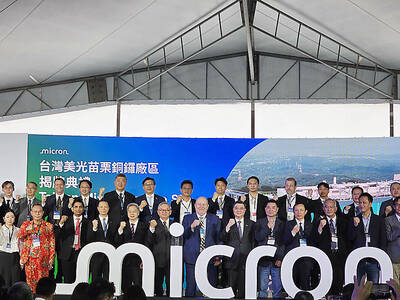
UNPRECEDENTED PACE: Micron Technology has announced plans to expand manufacturing capabilities with the acquisition of a new chip plant in Miaoli Micron Technology Inc unveiled a newly acquired chip plant in Miaoli County yesterday, as the company expands capacity to meet growing demand for advanced DRAM chips, including high-bandwidth memory chips amid the artificial intelligence boom. The plant in Miaoli County’s Tongluo Township (銅鑼), which Micron acquired from Powerchip Semiconductor Manufacturing Corp (力積電) for US$1.8 billion, is expected to make a sizeable capacity contribution to the company from fiscal 2028, the company said in a statement. It would be an extended production site of Micron’s large-scale manufacturing hub in Taichung, the company said. As the global semiconductor industry is racing to reach US$1 trillion

Singapore-based ride-hailing and delivery giant Grab Holdings Ltd has applied for regulatory approval to acquire the Taiwan operations of Germany-based Delivery Hero SE's Foodpanda in a deal valued at about US$600 million. Grab submitted the filing to the Fair Trade Commission on Friday last week, with the transaction subject to regulatory review and approval, the company said in a statement yesterday. Its independent governance structure would help foster a healthy and competitive market in Taiwan if the deal is approved, Grab said. Grab, which is listed on the NASDAQ, said in the filing that US-based Uber Technologies Inc holds about 13 percent of

Taiwan’s food delivery market could undergo a major shift if Singapore-based Grab Holdings Ltd completes its planned acquisition of Delivery Hero SE’s Foodpanda business in Taiwan, industry experts said. Grab on Monday last week announced it would acquire Foodpanda’s Taiwan operations for US$600 million. The deal is expected to be finalized in the second half of this year, with Grab aiming to complete user migration to its platform by the first half of next year. A duopoly between Uber Eats and Foodpanda dominates Taiwan’s delivery market, a structure that has remained intact since the Fair Trade Commission (FTC) blocked Uber Technologies Inc’s

Memory chip stocks extended their losses yesterday after Alphabet Inc’s Google publicized research that could allow more efficient use of the storage needed for artificial intelligence (AI) development. SK Hynix Inc and Samsung Electronics Co, South Korean leaders in the market, fell more than 6 percent and about 5 percent respectively in Seoul. In the US, Micron Technology Inc, Western Digital Corp and Sandisk Corp slid more than 2 percent in pre-market trading, after they all closed lower on Wednesday. Memory companies have been on a tear in recent months as the rapid development of AI infrastructure triggered a spike in chip


 RSS
RSS